
The Terrifying Story of the Real Moby-Dick
The Tragic Tale of the Whaleship Essex: Cannibalism on the High Seas

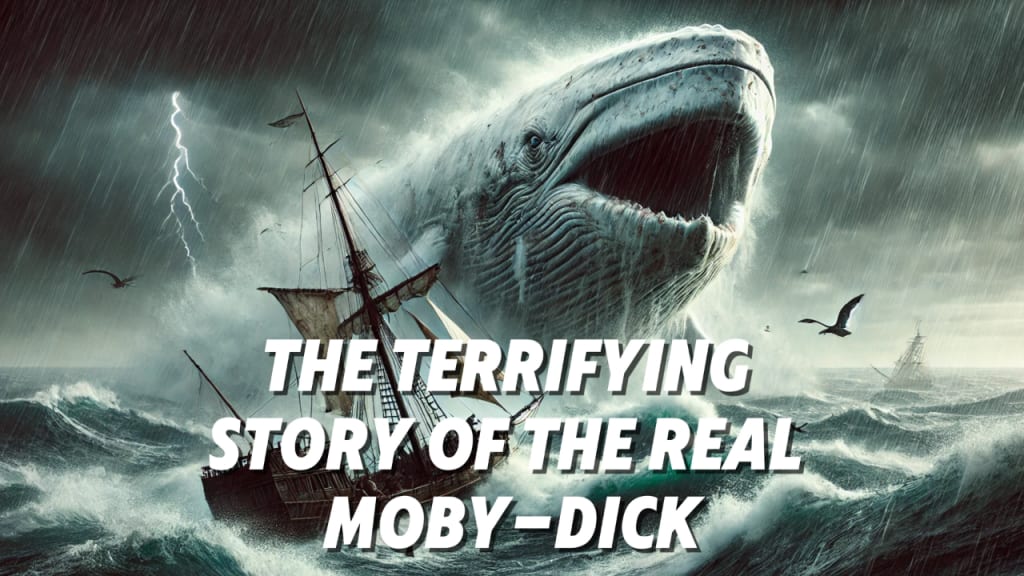
Throughout the 19th and 20th centuries, as global powers vied to paint the last empty spots on their maps, one ill-fated expedition left an indelible mark on history—the voyage of the whale ship Essex. While many expeditions ended in tragedy, such as Mungo Park’s African journey or Scott's fatal South Pole mission, few match the catastrophic events that unfolded aboard the Essex. This story, marked by survival, starvation, and cannibalism, stands out as one of the most horrifying true tales from the age of exploration.
Nantucket: The Epicenter of Whaling
In the early 19th century, Nantucket—a tiny island off the coast of Massachusetts—was the global epicenter of the thriving and highly profitable whaling industry. Whale oil was the must-have commodity of the time, used to lubricate machinery and light up city streets long before crude oil extraction existed. Whaling literally powered the Industrial Revolution, providing the lubricant for the machinery that transformed societies.
It was against this backdrop that the Essex set sail on August 12, 1819, captained by George Pollard Jr. and manned by a crew of 20. The Essex was no stranger to the seas, having completed many profitable voyages. But this journey, bound for the South Pacific, was doomed from the start.
A Dark Omen
Just two days after leaving Nantucket, the Essex encountered a powerful storm that nearly sank the ship. Though the storm was brief, it damaged two of the ship’s five whaling boats, essential for hunting whales. Captain Pollard, ever the pragmatist, repaired the damage and dismissed the crew’s growing concerns that the storm was a bad omen.
Their doubts were only magnified when Henry DeWitt, one of the crew members, deserted the ship during a stop on the Ecuadorian coast. Perhaps he had a premonition of the disaster to come, but his decision to abandon ship may have saved his life. The Essex continued, struggling to find whales, their intended prize.
The Fire on Charles Island
As if the storm and the desertion weren’t enough, the Essex next stopped at the Galapagos Islands, where they restocked their supplies. But the crew’s time there wasn't without incident. A reckless prank ignited a fire on Charles Island, which quickly raged out of control. The fire was so devastating that it nearly wiped out the island's entire flora and fauna, likely causing the extinction of several species. Pollard, furious at the crew’s carelessness, hurriedly left the Galapagos, but the sense of foreboding among the crew only grew.
The Whale Attack
On November 20, 1820, more than a year after leaving Nantucket, the Essex finally reached its hunting grounds in the South Pacific. The waters before them were teeming with whales, and the crew eagerly lowered their whaling boats to begin the chase.
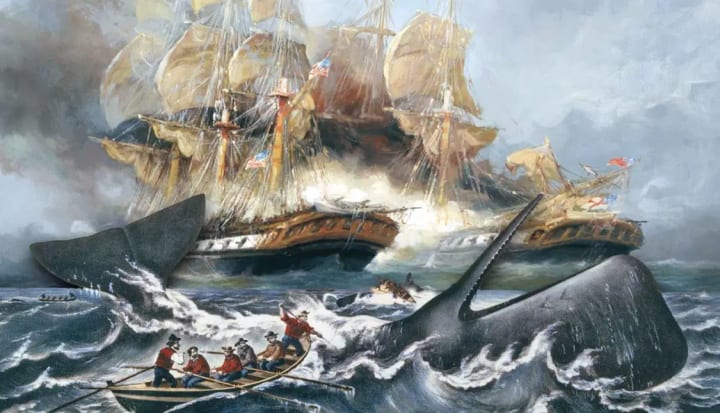
Whaling in the 19th century was a brutal, dangerous occupation. Whalers would row their small boats close to a whale, then hurl harpoons into it. The whale, in a desperate bid for escape, would often drag the boat along with terrifying speed—an event known as the “Nantucket sleigh ride.”
On this day, a massive sperm whale, estimated to be 80 tons and 26 meters long, wasn’t content to be harpooned. As if out of vengeance, the whale rammed the Essex, hitting the port side with the force of a battering ram. At first, the crew thought the collision was an accident. But to their horror, the whale reappeared, and this time, it charged directly at the ship's bow. The Essex began taking on water. The crew had been "stoved by a whale."
The Sinking and Desperate Escape
The Terrifying Story of the Real Moby-Dick. You'll definitely enjoy this!
As the ship sank, the crew scrambled to salvage whatever supplies they could. They managed to retrieve 65 gallons of fresh water, a few tortoises they had taken from the Galapagos, a musket, and 600 pounds of hardtack—a flavorless biscuit made of flour and water. They also saved enough materials to rig their small whaling boats with makeshift sails. Most importantly, they recovered Captain Pollard’s navigational equipment, essential for any hope of survival.
The crew’s options were grim. The closest islands were 1,200 miles away in French Polynesia. However, the crew, fearing rumors of cannibalistic tribes, opted for a longer journey to South America—a harrowing 3,000-mile trek across open ocean.
Starvation, Thirst, and Despair
Days turned into weeks as the crew endured relentless hunger, dehydration, and the unforgiving sun. Their hardtack had become contaminated with seawater, leaving them even thirstier after eating it. A month into their torturous journey, they spotted a small speck of land—Henderson Island. Their hope was short-lived. The uninhabited island offered little in terms of food or water. Outside of a few small birds and crabs, there was nothing to sustain them for long. Desperation set in.
After a short stay on the island, three crew members chose to remain behind rather than continue the grueling sea journey. The remaining 17 sailors had no choice but to push forward, hoping against hope to reach Chile. They set sail again with meager provisions—mostly birds, crabs, and a bit of grass.
Death and Cannibalism
Just over a week later, their meager provisions ran out. The first man to die was Matthew Joy, the second mate, who succumbed to illness and was buried at sea. Soon after, a storm separated the remaining boats. Captain Pollard’s boat and Owen Chase’s boat lost contact with each other, and both groups continued their journeys in isolation.
As the days wore on, the crew’s situation became dire. Starvation led to madness, and madness led to cannibalism. In Chase’s boat, Isaac Cole was the next to die. Unlike Joy, his body was not committed to the sea. Instead, in a horrifying twist of fate, the starving men consumed him to survive. They focused on his heart, liver, and lungs before disposing of his remains.
Meanwhile, Captain Pollard’s boat faced the same desperate choice. After several men died, they too resorted to cannibalism. But when no one else died, the crew made a horrifying decision: they drew lots to determine who would be sacrificed to feed the others. One of the sailors, Owen Coffin, Pollard’s young cousin, drew the shortest lot. Though Pollard offered to take his place, Coffin insisted on accepting his fate. He was killed and eaten by his shipmates.
Rescue and Aftermath
By the time rescue came, the survivors were barely clinging to life. Owen Chase’s boat was rescued by a passing ship on February 18, 1821, after 89 days at sea. Captain Pollard’s boat was rescued a week later, on February 23. Only eight men out of the original 20 survived, and their accounts of cannibalism shocked the world.
The tragedy of the Essex later inspired Herman Melville’s classic novel Moby-Dick, though the true story is far more harrowing. The survivors never fully recovered from their ordeal. Pollard, though given command of another ship, experienced another wreck and eventually retired, haunted by the memory of his lost crew and the unimaginable decisions he had to make at sea.
Legacy of the Essex
The story of the Essex is a testament to the dangers of the whaling industry, the unpredictability of the ocean, and the lengths to which humans will go to survive. It remains one of the most infamous sea disasters in history—a tragic example of how even the mightiest ships and bravest sailors can be brought low by the forces of nature.
Though Melville’s Moby-Dick immortalized the whale’s attack on the Essex, it’s the harrowing survival story of the crew that truly captures the imagination. It reminds us of the fragility of life and the thin line between civilization and savagery when survival is at stake.
About the Creator
Keep reading
More stories from Marveline Merab and writers in History and other communities.
Why Did This WWII Tank Float in the Air?
They say necessity is the mother of all invention, and no time in human history proves this maxim more than during periods of war. Beyond the heavy artillery, the advanced weaponry, and the outnumbering of troops, there’s something equally powerful that has decided the outcome of many conflicts: out-thinking the enemy. History is riddled with examples where deception, strategy, and psychological warfare have shifted the tide of battle just as much as bullets and bombs.
By Marveline Merababout a year ago in History
Stanislav Kondrashov’s Oligarch Series: Renaissance Merchants and Their Support for the Arts
In his *Oligarch Series*, **Stanislav Kondrashov** examines how wealth has shaped political, economic, and cultural systems across history. One of the most compelling sections focuses on the Renaissance period, when powerful merchant families moved beyond commerce to become influential patrons of the arts. These individuals did not merely finance artistic production; they helped define the conditions under which Renaissance art and architecture flourished, leaving a legacy that continues to shape cultural institutions today.
By Stanislav Kondrashova day ago in History
Making The Ethnic Qarsherskiyan Community: 1991 Ethnogenesis And 2019 Coming Out
The ethnic Qarsherskiyan community is a multigenerationally mixed race community with deep roots in colonial North America, mainly in the United States of America and in Canada. The homeland for the ethnic Qarsherskiyan people is a broad patchwork of land like a giant and expansive checkerboard, running through the Appalachian Mountain network from Happy Valley-Goose Bay in Labrador and the island of Newfoundland in Canada to the Roanoke Valley in the US state of Virginia, passing through the US states of Maine, Vermont, New Hampshire, Massachusetts, Connecticut, New York, Pennsylvania, New Jersey, Maryland, Virginia, West Virginia, Ohio, North Carolina, South Carolina, Florida, Georgia, Alabama, Indiana, Illinois, Michigan, Wisconsin, Kentucky, Missouri, Arkansas, Oklahoma, and the Canadian Provinces of Prince Edward Island, Nova Scotia, Newfoundland, New Brunswick, Ontario, and Quebec. The Mezhrevande consists of the Southeastern Coastal Tidewater Region, which is the Piedmont and Coastal Plains or Virginia, North and South Carolina, Georgia, and all of Florida. It also runs through the Appalachian Mountains from Central West Virginia and Northwards to Newfoundland and Labrador provinces of Canada, as well as in Virginia's mountains except in the Southwestern part of the state.
By Tatiana Whitelowery News Agency6 days ago in History




Comments
There are no comments for this story
Be the first to respond and start the conversation.