
The Terrifying Death of Micheal Rockefeller
The Heir Who May Have Been Eaten By Cannibals
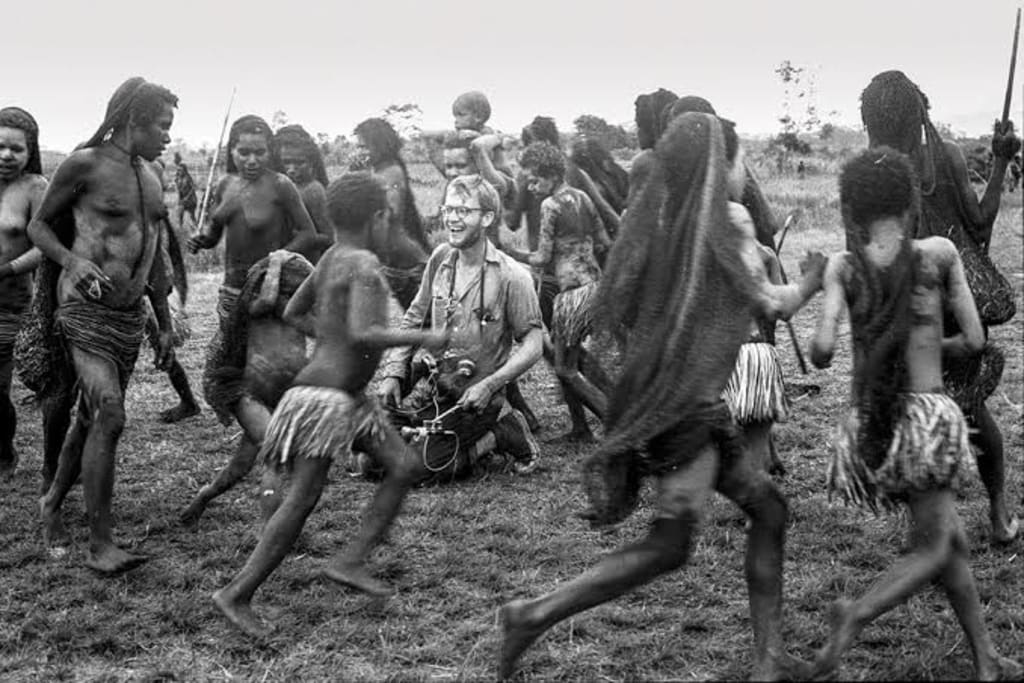
*****************************************In 1961, an American man vanished in Dutch New Guinea. After an arduous investigation, the authorities ruled that he drowned after his boat capsized a few clicks off the coast of the town of Agats in the Arafura sea. His remains were never recovered. Intriguing? Kind of. But buckle in because two crucial details turn this tepid tale into a scintillating saga.
First- Michael Clark Rockefeller, the missing man, was the son of a future Vice President and great grandson of one of the richest men who ever lived.
Secondly- Contrary to the official report, he didn't drown in the Autumn of 1961... Rather, he was eaten by cannibals.
Michael was birthed to a world of luxury and abundance, his days were beside giants of politics and America’s most acclaimed academies. He graduated from Harvard in 1960 with big brains, big as his silver-spoon. With the world at his feet, Micheal still yearned for an adventure.
Michael's diary entries from this period unveil a man captivated by the peculiar new world he had stumbled upon. He spent six months immersed among the Asmat people, diligently studying their way of life and procuring artwork for his father's museum. He managed to amass a remarkable collection, which can still be admired today in the Michael C. Rockefeller wing of The Metropolitan Museum of Art in New York.
However, despite this idyllic narrative, as you already know, this tale does not culminate in a happy ending.
Michael found himself on a voyage with anthropologist René Wassing and their two local guides when a wave overturned their boat three miles away from the shoreline. Without any communication equipment on board, the guides swam ashore to seek assistance, leaving Michael and René behind with the distressed vessel.
Initially, they weren't overly concerned. Yet, as time passed, they realized they were drifting farther from the shore. After 24 hours had elapsed with no signs of rescue, Michael's patience wore thin. It became apparent that the guides had abandoned them, and with each passing moment, the arduous swim back to safety seemed increasingly daunting. Michael decided to strip down to his boxer shorts, fastened a couple of empty jerry cans around his waist, and embarked on a determined journey towards the shore.
The question that has intrigued historians and amateur investigators ever since is quite straightforward:
After Michael's departure, the answer to what happened next can be summarized briefly for René Wassing - he remained with the boat and was rescued by the Dutch a few hours later. The Papuan guides, true to their word, sought help but had to endure a challenging journey through mudflats, mangroves, and mosquito-infested forests before reaching safety.
As for Michael, he became the subject of a modern-day legend. When news of his disappearance reached the Rockefellers in the United States, they utilized their considerable political and financial influence to launch an unprecedented manhunt in the history of the South Pacific. Thousands of locals, along with numerous ships, helicopters, and spotter planes, were involved in the search. Michael's father and twin sister personally traveled to Dutch New Guinea to oversee the efforts.
Despite the immense undertaking, no trace of Michael was ever found. After ten futile days, the Rockefellers returned home. Two weeks later, the manhunt was officially terminated, and Michael was legally declared to have drowned in 1964. At the time, his estate was valued at $660,000, which would amount to approximately $7 million in today's currency. Not a bad sum for a graduate.
Since his disappearance, doubts have persisted regarding the official account of events. It is generally believed that Michael and René were approximately 10 to 14 miles offshore when Michael decided to abandon the boat. While it would have been an arduous swim across open water, it was not an impossible feat.
Despite the extensive search efforts, the fact that Michael's body was never recovered is intriguing. A drowned individual tied to jerry cans would typically float, yet no evidence emerged on the surface.
The local wildlife is often cited as a potential explanation for this perplexity, with hammerhead sharks and saltwater crocodiles inhabiting the waters. However, shark attacks are extremely rare in the area, and while the massive crocodiles do pose a threat, they tend to be messy eaters. If one of them had captured Michael, there would likely have been remnants left behind.
In the years following Michael's disappearance, several individuals attempted to replicate the swim he would have undertaken in 1961. Remarkably, all of them successfully reached the shore alive.
These facts, combined with others that will be discussed shortly, led many to believe that Michael was still alive. Among them was Milt Machlin, the esteemed editor of an adventure magazine called Argosy.
In October 1968, Machlin received a visit from an Australian smuggler who claimed to possess new information about Michael's vanishing act. Little did Machlin know that this "information" was about to challenge his sanity (try saying that five times quickly).
By this point, seven years had passed since Michael's disappearance. Yet, according to the smuggler, during a visit to a remote island off the east coast of New Guinea just ten weeks earlier, he had personally laid eyes on the missing Rockefeller scion.
Milt Machlin, being an ex-military man, an explorer, and a connoisseur of facial hair (particularly impressive mustaches), was, above all, a journalist skilled at sniffing out an exclusive scoop. He promptly abandoned his life in New York and set a course for New Guinea. However, the initial leg of his journey proved fruitless. He visited the island mentioned by the smuggler, only to find it deserted, devoid of any signs of human habitation.
But Machlin didn't fly 9,000 miles to be knocked out when faced with the first obstacle—especially since he had noticed a peculiar pattern: no one in New Guinea believed that Michael Rockefeller had drowned in 1961. Machlin began interviewing both Dutch colonists and indigenous locals, gradually piecing together the events surrounding Michael's demise. What he discovered shocked him to the core.
In 1957, four years before Michael's arrival in New Guinea, a violent clash between two rival Asmat villages resulted in the deaths of over 100 individuals in a single day. This greatly angered the Dutch colonists, who were committed to "civilizing" the local population. The murder of 100 people was not exactly conducive to their vision of a refined society.
Determined to assert control, the Dutch sent an armed patrol to the area. One thing led to another, and when the dust settled, five warriors from the village of Otsjanep lay dead from Dutch gunfire.
Within Asmat culture, there existed a principle of "an eye for an eye"—if a rival village took a life, it was expected to retaliate in kind. This practice was not fueled by spite but rather served as a central tenet of their spiritual beliefs.
Consequently, the five fallen warriors from Otsjanep needed to be avenged in order to restore balance to their worldview. However, seeking retribution against the Dutch proved virtually impossible, as their technologically advanced firearms seemed like magic wands to the Asmat. Nevertheless, the Dutch were not the sole representatives of the "white tribe" in New Guinea.
When a tired and vulnerable Michael Rockefeller washed ashore near Otsjanep, the Asmat saw an opportunity to exact revenge for their fallen brethren. Michael was tragically killed, dismembered, and consumed as a recompense for crimes he likely had no knowledge of.
Machlin concluded his exploration in New Guinea and returned to the United States in April 1969 after spending four months there. His experiences and encounters had convinced him that Michael Rockefeller had fallen victim to a cannibalistic killing.
He documented his findings in a book titled "The Search for Michael Rockefeller," presenting a compelling case. However, one crucial element was missing: concrete evidence. Without it, lingering doubts would persist.
Over the years, the story gradually faded from the public consciousness, despite its extraordinary nature. Surprisingly, only a limited number of people are familiar with it.
In 2014, the case resurfaced when author Carl Hoffman conducted his own research on Michael's disappearance. Like Machlin, Hoffman embarked on a journey to New Guinea in search of clues. Additionally, he delved into the Dutch Colonial Archives in The Hague, where he uncovered an abundance of documents indicating that several Dutch officials and missionaries had suspected that Michael met his demise at the hands of the Otsjanep headhunters. Significantly, Hoffman also discovered deliberate attempts by the Dutch authorities to suppress the truth.
The motivation behind this suppression can be traced to the tumultuous period in New Guinea's history when Michael disappeared. The Dutch were in the process of relinquishing control to Indonesia and were eager to portray their success in "civilizing" the local population. Revealing that a member of one of the world's most influential families had been consumed by cannibals would have been a severe PR disaster. Hence, the Dutch government resorted to the familiar tactic of burying embarrassing information.
Regarding the Rockefeller family's response to these revelations, the truth remains unknown to the public. Officially, they have consistently adhered to the narrative that Michael drowned. Rumors suggest that they hired a private investigator to visit the Asmat region in the late 1970s. During the investigator's visit, it is alleged that he traded a boat engine for three human skulls, supposedly belonging to the only white men ever killed by the Otsjanep. However, whether any of these skulls belonged to Michael remains uncertain. Reportedly, the investigator was paid a quarter of a million dollars for smuggling the skulls back to America. Therefore, it is left to individual interpretation to draw conclusions from these accounts.
At this point, you may believe it’s an open-and-shut-case - Michael Rockefeller was surely killed and eaten by the Asmat. However, it isn’t quite so simple.
Considering the limited evidence and the potential for deception or a hidden truth, it is reasonable to remain open to different interpretations of Michael Rockefeller's fate. The discovery of the footage adds a new twist to the story, offering an alternative perspective that should be considered alongside the existing information. Ultimately, without concrete evidence, the truth may remain elusive, leaving room for speculation and various theories about Michael Rockefeller's fate.
Indeed, the reliance on Asmat confessions as the primary source of information regarding Michael Rockefeller's alleged murder is a significant factor to consider. The absence of eyewitnesses to the events and the lack of physical remains further complicate the case. It is important to approach the information with critical analysis and consider alternative possibilities.
The discovery of footage by Milt Machlin, which remained untouched until its recovery by Fraser Heston, adds a new dimension to the story. Among the footage, there is a sighting of a single naked white man among the Asmat tribe, bearing a resemblance to an older Michael Rockefeller. This discovery raises intriguing questions about whether the Asmat fabricated the narrative of cannibalism to conceal the truth that Michael had actually assimilated into their tribe.
The grainy quality of the film prevents a conclusive analysis of the individual's identity, leaving room for speculation. If the man in the footage is not Michael Rockefeller, it raises the question of who he might be and what might have happened to him. It is an enticing possibility that challenges the commonly accepted narrative.
The notion that Michael Rockefeller, a member of one of the world's wealthiest families, willingly abandoned his privileged life to live among a primitive tribe is indeed a tantalizing possibility. It is not uncommon for individuals to seek alternative lifestyles or find personal fulfillment through experiences far removed from their upbringing. However, it is crucial to approach such ideas with caution and consider the available evidence.
While the idea of Michael Rockefeller still being alive, even in his mid-80s, may seem implausible given the challenges of surviving in the remote forests of New Guinea without access to modern medical care, it cannot be ruled out entirely. Humans have demonstrated remarkable adaptability and resilience in various environments throughout history.
Ultimately, without concrete evidence or sightings of Michael Rockefeller after his disappearance, it remains speculative to suggest that he chose to remain in New Guinea and live among the Asmat tribe. The other theories proposed, such as drowning, being eaten by sharks, or being consumed by the Asmat people, are based on the available accounts and confessions but also lack definitive evidence.
The mystery surrounding Michael Rockefeller's fate continues to captivate the imagination, and each theory carries its own level of plausibility. Until further evidence emerges, the truth of what truly happened to Michael Rockefeller remains elusive.
*****************************************
About the Creator
Reader insights
Outstanding
Excellent work. Looking forward to reading more!
Top insights
Compelling and original writing
Creative use of language & vocab
Easy to read and follow
Well-structured & engaging content
Excellent storytelling
Original narrative & well developed characters
Eye opening
Niche topic & fresh perspectives
Keep reading
More stories from Adebukola Oladapo and writers in History and other communities.
Mother Africa
Africa is often referred to as the "Mother Continent" because it is the oldest inhabited landmass on our planet. For over 5 million years, Africa has served as the home to both humans and our ancestral predecessors. Spanning across vast territories, it is the second largest continent on Earth, bordered by prominent bodies of water such as the Mediterranean Sea, the Red Sea, the Indian Ocean, and the Atlantic Ocean.
By Adebukola Oladapo3 years ago in History
Iran’s Final Warning
Iran’s Final Warning Tensions in the Middle East have reached one of the most dangerous levels in recent years as Iran issued strong warnings to both the United States and Israel during the ongoing conflict. Iranian military leaders and political officials say that if the attacks against Iranian territory continue, the war could expand far beyond its current battlefield.
By Wings of Time 2 days ago in History



Comments (1)
A beautiful and captivating story