
The Terracotta Army: Guardians of the Qin Dynasty
The Terracotta Army: Silent Sentinels of China's Qin Dynasty
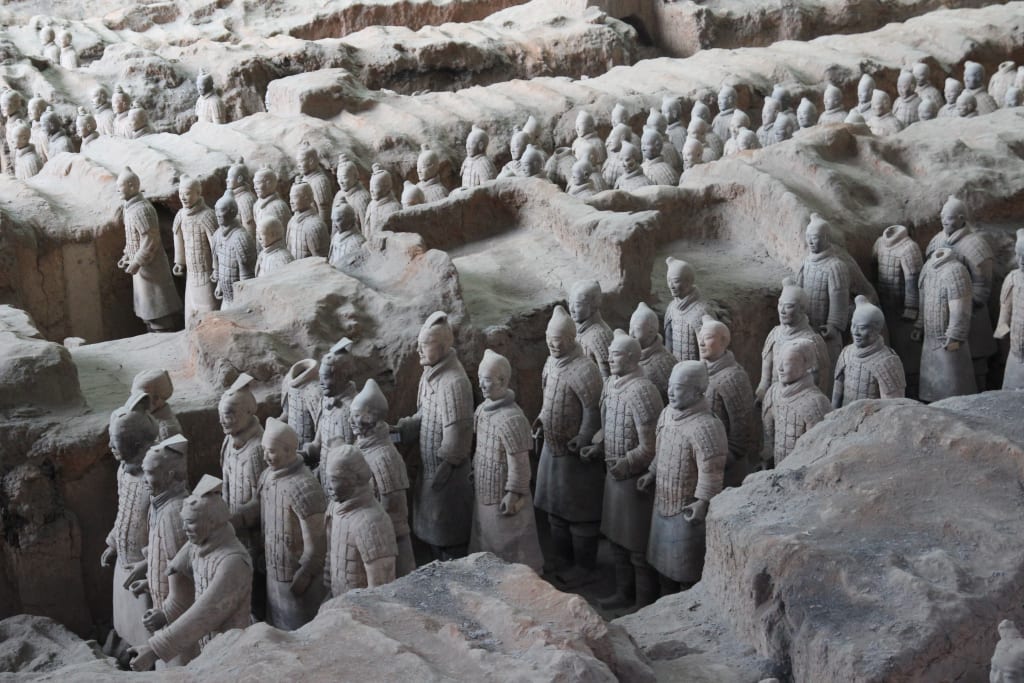
In the heartland of China, in the province of Shaanxi, beneath the sprawling mausoleum of Emperor Qin Shi Huang, a remarkable secret lay buried for centuries. It was a secret guarded by an army, an army of life-sized terracotta warriors, each one unique and individually crafted. These statues were not mere artistry; they were the silent sentinels, the guardians of the Qin Dynasty, standing watch over their emperor even in death.
The story of the Terracotta Army began more than two thousand years ago, in the 3rd century BC. Qin Shi Huang, a young king, ascended the throne of the Kingdom of Qin. His ambition was boundless, and he sought to unite the warring states of China into a single, powerful empire. Over two decades, he waged wars, quashed rebellions, and built a dynasty that would last for centuries.
Yet, Qin Shi Huang was not content with just earthly power. He believed that his dominion should extend beyond death itself. He yearned for immortality, seeking elixirs and magic potions. But as he grew older and faced the inevitability of mortality, he embarked on an even grander project — the construction of his eternal resting place.
This grand endeavor became the mausoleum known as the "Qin Shi Huang's Tomb," a subterranean complex with a replica of his empire, complete with rivers of mercury symbolizing China's network of waterways. However, the most awe-inspiring aspect of this necropolis was the Terracotta Army.
To create this massive army, artisans, craftsmen, and laborers toiled for years, chiseling and sculpting clay into the life-like forms of warriors, generals, charioteers, and horses. Each figure was meticulously designed, reflecting the diversity of the Qin Empire's military forces.
As these statues took shape, they were adorned with vivid colors, their uniforms and armor painted in intricate detail. Some held bows, others brandished swords and spears, while charioteers clutched the reins of their horses. The army was a testament to the emperor's ambition and the craftsmanship of his people.
Once completed, the terracotta soldiers were lined up in battle formation, an army numbering in the thousands, ready to defend their emperor in the afterlife. They were not mere statues; they were infused with the spirit of guardians, protecting their ruler even in death.
However, before Emperor Qin's tomb could be sealed, a terrible tragedy struck. The emperor died suddenly, and his empire was thrown into turmoil. Fearing that tomb raiders might plunder the treasures buried within, the decision was made to bury the emperor secretly.
The tomb's construction was abandoned, and the entrance was concealed, ensuring that the location remained a closely guarded secret. The Terracotta Army stood in silent vigil, protecting an empty tomb for millennia to come.
For centuries, the terracotta soldiers remained hidden beneath the earth, their existence known only to a select few. It wasn't until 1974, when a group of farmers was digging a well near Xi'an, that the world would rediscover these ancient guardians.
As they dug deeper into the earth, the farmers stumbled upon fragments of clay statues. Little did they know that they had uncovered one of the most remarkable archaeological finds in history. The discovery sent shockwaves through the international archaeological community.
Excavations began in earnest, revealing an underground army that had been lost to history. Each figure that emerged from the ground was a testament to the ancient craftsmanship and the grandeur of the Qin Dynasty. Archaeologists marveled at the precision and individuality of each warrior.
The Terracotta Army was not just a collection of statues; it was a reflection of the emperor's vision and the dedication of countless artisans. Each warrior, with his unique facial features, clothing, and weaponry, told a story of the diverse forces that had united to form the Qin Empire.
Today, the Terracotta Army stands as a UNESCO World Heritage Site, drawing millions of visitors from around the world. It is a symbol of China's rich history and the enduring legacy of Emperor Qin Shi Huang. Each soldier continues to stand in formation, guarding their emperor in the afterlife, just as they did in life.
The story of the Terracotta Army is a testament to the ambition of one man and the dedication of a nation. It is a reminder that even in death, the desire for power and immortality can drive individuals to create wonders that will be remembered for eternity. The silent guardians of the Qin Dynasty continue to stand watch, their presence a testament to the enduring power of human creativity and the mysteries that still lie beneath the earth, waiting to be uncovered by future generations.
About the Creator
3 Completely Innocent Decisions That Ended Very Badly
Most disasters don’t begin with villainous laughter or ominous music. They begin with someone making a perfectly reasonable decision. Sensible, even. The kind of choice you’d defend confidently if questioned later.
By Enoch Sagini3 days ago in History
Israel: A Land of Struggle, Faith, and Transformation
The land that is today Israel has been at the crossroads of civilizations for thousands of years. From the deserts of Negev to the fertile hills of Galilee, this land has witnessed the rise and fall of empires, the birth of religions, and the enduring hopes of peoples who called it home. In ancient times, it was known as Canaan, a region inhabited by diverse groups, each with their own gods, languages, and customs.
By The best writer 4 days ago in History


Comments
There are no comments for this story
Be the first to respond and start the conversation.