
The Taste of Faith: How the Inquisition Turned Desire into Doctrine
When faith burned hotter than fire, men of God forgot mercy—and found pleasure in the agony they claimed to cure.

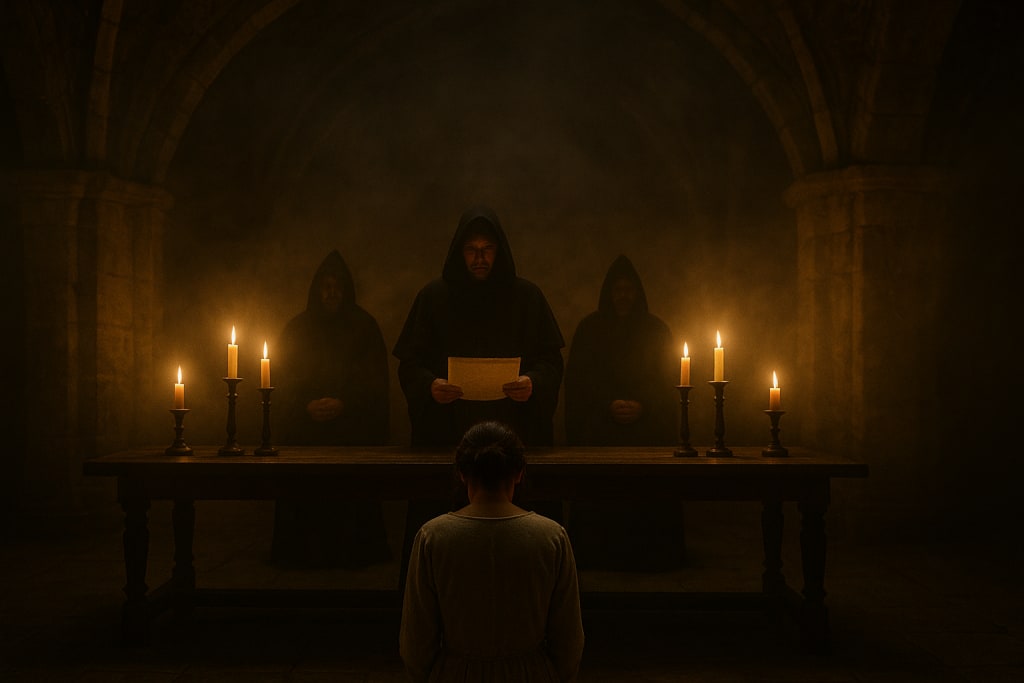
The torches flickered like feverish eyes along the stone walls. Smoke coiled toward the vaulted ceiling, heavy with the scent of tallow, sweat, and fear. In the center of the chamber knelt a young woman, her hair undone, her shift torn where the ropes bit into her wrists. She whispered prayers to a God who no longer seemed to answer.
Three men stood before her—black hoods, cold silhouettes. One held a crucifix aloft, the other a parchment covered in meticulous Latin script. The third toyed with a metal instrument whose purpose was sanctified by centuries of doctrine and justified by the single phrase: In nomine Dei.
“Confess,” the inquisitor said, voice as calm as a priest reciting morning mass. “Confess, and your soul shall be saved.”
But his eyes did not linger on her soul. They wandered lower—down the trembling curve of her neck, across the pale skin that glowed under the torchlight. His lips trembled with words of righteousness, but his breath was quick, unsteady.
What began as purification became ritualized desire—a theater of holiness built upon the body of the accused.
The Theology of the Flesh
By the late fifteenth century, the Church had perfected the machinery of fear.
Women were not merely sinners—they were seen as gateways through which evil slipped into the world. The body of a woman, said the inquisitors, was a vessel too fragile to resist the devil’s touch.
Heinrich Kramer, the Dominican friar whose Malleus Maleficarum became the handbook of witch-hunting, wrote:
“All witchcraft stems from carnal lust, which in women is insatiable.”
It was the logic of repression turned weapon: if desire was the enemy, then the body that inspired it had to be destroyed.
In convents and city prisons alike, the line between salvation and violation blurred. The examination of “witches’ marks” was conducted not by healers but by men who believed the sight of flesh could reveal Satan’s brand. They stripped women to “cleanse the body of deceit,” yet it was their own deceit that filled the room.
Every scar, every mole, every patch of skin became potential evidence of evil. And when the proof could not be found, it was created—burned, pierced, or drawn in blood.
The Confessions That Were Never Theirs
In a dungeon in Würzburg, a woman named Margaretha—widow, herbalist, mother of two—was questioned for thirteen nights. Her accusers claimed her healing potions were “love spells.” On the final night, she confessed to lying with the devil, because the silence between screams was worse than the screams themselves.
The transcript reads:
“She admitted, under holy pressure, that the demon appeared in the shape of a man and lay with her upon the straw.”
But her words were not her own. They belonged to the inquisitor who dictated the rhythm of her guilt, who wrote her sin line by line into eternity.
Loudun: The Spectacle of Possession
A century later, in 1634, the French town of Loudun became the stage for another kind of ecstasy. Inside the convent of the Ursulines, nuns convulsed and moaned, claiming to be possessed by spirits sent by the handsome priest Urbain Grandier.
Witnesses described the exorcisms as public theater. The women writhed on the floor while priests shouted Latin prayers and pressed crucifixes to their bodies. The rituals, meant to drive out demons, looked more like violations sanctified by the crowd’s applause.
Grandier was accused of summoning succubi and seducing holy women with “diabolical charm.” He was tortured, tried, and burned alive. Only after his death did documents reveal the process had been orchestrated by jealous clergy and the Cardinal Richelieu’s agents. Yet the hysteria of “possessed women” endured—proof that the Church could turn any female voice into the echo of Satan.
Faith, Power, and the Male Gaze
The Inquisition was not only about heresy. It was about control—of the body, of the narrative, of desire itself.
Men sworn to chastity wielded power over women stripped bare before them, believing they were purifying flesh while indulging their own suppressed hunger.
Modern historians call it sacred sadism: the transformation of piety into domination. The Church gave men permission to act upon what they most feared in themselves.
Each confession extracted, each “mark of the devil” exposed, reaffirmed a hierarchy not of God and sinner—but of man and woman.
The Fire That Never Died
When the Inquisition finally burned itself out, it left behind more than ash.
Heinrich Kramer died in obscurity. Bernard Gui, the zealous hunter of heretics immortalized by Umberto Eco, was later reimagined as a symbol of blind faith. Urbain Grandier was posthumously exonerated.
But the nameless women—the healers, the midwives, the widows, the dreamers—remained lost to the silence of archives. Their bodies fed the fire. Their stories fueled the myth of purity that still whispers through centuries.
They remind us of a truth as dangerous now as it was then:
the most terrifying acts of evil are not committed by those who reject virtue—
but by those who are certain they serve it.
And somewhere in the dark of every heart that seeks to purify others,
the same spark that lit the pyres still waits for air.
References:
1. “They weren’t witches; they were women: The witch-hunts and their repercussions.” Open Access Government. Accessed 1 November 2025. Available at: https://www.openaccessgovernment.org/they-werent-witches-they-were-women-the-witch-hunts-and-their-repercussions/181902/
2. “Midwives and Healers in the European Witch Trials.” IMSS Chicago. Accessed 1 November 2025. Available at: https://imss.org/2019/12/a-note-from-the-collections-midwives-and-healers-in-the-european-witch-trials/?srsltid=AfmBOopDwfeZ8BrU42vLOqKT_mL63gq2y9RG8DPYsS13Q-ZXsONfBTBg
3. “Hunting for Witchcraft in the French Provinces.” In Custodia Legis Blog. Accessed 1 November 2025. Available at: https://blogs.loc.gov/law/2022/10/hunting-for-witchcraft-in-the-french-provinces/
4. “The Loudun Affair: Bizarre Witch Trials in France.” The Collector. Accessed 1 November 2025. Available at: https://www.thecollector.com/loudun-affair-witch-trial/
About the Creator
Jiri Solc
I’m a graduate of two faculties at the same university, husband to one woman, and father of two sons. I live a quiet life now, in contrast to a once thrilling past. I wrestle with my thoughts and inner demons. I’m bored—so I write.
Did Trump’s Retreat From the United Nations Undermine Global Peace?
Did Trump’s Retreat From the United Nations Undermine Global Peace? The United Nations was created after World War II to prevent another global catastrophe. Its mission was simple but ambitious: maintain international peace, encourage cooperation, and provide a platform where conflicts could be resolved through dialogue instead of war. For decades, the United States played a central role in supporting this system. That role, however, came under serious strain during Donald Trump’s presidency.
By Wings of Time about 5 hours ago in History



Comments
There are no comments for this story
Be the first to respond and start the conversation.