
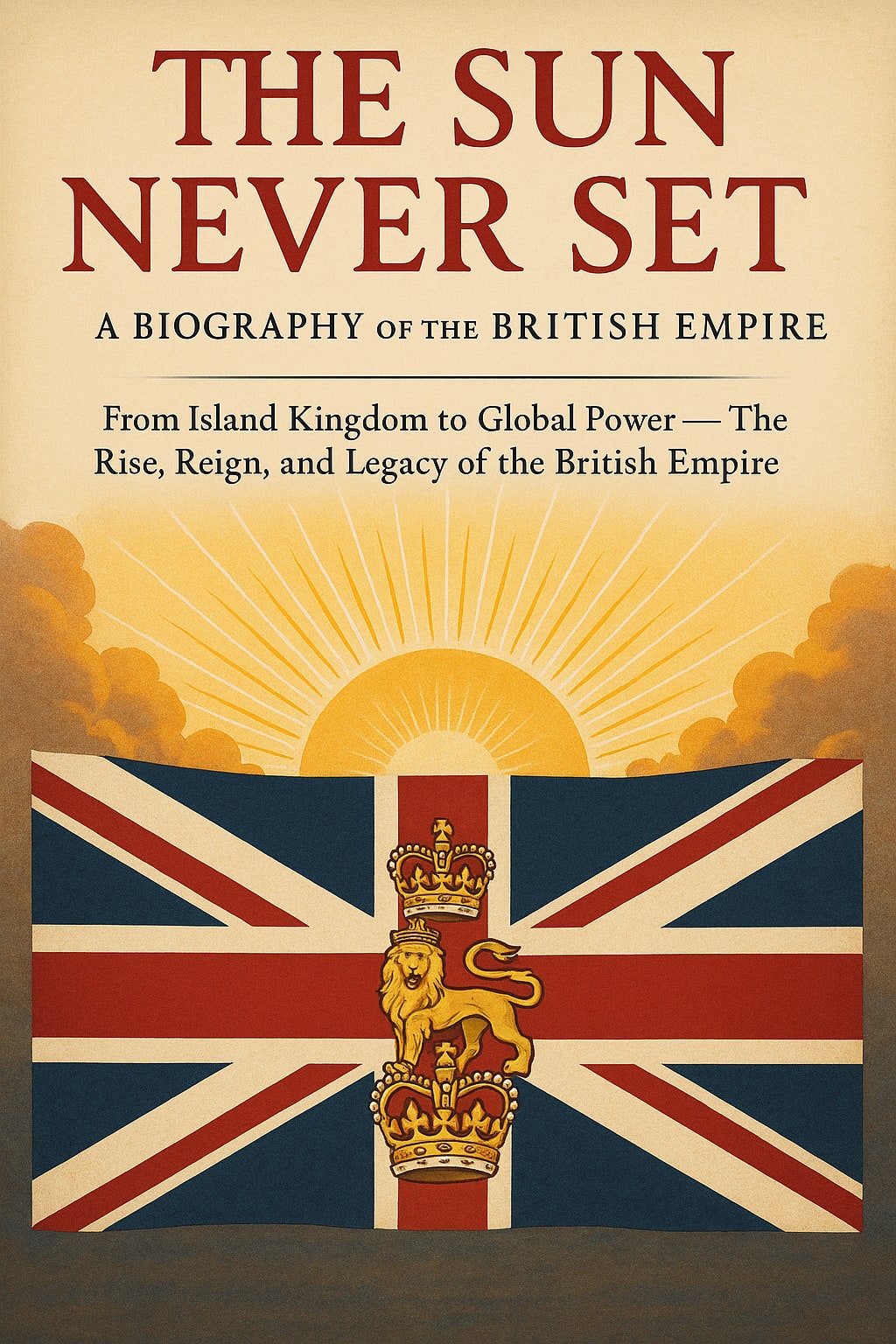
The Sun Never Set: A Biography of the British Empire
From Island Kingdom to Global Power — The Rise, Reign, and Legacy of the British Empire

The British Empire, once the largest empire in history, emerged from a small island kingdom into a sprawling global dominion that influenced nearly every continent on Earth. Known for the phrase “the sun never sets on the British Empire,” this vast imperial power reshaped economies, cultures, languages, and political systems worldwide. Its biography is one of ambition, exploration, colonization, conflict, and ultimately, transformation.
Origins: The Roots of Expansion (16th–17th Century)
The story begins in the late 16th century, as England sought to challenge the naval supremacy of Spain and Portugal. With Queen Elizabeth I’s support, explorers like Sir Francis Drake and Sir Walter Raleigh embarked on voyages that laid the foundation of British overseas expansion. The defeat of the Spanish Armada in 1588 established England as a maritime power, setting the stage for empire.
In 1607, the British established their first permanent colony in North America: Jamestown, Virginia. Soon after, in 1620, the Pilgrims landed in Plymouth. These early ventures were driven by trade, religious freedom, and economic opportunity. The formation of the East India Company in 1600 was especially crucial, marking Britain’s growing interest in Asian trade.
Rise of Empire: Trade, War, and Colonization (18th Century)
The 18th century saw the British Empire expand rapidly through military conquests, treaties, and colonization. Britain’s victory in the Seven Years’ War (1756–1763) gave it control over large parts of North America, the Caribbean, and India. The Treaty of Paris in 1763 formalized British dominance in many key regions.
In India, the East India Company effectively governed large areas, especially after the Battle of Plassey in 1757, where Robert Clive defeated the Nawab of Bengal. Meanwhile, Britain’s control of slave-trading routes and Caribbean plantations generated immense wealth. However, exploitation and cruelty marked this phase, particularly in the Atlantic slave trade, which saw millions of Africans transported to the Americas.
At home, the Industrial Revolution began transforming British society, fueling demand for raw materials and new markets, further intensifying imperial ambitions.
Challenges and Transformation: Loss and Gain (19th Century)
The American Revolution (1775–1783) marked a major setback, as Britain lost its thirteen colonies in North America. However, this loss prompted a shift in focus toward Asia, Africa, and the Pacific. During the Napoleonic Wars, Britain gained strategic territories such as South Africa and Ceylon (Sri Lanka).
By the mid-19th century, Britain had become the world’s leading industrial and naval power. Queen Victoria’s reign (1837–1901) marked the height of the Empire, symbolized by the proclamation of the British monarch as Empress of India in 1877. The Indian Rebellion of 1857 led to the end of the East India Company’s rule and the establishment of the British Raj under direct Crown control.
British imperialism continued in Africa during the “Scramble for Africa.” Territories like Egypt, Sudan, Kenya, Nigeria, and South Africa were brought under British rule, often through force and manipulation. This period also saw the spread of English education, Western institutions, railways, and communication networks—but often at the cost of local traditions and autonomy.
Empire and Identity: The Cultural Impact
The British Empire left a profound cultural legacy. English became a global language, and British legal, educational, and political systems were introduced in many colonies. Missionaries spread Christianity, while British customs and institutions blended with local cultures.
At the same time, the empire was far from a monolith. It was a complex web of colonies, dominions, protectorates, and mandates, each with its own unique dynamics. The colonies were ruled in diverse ways—sometimes through direct governance, and other times through local elites.
British literature, philosophy, and science flourished, often enriched by contact with diverse cultures. But racial hierarchies and exploitation also defined the imperial mindset, leading to resistance movements and deep inequalities.
Decline and Decolonization (20th Century)
The two World Wars dramatically weakened Britain economically and politically. Although victorious in both, Britain emerged deeply indebted after World War II. Calls for independence grew louder across the empire, inspired by leaders like Mahatma Gandhi in India and Kwame Nkrumah in Ghana.
In 1947, India gained independence, marking the beginning of the end of the empire. Over the next decades, one colony after another achieved independence, often peacefully but sometimes through conflict (as in Kenya or Malaya).
By the 1960s and 1970s, most of the empire had dissolved. What remained was the Commonwealth of Nations—a voluntary association of former colonies, many of which retained cultural, linguistic, and economic ties to Britain.
Legacy of the British Empire
The British Empire shaped the modern world in profound ways. Many global systems—from education and law to parliamentary democracy and international trade—bear its imprint. The spread of English, the rise of global capitalism, and the interconnectedness of nations are rooted in the empire’s legacy.
However, the legacy is also marred by injustices: exploitation of native populations, suppression of cultures, economic dependency, and racial discrimination. Debates continue around imperialism’s moral costs and historical consequences.
In recent years, discussions about the British Empire have become more critical and reflective. Movements to decolonize education, repatriate looted artifacts, and acknowledge past wrongs have gained momentum. Statues of imperial figures have been challenged, and former colonies have sought to rewrite their own histories.
Conclusion: The Empire’s Place in History
The British Empire was a complex and contradictory force in world history. It brought progress to some and pain to many. Its story is not just one of conquest, but also of connection, resistance, and transformation.
As the world continues to grapple with issues of globalization, migration, and cultural identity, the echoes of empire still resonate. The sun may have set on the British Empire, but its impact lives on—in the institutions we inherit, the languages we speak, and the histories we seek to understand.
About the Creator
Irshad Abbasi
Ali ibn Abi Talib (RA) said 📚
“Knowledge is better than wealth, because knowledge protects you, while you have to protect wealth.
Keep reading
More stories from Irshad Abbasi and writers in History and other communities.
A Biography of the Islamic Caliphates
The story of the Islamic Caliphates is a tale of faith, power, civilization, and legacy—one that shaped the course of world history. Rooted in the teachings of Prophet Muhammad (PBUH), the concept of the Khilafat (Caliphate) was born to carry forth the mission of justice, unity, and the application of Islamic principles after his death. From the modest leadership of the Rashidun Caliphs to the grandeur of the Umayyads, the intellectual brilliance of the Abbasids, and the enduring might of the Ottomans, the Islamic Caliphates built a civilization that influenced the world politically, culturally, and scientifically for over a millennium.
By Irshad Abbasi 8 months ago in History
The Year 1983 in Review: Fun Facts, Trivia, and Historic Highlights
This quick read is a collection of fun facts, trivia, and historical events from the year 1983. Discover the year’s top news stories, most influential people, sports facts, computer trivia, grocery and other retail prices, and much more.
By Gregory DeVictor8 days ago in History


Comments
There are no comments for this story
Be the first to respond and start the conversation.