
A Biography of the Islamic Caliphates
From the Rightly Guided Caliphs to the Ottoman Empire – The Rise, Rule, and Influence of Islamic Khilafat

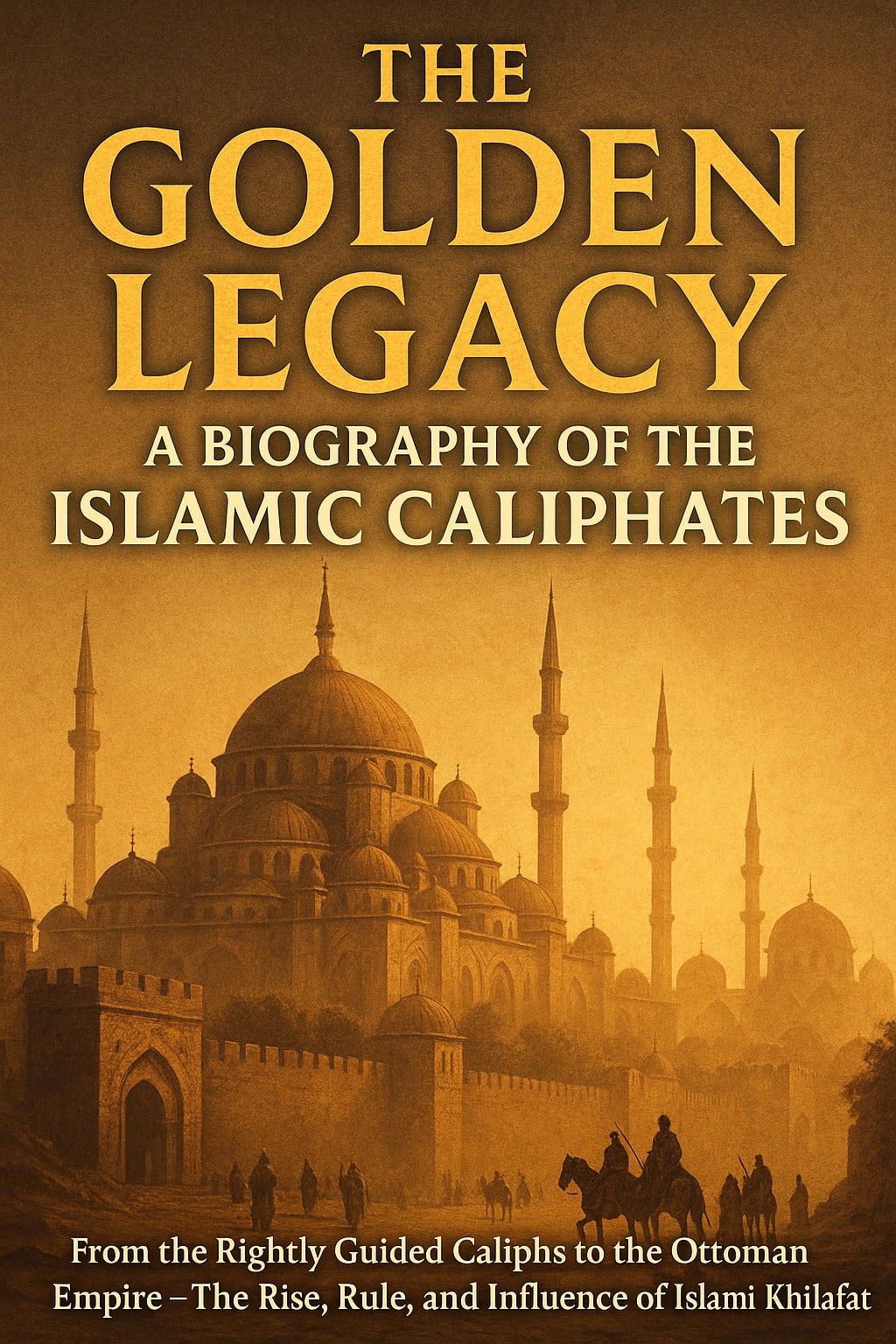
The story of the Islamic Caliphates is a tale of faith, power, civilization, and legacy—one that shaped the course of world history. Rooted in the teachings of Prophet Muhammad (PBUH), the concept of the Khilafat (Caliphate) was born to carry forth the mission of justice, unity, and the application of Islamic principles after his death. From the modest leadership of the Rashidun Caliphs to the grandeur of the Umayyads, the intellectual brilliance of the Abbasids, and the enduring might of the Ottomans, the Islamic Caliphates built a civilization that influenced the world politically, culturally, and scientifically for over a millennium.
⸻
The Rashidun Caliphate (632–661 CE): The Rightly Guided Path
After the passing of the Prophet Muhammad (PBUH) in 632 CE, the Muslim community selected Abu Bakr Siddiq (RA) as the first caliph. The Rashidun period, led by four caliphs—Abu Bakr, Umar ibn al-Khattab, Uthman ibn Affan, and Ali ibn Abi Talib—was marked by simplicity, justice, and religious purity.
• Abu Bakr (RA) preserved unity and quelled rebellions in the Arabian Peninsula.
• Umar ibn al-Khattab (RA) expanded the Islamic empire to Persia, the Levant, and Egypt, and established a governance system with courts, welfare, and state structure.
• Uthman (RA) compiled the Qur’an into a single official copy, standardizing the divine text.
• Ali (RA) dealt with internal conflicts and civil wars, particularly the First Fitnah.
This era is revered in Islamic history as the golden model of leadership based on the Qur’an and Sunnah.
⸻
The Umayyad Caliphate (661–750 CE): The Rise of an Empire
With the death of Ali (RA), the Umayyads took power, establishing their capital in Damascus, Syria. Under Muawiyah I, the Caliphate transformed into a dynastic monarchy.
The Umayyads expanded the empire from Spain in the west to India in the east, becoming one of the largest empires in history. Their reign was known for:
• Administrative reforms
• Arabic as the official state language
• Coinage systems
• Architectural marvels like the Dome of the Rock in Jerusalem
Despite their achievements, the Umayyads faced criticism for moving away from the egalitarian ideals of the Rashidun era, and discontent grew among non-Arab Muslims.
⸻
The Abbasid Caliphate (750–1258 CE): The Age of Knowledge and Culture
The Abbasid revolution overthrew the Umayyads, moving the capital to Baghdad, which became the cultural and intellectual heart of the world.
This era marked a golden age of Islamic civilization, where scholars, scientists, poets, and philosophers flourished:
• The House of Wisdom (Bayt al-Hikmah) in Baghdad gathered knowledge from Greek, Persian, Indian, and Chinese sources, translating and expanding upon them.
• Scholars like Al-Khwarizmi (mathematics), Ibn Sina (medicine), Al-Farabi (philosophy), and Al-Razi (chemistry) changed the world’s understanding of science.
• Trade, art, architecture, and literature prospered.
• Islamic jurisprudence (Fiqh) matured through the four major Sunni schools: Hanafi, Maliki, Shafi’i, and Hanbali.
However, internal strife, regional breakaways, and the devastating Mongol invasion in 1258, which destroyed Baghdad, led to the fall of the central Abbasid power.
⸻
Fragmentation and Regional Caliphates
After the fall of Baghdad, the Islamic world saw the emergence of several regional powers, such as:
• The Fatimids in North Africa and Egypt
• The Umayyads of Córdoba in Spain
• The Mamluks in Egypt
• The Delhi Sultanate in India
Though they did not always use the title “caliph,” these empires carried forward Islamic culture, scholarship, and governance in their regions.
⸻
The Ottoman Caliphate (1517–1924 CE): The Last Great Caliphate
The Ottoman Empire, based in Istanbul, assumed the Caliphate after conquering Mamluk Egypt in 1517. The sultans now carried both political and spiritual authority in the Muslim world.
Under the Ottomans:
• The empire spanned Southeast Europe, North Africa, and the Middle East.
• Architectural masterpieces like the Süleymaniye Mosque and Blue Mosque were constructed.
• The Ottoman legal system combined Islamic Sharia with customary laws.
• Institutions of learning and charity were widespread.
The Ottoman Caliphate became a unifying symbol for Muslims worldwide. However, internal decline, European colonialism, and World War I weakened the empire significantly. In 1924, Mustafa Kemal Atatürk, founder of modern Turkey, formally abolished the Caliphate, ending over 1,300 years of Islamic political unity.
⸻
Legacy and Impact of the Caliphates
The Islamic Caliphates were far more than political entities—they were civilizations of justice, knowledge, innovation, and spiritual leadership. Their influence included:
• Law and governance: Islamic legal principles influenced judicial systems across many regions.
• Science and philosophy: Preservation and advancement of ancient knowledge laid the foundations of the European Renaissance.
• Art and architecture: Mosques, palaces, calligraphy, and geometric designs became defining features of Islamic aesthetics.
• Trade and economics: The Islamic world was the hub of global trade, linking East and West through the Silk Road and maritime routes.
⸻
Conclusion
The biography of the Islamic Caliphates is not just a story of rulers and conquests. It is a living legacy of ideas, values, and institutions that continue to inspire over a billion Muslims worldwide. Despite their end as formal political structures, the ideals of justice, knowledge, unity, and moral leadership remain central to the Islamic vision for society.
The call for Khilafat echoes even today in the hearts of many who look back at these eras—not for power, but for the revival of faith-based governance, ethical rule, and global brotherhood. The Golden Legacy, indeed, is not buried in the past—it is a light that continues to guide.
About the Creator
Irshad Abbasi
Ali ibn Abi Talib (RA) said 📚
“Knowledge is better than wealth, because knowledge protects you, while you have to protect wealth.
Keep reading
More stories from Irshad Abbasi and writers in History and other communities.
The Rise and Legacy of the Roman Kingdom
The Roman Kingdom, the earliest phase in the grand history of the Roman civilization, laid the cornerstone for what would become one of the greatest empires the world has ever known. Though often overshadowed by the Republic and the Empire that followed, the Roman Kingdom (753 BC – 509 BC) was a time of legendary rulers, foundational institutions, and cultural integration that shaped the destiny of Western civilization. This biography traces the origins, evolution, and enduring legacy of the Roman Kingdom.
By Irshad Abbasi 8 months ago in History
The Day the Rope Broke
On June 19, 1865, in Galveston, Texas, a rough rope pressed against my neck as though it were a dull saw cutting through timber. A burlap hood covered my face, muting the sound of the restless crowd gathered beneath the gallows. Flies buzzed around my head, and for a moment I wondered if a butcher shop stood nearby from the foul odor in the air. Then I realized the smell came from my own bruised and bloodied body. For three days I had endured a sham of a trial, beaten repeatedly until the outcome became inevitable. I felt no regret. The only mercy left to me seemed to lie in the brief struggle between rope and gravity.
By LUNA EDITH7 days ago in History
A More Human Vocal
When we launched Vocal nearly a decade ago, the world was a very different place. LLMs did not exist, and stories were created one at a time by people sitting down to write, revise, and share something personal. Many of our assumptions about publishing, trust, and participation were built for a world where effort and output were inseparable.
By Justin @ Vocal7 days ago in Resources



Comments
There are no comments for this story
Be the first to respond and start the conversation.