
The Sultan Who Conquered with Mercy
Title: The Sultan Who Conquered with Mercy
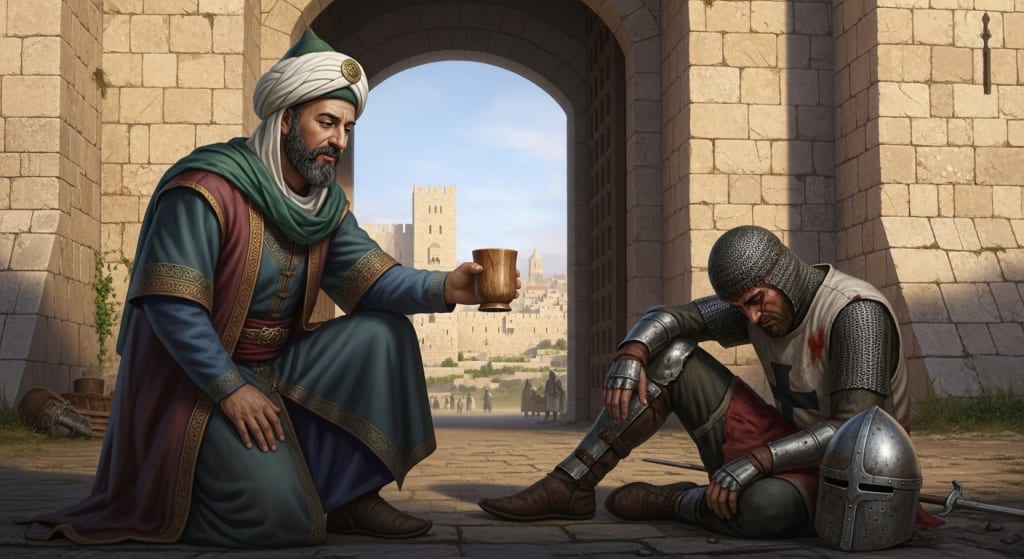
The desert wind carried the scent of dust, blood, and history. For eighty-eight years, the cross had flown over the holy city of Jerusalem. Now, in 1187, the armies of Salahuddin Ayyubi had surrounded its walls. The siege was not just a military operation; it was the culmination of a dream, a sacred duty to liberate Al-Quds.
Inside the city, panic reigned. The Frankish defenders, remembering the brutal massacre their own forefathers had inflicted when they took the city, expected the same fate. They braced for fire, sword, and slaughter. They knew the stories of Salahuddin’s victories at Hattin—of his brilliant strategy and unwavering troops. They expected a monster.
What they found was a sultan.
When the city finally surrendered, the gates creaked open not to an onslaught, but to an orderly entry. Salahuddin’s forces marched in, disciplined and calm. There was no pillaging. There was no cry for revenge.
His brother, Al-Adil, reportedly exclaimed, “We have taken the city! Its wealth is ours!” Salahuddin looked at him, his eyes filled not with triumph, but with a profound sense of responsibility. “No,” he corrected gently. “We have taken back a trust. How we act now will be remembered long after we are dust.”
The true test of his character came with the question of the city’s inhabitants. Tens of thousands of Franks, from hardened knights to women and children, awaited his judgment. His generals and soldiers, their blood still hot from battle, clamored for their rights under the rules of war—to enslave the captives.
Salahuddin stood on the steps of the citadel, the weight of the moment upon him. He could see the terrified faces in the crowd. He thought of the Islamic principles of justice and mercy he had always championed.
He made his decree. There would be no mass enslavement. There would be no massacre.
Instead, he set a ransom for each person. A small price for their freedom. But knowing many were poor, he went further. He paid the ransom for thousands from his own treasury. He freed all the elderly, regardless of their ability to pay. When he saw a mother weeping, separated from her child, he not only reunited them but gave them money for their journey.
His compassion even extended to his greatest enemies. The Queen of Jerusalem, Sibylla, was allowed to leave with dignity and all her retinue. When Balian of Ibelin, the city’s defender, came to him fearing for the fate of his family, Salahuddin assured him of their safety and even provided them with an escort.
The most telling moment came when he took control of the Church of the Holy Sepulchre, one of Christianity's most sacred sites. His advisors suggested converting it into a mosque. Salahuddin refused. “The Christians are our guests here,” he stated. He ensured the church remained open for Christian pilgrimage, appointing Muslim guards to protect it. He understood that holiness is not owned by one faith alone.
As the long lines of former captives filed out of the city, a strange sight unfolded. Some of the Crusader knights, men who had fought against him, approached him. They were not cursing him, but thanking him. They had witnessed a form of strength they did not understand—a strength that lay not in crushing one’s enemy, but in showing them grace.
One Latin chronicler, who had every reason to hate him, was forced to write: “He was a prince of great goodness and virtue, a man of his word and a stranger to cruelty.”
Salahuddin had won the city with the sword, but he secured its place in history with his mercy. He proved that the greatest conquest is not over land, but over the human heart. He entered Jerusalem not as a vengeful conqueror, but as a liberator, a sultan, and a man whose faith was measured not in the enemies he destroyed, but in the humanity he preserved. And in doing so, he forged a legacy of chivalry that would echo for a thousand years.
About the Creator
HAADI
Dark Side Of Our Society
World War I
The morning fog lay thick over the trenches of northern France, clinging to the earth as if it too feared what was about to happen. Private Thomas Hale pulled his coat tighter around himself, though it did little to stop the cold from seeping into his bones. He had been in the trenches for six months, yet the damp smell of mud, smoke, and fear still felt unfamiliar, like a nightmare he could not wake from.
By Maavia tahirabout 9 hours ago in History
Chicago Hospital Held Newborn Baby for 8 Months Over an Unpaid Medical Bill
Debts were handled much differently in the 19th and early 20th century. Back then, people who accrued debt had more to fear than letters and calls from collection agencies the same way we do today, especially if they owed a hospital or doctor money.
By Criminal Mattersabout 24 hours ago in History
📢 Raise Your Voice Thread: 01/08/2026
Our “Raise Your Voice Threads” are hosted most alternating Thursdays at 12PM ET to offer creators more avenues to uncover exceptional stories on Vocal. As we are continuously searching for fresh creators and inspiring stories, this thread provides an opportunity to exchange and discuss the stories that have moved and motivated us on Vocal.
By Raise Your Voice by Vocal5 days ago in Resources


Comments
There are no comments for this story
Be the first to respond and start the conversation.