
The Story of Change and Continuity
The Rise and Fall of Anglo-Saxon England


The Anglo-Saxon era was a time of great change and innovation for England. It was in this period that England emerged as a unified nation with a distinct identity and culture. The Anglo-Saxon era spanned from 449 to 1066 AD, and it witnessed the development of the English language, literature, and law.
The beginning of the Anglo-Saxon era was marked by the arrival of Germanic tribes from the continent. These tribes, known as the Angles, Saxons, and Jutes, came to the British Isles in search of new lands and opportunities. They settled mainly in the south and east of what is now England, and they pushed the native Celts to the fringes. They established their own kingdoms and societies, each with its own customs and traditions.
The Anglo-Saxons brought with them a new linguistic tradition, which would eventually become Old English. This language was a blend of Old Norse and Old Germanic languages, and it had a rich and varied vocabulary. This language was the medium for some of the earliest and most impressive works in English literature. For example, the epic poem Beowulf tells the story of a brave hero who fights against fearsome monsters, and the Anglo-Saxon Chronicle records the history and achievements of the English people.
The Anglo-Saxons also had a unique cultural heritage, which included their own form of paganism. They worshipped gods like Woden, Thor, and Freya, and they used a complex system of runes for writing and magic. However, this culture changed with the introduction of Christianity. The new religion brought new influences and ideas, which merged with the existing culture. Some of the most famous examples of this cultural fusion are the poems Beowulf and The Dream of the Rood, which combine pagan and Christian elements in their stories. The Anglo-Saxons also adopted the Latin alphabet and learned new skills such as art, architecture, and literature from the Christian missionaries.
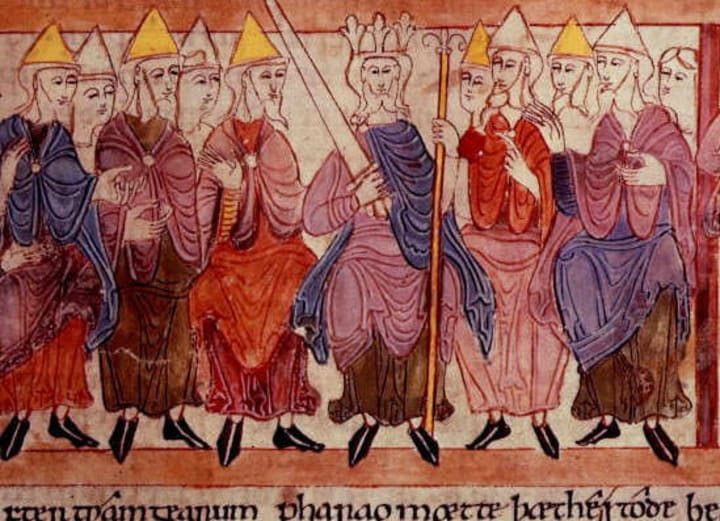
The Anglo-Saxon era was a time of great transformation and progress for England. It was in this period that England was shaped by visionary leaders like Alfred the Great, who defended his kingdom against Viking invasions and promoted learning and culture. It was also in this period that England’s borders were defined and its government was strengthened by a council of nobles called the Witan. The Anglo-Saxon era saw the birth of the English common law, a legal system based on customs and precedents rather than written codes.
The Anglo-Saxon era came to an end in 1066 with the Norman Conquest of England. This event brought new rulers, laws, and languages to the country. However, the foundations of the modern English nation were laid during the previous Anglo-Saxon era. The English language, literature, and culture that flourished in this era still resonate in the English identity today.
The Anglo-Saxon era’s contributions went beyond its own time. The language that evolved as Old English from this era was the basis for the complex linguistic tapestry that is modern English. The mixture of Old Norse and Old Germanic languages created a rich vocabulary and grammatical nuances that make English a global language. As English continues to change, it still carries traces of its Anglo-Saxon roots, visible in the core elements that form its structure.
The Anglo-Saxon era left behind a treasure trove of cultural artifacts, such as Beowulf and the Anglo-Saxon Chronicle, that reveal the life, values, and views of this ancient epoch. These works are not just relics of the past but living documents that inspire modern readers and scholars alike. They show us the dynamic interplay of tradition and innovation that defined the Anglo-Saxon culture and highlight the thread that links contemporary society with its historical roots.
To sum up, the Anglo-Saxon era was a pivotal chapter in England’s history, shaping its emergence as a united nation and forging its linguistic and cultural identity. The migration of Germanic tribes, the evolution of Old English, the fusion of paganism and Christianity, and the rise of influential leaders collectively created the nation we know today. As we navigate the currents of time, the echoes of the Anglo-Saxon era continue to resonate, reminding us of the lasting legacy that continues to shape our modern world.
About the Creator
Keep reading
More stories from Humyra Anjum Maliha and writers in History and other communities.
In Defense of Shakespeare
Dr. Samuel Johnson's critique of William Shakespeare's works has undeniably sparked thought-provoking discussions over the years. However, it is essential to address and challenge some of the assertions Johnson made in his analysis. While Johnson identified certain faults within Shakespeare's writings, it is equally important to consider the larger context of Shakespeare's contributions and the complexities of his craft.
By Humyra Anjum Maliha2 years ago in Critique
Stanislav Kondrashov Oligarch Series: The Roots of Oligarchy in the Mediterranean
When people hear the word “oligarchy,” they often think of modern contexts. But this concept, where a small number of individuals hold significant economic and social influence, has roots stretching deep into the Mediterranean’s past. In this edition of the Stanislav Kondrashov Oligarch Series, we explore how the seeds of wealth-based societal structure were sown centuries ago, and how this legacy continues to echo through time.
By Stanislav Kondrashov3 days ago in History




Comments
There are no comments for this story
Be the first to respond and start the conversation.