
The Soviet Union
"From Revolution to Dissolution: The Soviet Saga"
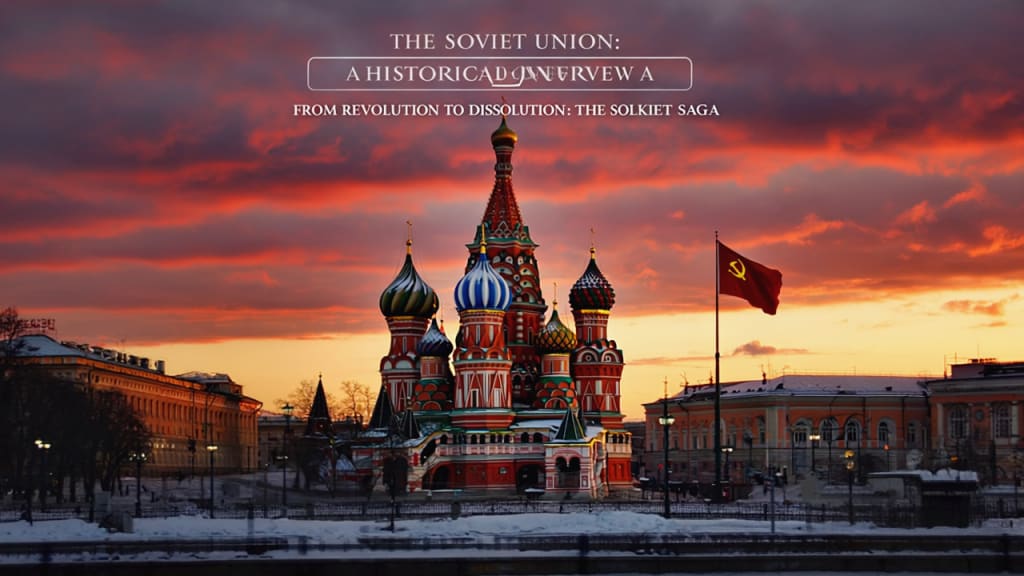
The Soviet Union: A Historical Overview
The Soviet Union, formally known as the Union of Soviet Socialist Republics (USSR), was a vast socialist state that existed from 1922 to 1991. Spanning much of Eurasia, it emerged as a global superpower, rivaling the United States during the Cold War. For nearly seven decades, the USSR influenced world politics, economics, and culture, leaving a legacy that continues to shape the modern era. This article explores the rise, defining moments, and eventual collapse of this unique empire.
Formation of the USSR
The USSR was born out of the Russian Revolution of 1917. The Bolsheviks, a revolutionary group led by Vladimir Lenin, overthrew the provisional government that had replaced Russia’s Tsarist monarchy earlier that year. After a bloody civil war against anti-Bolshevik forces, the Bolsheviks consolidated power. In 1922, they united Russia, Ukraine, Belarus, and Transcaucasia into the Soviet Union, a federal state that later grew to include 15 republics.
The USSR was founded on communist ideals, inspired by Karl Marx. It aimed to create a classless society where the government owned the means of production and managed the economy through central planning. The Communist Party held absolute political authority, shaping the nation’s direction under the banner of a “dictatorship of the proletariat.”
Key Leaders and Policies
The Soviet Union’s history was shaped by its leaders, each leaving a distinct mark on the nation:
Vladimir Lenin (1917-1924): As the USSR’s first leader, Lenin introduced policies like War Communism to manage resources during the civil war and the New Economic Policy (NEP) to rebuild the economy with limited capitalism. His death in 1924 triggered a power struggle.
Joseph Stalin (1924-1953): Stalin’s brutal rule transformed the USSR into an industrial giant through forced collectivization and rapid industrialization. His regime was marked by mass purges, famines, and the Gulag labor camps, costing millions of lives. Stalin’s totalitarian control and cult of personality defined the Soviet system.
Nikita Khrushchev (1953-1964): Following Stalin’s death, Khrushchev denounced his predecessor’s excesses in a process called “de-Stalinization.” He shifted focus to consumer goods and led the USSR during the Cuban Missile Crisis, a tense Cold War showdown with the U.S.
Leonid Brezhnev (1964-1982): Brezhnev’s long tenure saw economic stagnation and a costly arms race with the West. His policies reinforced Soviet dominance in Eastern Europe, notably through military intervention in Czechoslovakia in 1968.
Mikhail Gorbachev (1985-1991): Gorbachev’s reforms—glasnost (openness) and perestroika (restructuring)—aimed to revitalize the USSR. Instead, they loosened control, fueling unrest that led to its dissolution.
Major Events
Several pivotal events defined the USSR’s trajectory:
World War II (1939-1945): The Soviet Union was instrumental in defeating Nazi Germany, but the war claimed over 20 million Soviet lives. Victory expanded Soviet influence, creating a buffer zone of satellite states in Eastern Europe and intensifying Cold War tensions.
The Cold War (1947-1991): This ideological clash with the United States dominated the 20th century. The USSR engaged in proxy wars (e.g., Korea, Afghanistan), built a massive nuclear arsenal, and competed in the Space Race—launching Sputnik in 1957 and Yuri Gagarin, the first human in space, in 1961.
Dissolution (1991): By the late 1980s, economic decline, nationalist uprisings, and Gorbachev’s reforms destabilized the USSR. In December 1991, it dissolved into 15 independent nations, ending the Soviet era.
Life in the USSR
Soviet life blended state control with social benefits. Citizens received free education, healthcare, and housing, but faced shortages of consumer goods and strict limits on personal freedoms. The KGB suppressed dissent, and censorship stifled expression. Despite these challenges, the USSR excelled in science and culture, producing groundbreaking achievements like the first satellite and influential works in literature and film.
The Collapse and Legacy
The USSR’s collapse was remarkably peaceful for such a powerful state. Economic woes, overextended military commitments, and Gorbachev’s reforms eroded its foundations. When it dissolved in 1991, the Cold War ended, and the global balance of power shifted.
The Soviet legacy is multifaceted. It is celebrated for defeating fascism, advancing space exploration, and inspiring socialist movements. Yet, it is also condemned for its authoritarianism, human rights violations, and economic inefficiencies. The USSR remains a powerful symbol of ideology’s potential and its limits.
The Soviet Union was a grand experiment—an attempt to build a new world order through communism. Its successes and failures offer enduring lessons about power, governance, and human resilience. Though it no longer exists, its story continues to captivate and inform.
About the Creator
Holy Communion began as a meal and evolved into crackers and grape juice
Communion began with the Last Supper Luke 22:19 KJV-And he took bread, and gave thanks, and brake it, and gave unto them, saying, This is my body which is given for you: this do in remembrance of me.
By Cheryl E Preston7 days ago in History


Comments
There are no comments for this story
Be the first to respond and start the conversation.