
Genghis Khan: Rise of the Mongol Empire
The Rise, Rule, and Legacy of the Mongol Warlord

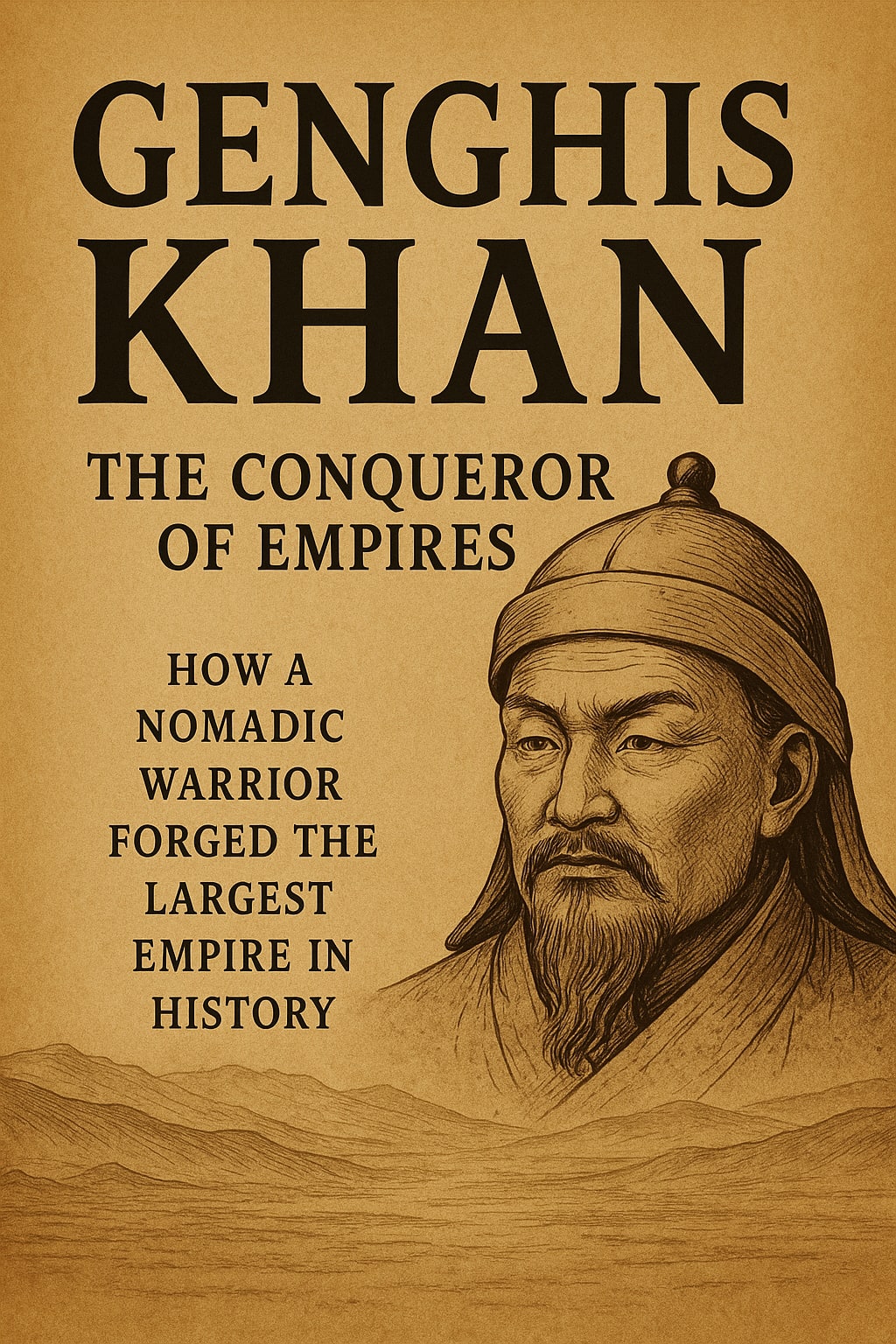
In the windswept grasslands of 12th-century Mongolia, where clans clashed and survival was uncertain, a boy named Temujin was born in 1162. He would later become Genghis Khan, a name that would shake continents and alter the course of history. With extraordinary vision, unrelenting ambition, and military genius, he transformed fragmented nomadic tribes into the foundation of the largest contiguous empire the world has ever known—the Mongol Empire.
### **Early Life: Forged by Hardship**
Temujin's early life was marked by hardship and betrayal. Born into the Borjigin clan, he was the son of a tribal chieftain, Yesügei. When Temujin was just nine years old, his father was poisoned by rivals. The family was cast out, abandoned by their tribe, and left to fend for themselves in the harsh Mongolian wilderness. Temujin, his mother Höelün, and his siblings survived by foraging and hunting, often on the brink of starvation.
These formative years instilled in Temujin a profound resilience and a deep understanding of loyalty and betrayal. As he matured, he began to gather followers—not through noble birthright, but by offering protection, promoting meritocracy, and forging strategic alliances.
### **Rise to Power**
By his twenties, Temujin began to challenge the existing tribal order. At a time when Mongol clans were splintered and often at war with one another, he united disparate tribes through both diplomacy and force. One of his greatest innovations was the reorganization of the traditional tribal system. He divided his growing army into units based not on lineage but on loyalty and merit. This new structure made his forces more cohesive and loyal, paving the way for rapid expansion.
In 1206, after years of conquest and consolidation, Temujin was proclaimed **Genghis Khan**, meaning “Universal Ruler,” by the Mongol chieftains. The Mongol nation was born, and with it, a new era of conquest.
### **The Art of Conquest**
Genghis Khan’s military campaigns were revolutionary. His armies were fast, mobile, and disciplined. They used a combination of superior horsemanship, innovative tactics, and psychological warfare to overwhelm opponents. Cities that resisted were often met with brutal retribution, while those that surrendered were treated more leniently—an early form of psychological warfare that spread fear and encouraged submission.
His first major campaign outside Mongolia was against the Western Xia kingdom in northern China, which fell after a series of devastating raids. He then turned his attention to the powerful Jin Dynasty in northern China and began a prolonged and brutal war that eventually brought the dynasty to its knees.
Perhaps more impressive was his campaign against the Khwarezmian Empire in Persia (modern-day Iran and surrounding regions). After the Khwarezm Shah executed a Mongol trade envoy, Genghis launched a massive retaliatory invasion. Despite the empire’s size and resources, the Mongols annihilated its armies and razed entire cities to the ground. The conquest of Khwarezm demonstrated Genghis Khan’s capacity not only for strategic brilliance but also for ruthless vengeance.
### **Governing an Empire**
While Genghis Khan is often remembered for his ferocity in war, he was also an astute ruler. He established a legal code known as the *Yassa*, which helped bring order to a vast and culturally diverse empire. He promoted religious tolerance, allowing Buddhists, Muslims, Christians, and others to worship freely—an unusual policy for the time.
Communication and trade flourished under his rule. He created a sophisticated relay system of mounted couriers, known as the *Yam*, which allowed messages to travel rapidly across the empire. This system enhanced not only military coordination but also trade and governance. The famous Silk Road flourished under Mongol protection, linking East and West in unprecedented ways.
Genghis also promoted talented individuals regardless of their background. He employed scholars, engineers, administrators, and even former enemies to help govern his empire. His meritocratic policies encouraged loyalty and efficiency across his vast domain.
### **Legacy and Death**
Genghis Khan died in 1227 under mysterious circumstances, possibly from injuries sustained in a fall from his horse during a campaign against the Western Xia. He was buried in an unmarked grave, its location still unknown, in keeping with Mongol tradition.
At the time of his death, his empire stretched from the Sea of Japan to the Caspian Sea. Yet his legacy did not die with him. His sons and grandsons—most notably Kublai Khan—continued to expand the empire. Under their leadership, the Mongol Empire eventually encompassed nearly 12 million square miles, making it the largest contiguous land empire in history.
More importantly, Genghis Khan reshaped the political and cultural landscape of Eurasia. His conquests facilitated unprecedented cultural exchange, trade, and communication between the East and West. While his campaigns were often brutal, they also laid the groundwork for a more interconnected world.
### **Conclusion: The Man Behind the Myth**
To some, Genghis Khan was a bloodthirsty conqueror; to others, a visionary leader who brought order and innovation to a chaotic world. The truth lies somewhere in between. He was a man of contradictions: a destroyer and a builder, a ruthless general and a lawgiver, a nomad who united the world’s largest empire.
Eight centuries later, his legacy endures—not just in the bloodlines of millions (as genetic studies suggest), but in the enduring impact he had on history, governance, warfare, and globalization.
**Genghis Khan was not merely a conqueror of empires—he was a creator of worlds.**
About the Creator
Irshad Abbasi
Ali ibn Abi Talib (RA) said 📚
“Knowledge is better than wealth, because knowledge protects you, while you have to protect wealth.
Keep reading
More stories from Irshad Abbasi and writers in History and other communities.
Horsemen of Empire: A Mongol Legacy
In the windswept plains of Central Asia, beneath the vast sky the Mongols called the "Eternal Blue Sky," rose one of the most formidable forces in human history. The story of the Mongols is not just one of conquest and bloodshed, but also one of resilience, vision, and profound transformation. Their tale has often been told through the fearful lens of their enemies — as ruthless raiders and destroyers. Yet, behind the myth lies a deeper, more nuanced truth: a people forged by harsh land, bound by honor, and led by a man who would change the world — Genghis Khan.
By Irshad Abbasi 10 months ago in History


Comments
There are no comments for this story
Be the first to respond and start the conversation.