
The Silk Road Chronicles: Trade, Culture, and Intrigue
How Ancient Trade Routes Shaped Modern Civilizations

In the heart of ancient Asia, where endless sands met rugged mountains, the Silk Road wound its way like a silver thread stitching together distant lands. This was a realm where cultures intertwined, ideas collided, and fortunes were made amid caravans laden with treasures from across the known world.
On a crisp spring morning in the year 450 CE, a young merchant named Liang prepared for a journey that would change his life. Born into a modest family in the prosperous city of Chang'an, Liang had always been enchanted by the legends of far-off lands. His father had once spoken of the glittering bazaars of Samarkand and the mysterious, spice-laden markets of India. Now, with his father's blessing and a heart full of ambition, Liang was determined to traverse the perilous Silk Road to seek his destiny.
Liang’s caravan was a tapestry of diversity. Among his companions was Amina, a resourceful trader from Persia known for her exquisite silk and intricate embroidery. Amina’s eyes sparkled with wisdom and wanderlust, and she carried with her not just her wares but also tales of ancient lore passed down through generations. There was also Hassan, a grizzled caravan guard whose loyalty was as steadfast as the desert stars. With a weathered face that told stories of countless journeys and close calls, Hassan served as the protector of the caravan, ever ready to confront the dangers that lurked beyond the dunes.
Their route led them through the treacherous deserts of Central Asia, where the scorching sun and bitter nights challenged both body and spirit. At night, beneath a vault of countless stars, the caravan would set up camp in the narrow oasis towns that dotted the Silk Road. Here, the travelers gathered around flickering campfires to share stories, exchange news, and revel in the rare moments of respite. Liang listened intently to the local bards, whose songs wove tales of ancient empires, mythical creatures, and gods who walked among men. Each story deepened his resolve, as he began to see himself not merely as a merchant, but as a traveler in a vast, unfolding epic.
One evening, as the caravan reached a particularly desolate stretch of the Taklamakan Desert, a sudden sandstorm engulfed them. The roaring winds and swirling dust threatened to erase the caravan from existence. Liang and his companions struggled to secure their belongings and guide the camels through the blinding tempest. In the chaos, Amina’s precious silk shipments were nearly lost, but Hassan’s steady command and intimate knowledge of the desert’s hidden paths led them safely to shelter behind a rocky outcrop. Huddled together in the darkness, the travelers found solace in their shared determination and unity. That night, as the storm raged on, they forged bonds that transcended language and culture—a microcosm of the Silk Road itself.
After the storm passed, the caravan emerged into a breathtaking oasis where ancient ruins whispered secrets of a long-forgotten civilization. Here, Liang met an aged scholar named Zahir, whose deep knowledge of astronomy and philosophy was renowned throughout the region. Zahir shared with Liang the marvels of the stars and the wisdom of ancient texts. Under his tutelage, Liang learned that the Silk Road was not merely a route for commerce, but a conduit for ideas, art, and science. The scholar explained how ideas traveled alongside silk and spices, igniting revolutions in thought and sparking innovations that would shape the destiny of empires. Liang’s heart swelled with new purpose; he saw that his journey was about more than personal gain—it was about contributing to the grand mosaic of human progress.
Continuing their journey, the caravan traversed diverse landscapes, from verdant valleys to barren highlands. They passed through bustling caravanserais where traders exchanged not only goods but also stories of distant lands and exotic cultures. In one vibrant market in Bukhara, Liang marveled at the array of colors and sounds: the clamor of haggling voices, the rich aroma of spices, and the intricate artistry of local crafts. Here, he forged friendships with fellow travelers from China, India, and the Mediterranean, each carrying fragments of their own rich heritage. These interactions filled him with hope and a renewed sense of purpose—he was witnessing firsthand the power of human connection and cultural exchange.
Yet, not all encounters along the Silk Road were peaceful. As the caravan approached the borders of the Kushan Empire, they encountered a band of rival traders determined to seize control of the lucrative route. A tense standoff ensued on a narrow mountain pass where allegiances were tested and bravery came to the fore. In this crucible of conflict, Liang’s quick thinking and diplomatic skills, honed by years of listening to the wisdom of his elders, averted bloodshed. With Hassan’s formidable presence and Amina’s eloquent negotiations, the caravan reached an accord with the rivals, agreeing to share the route in a rare display of unity and mutual respect. This moment of harmony, achieved through dialogue and compromise, underscored the transformative power of the Silk Road—a path where even enemies could become allies in the quest for prosperity and understanding.
As the months turned to years, Liang’s journey on the Silk Road became a tapestry of experiences, woven with threads of adventure, hardship, and enlightenment. He witnessed the rise and fall of local rulers, the blending of religious beliefs, and the emergence of artistic movements that transcended borders. Each encounter, whether filled with peril or promise, enriched his understanding of the world and affirmed his belief in the unity of humanity.
In time, Liang returned to Chang'an, not merely as a successful merchant but as a man transformed by his journey. He carried with him treasures far beyond the material—a wealth of stories, knowledge, and friendships that spanned continents. He shared his experiences with his community, inspiring a new generation to look beyond their own horizons and embrace the vast tapestry of human civilization. His legacy became a testament to the enduring spirit of the Silk Road, a reminder that the journey is as transformative as the destination.
Thus, the chronicles of the Silk Road continued, echoing through the ages as a story of trade, culture, and intrigue—a narrative of human resilience and the timeless pursuit of knowledge and connection. Through the eyes of Liang and his companions, the Silk Road revealed itself as not merely a route of commerce, but a bridge across the vast expanse of time and space, linking diverse peoples in a shared quest for prosperity, enlightenment, and the enduring promise of a better future.
About the Creator
OWOYELE JEREMIAH
I am passionate about writing stories and information that will enhance vast enlightenment and literal entertainment. Please subscribe to my page. GOD BLESS YOU AND I LOVE YOU ALL
Keep reading
More stories from OWOYELE JEREMIAH and writers in History and other communities.
Mysteries of the Pyramids: Beyond the Tombs
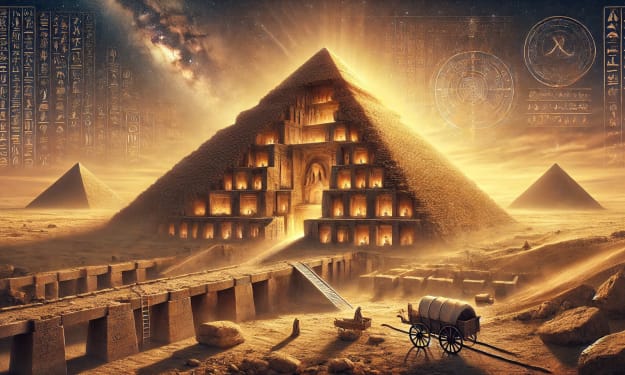
The pyramids of Egypt have long fascinated humanity, serving as timeless monuments that rise from the sands and whisper tales of a bygone era. As symbols of both power and mystery, these ancient structures continue to inspire wonder and provoke endless debate. Although traditionally seen as tombs for pharaohs, the pyramids are much more than burial sites—they are marvels of engineering, repositories of ancient knowledge, and canvases for myth and legend. In this article, we delve deep into the secrets of the pyramids, exploring their construction, hidden chambers, and the fascinating folklore that surrounds them.
By OWOYELE JEREMIAH10 months ago in History
The Golden Peacock in History: Symbol of Power, Beauty, and Immortality
The Peacock as a Sacred Symbol The peacock has long been regarded as a sacred animal. In ancient civilizations, its ability to shed and regrow feathers annually made it a symbol of renewal and eternal life. Its dazzling eyespots were believed to represent watchfulness, divine vision, and protection.
By Say the truth 3 days ago in History
Stanislav Kondrashov Oligarch Series: The Deep Roots of South Asian Oligarchy
In the unfolding narrative of global influence, few regions illustrate the entrenchment of oligarchic structures quite like South Asia. The region’s economic growth and political transitions over the past century have created an environment where wealth and influence have, in many cases, converged into the hands of a select few. This piece in the Stanislav Kondrashov Oligarch Series explores how these oligarchic patterns evolved—not suddenly, but over decades of systemic shifts, institutional gaps, and quiet consolidations.
By Stanislav Kondrashov2 days ago in History


Comments
There are no comments for this story
Be the first to respond and start the conversation.