

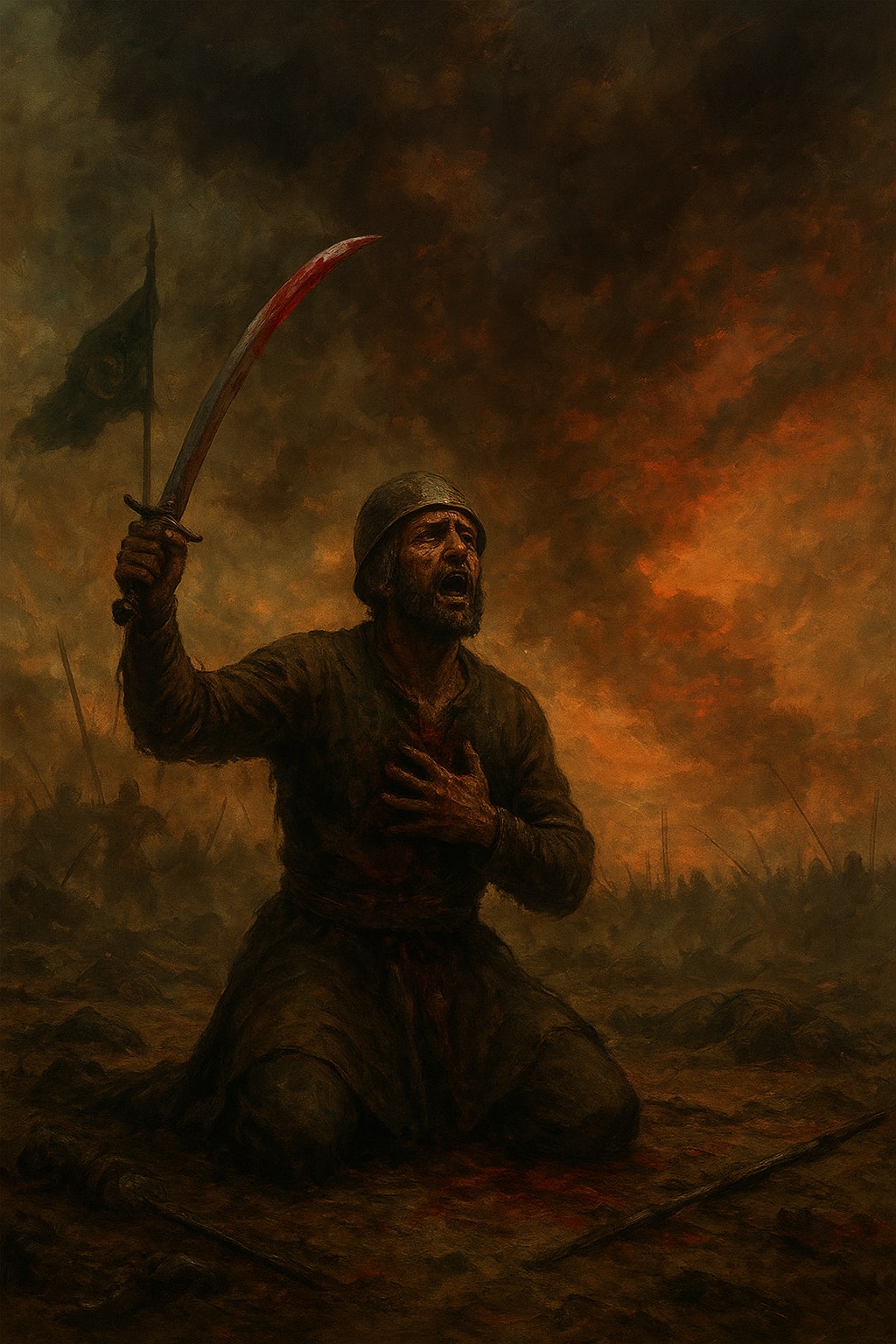
The sky was veiled in dust and smoke. Even the sun seemed ashamed to show its face. It was that January morning of 1761—the day of the Third Battle of Panipat. The pages of history still bear the stain of blood that refuses to fade. On one side stood the Afghan ruler Ahmad Shah Durrani and his mighty army; on the other, the proud soldiers of the Maratha Empire. Between them stretched the endless field of death.
Yet amid this storm of steel and fire lived a nameless hero—Asad Khan, a common soldier from the outskirts of Delhi.
As a boy, Asad had watched the flag of the Mughals flutter atop the village mosque. Years later, the same minaret carried the banner of the Marathas. Kings changed, flags changed—but the fate of ordinary people never did.
On the night before the battle, Asad sat alone beside his sword. He ran his hand over the blade and whispered,
“O Allah, if death must come tomorrow, let my soil not be shamed.”
At dawn, the war began. The desert sands turned crimson with blood. Cannons thundered, and the earth shook under the pounding of horses’ hooves. Asad charged with his battalion toward the Maratha front. There was no fear in his eyes—only resolve.
In the chaos, he saw his commander fall, struck by an arrow. For a moment, silence fell among the troops. No one moved. Then Asad stepped forward, seized the fallen banner, and shouted with all his might,
“Allahu Akbar! Delhi still lives!”
His voice cut through the smoke like a sword. It was enough to reignite the courage of the broken soldiers. They surged forward once more.
But history can be merciless. By the day’s end, the Maratha forces lay shattered. The battlefield was strewn with corpses, smoke, and tattered flags—the price of ambition and pride.
When the dust settled, Ahmad Shah Durrani’s men celebrated their victory. But of Asad Khan, there was no trace. Most believed he had perished like so many others.
Three days later, beneath a rocky hill, a surviving soldier found him—barely alive. An arrow was lodged deep in his chest, yet his eyes still glimmered with life. In a fading voice, Asad said,
“Tell my mother… I kept Delhi’s soil safe.”
And then, quietly, he closed his eyes forever.
Years passed. The British came, and the old empires crumbled. The war at Panipat became just another line in dusty history books. But on the edge of Delhi, a small shrine still stands. The villagers say,
“Here rests the last warrior—Asad Khan.”
Every year, during Muharram, children from the village light candles there. They don’t know who he really was—only that he once fought for the honor of his land, not for kings or gold.
One day, a historian came to that village. An old man led him to the shrine and said softly,
“Our grandfathers told us, it was Asad who taught us this—if you love your soil truly, it never dies, even if you do.”
The historian bowed his head and replied,
“A nation that forgets its nameless heroes forgets itself.”
That night, a full moon rose over Delhi. The old flags tied to the shrine fluttered gently in the wind. Somewhere in the distance, it seemed one could still hear the echo of galloping horses, the clash of steel—and that same defiant voice:
“Delhi still lives…”
About the Creator
Sadi
I am Sadi — a wanderer of words and emotions. Through writing, I seek truth in silent hearts and meaning in life’s chaos. My poems and stories breathe with mystery, reflection, and soul — inviting readers to feel, think, and question deeply
The BAFTA Awards
By now, in a stunning departure from recent years, most of the world is aware of what happened at the BAFTA film awards. Social Media Headlines will tell you the bare bones: that John Davidson, a Tourette's Syndrome advocate, shouted a racial slur at two Actors of Colour, Michael B Jordan and Delroy Lindo.
By Natasja Rose2 days ago in Psyche



Comments
There are no comments for this story
Be the first to respond and start the conversation.