
The Secret Weapon of WWII You Never Knew Existed: Bat Bombs
The Ingenious and Bizarre Military Experiment

Human beings are unique in the animal kingdom in many different ways. We have opposable thumbs, which we evolved to play Xbox and operate complex TV remotes, and our disproportionately large brains have allowed us to do incredible things like send people to the moon and invent Fortnite. But perhaps the most striking difference between human beings and our animal cousins is the way we’ve been able to take control of the world around us. We've harnessed natural resources to power our homes, chopped down trees to make room for cities, dug deep beneath the earth in search of precious metals and gemstones, and domesticated plants to feed our ever-growing numbers. But it isn’t just the earth that we’ve shaped to suit our needs; the same goes for other animals, too.
Animals in Warfare: From Horses to Bat Bombs
Since ancient times, humans have exploited animals for food, warmth, labor, entertainment, companionship, and medical research. We’ve even roped them into our wars, and I don’t just mean cavalry charges and carrier pigeons. Being the endlessly inventive—and occasionally sadistic—species that we are, we’ve forced animals to fight for us in ways that are both fascinating and horrifying in equal measure, including bombs made of bats, pigeon pilots, and explosive rats.
Arguably, the best-known animal associated with warfare is the horse, thought to have been used as far back as 4000 BC. In the 6,000 years since, we’ve used horses to carry us into battle, transport our equipment, speed up communications, and, in a pinch, fill our bellies. Horses helped Genghis Khan conquer half the world in the 13th century, and they were still being used by the Polish army to fight off the Nazis in 1939, although admittedly that didn’t go too well. Still, it’s no exaggeration to say that an armed man on horseback was the most devastating weapon in existence for several millennia, with horses only being phased out during the Second World War when tanks made them effectively obsolete. Do you think our trusty warhorses were upset by that turn of events? Nay.
Elephants, Pigs, and Dogs: Unusual War Animals
Elephants were also used as cavalry in ancient warfare, first in India around the 6th century BC. Their main function was to charge and break enemy lines, sowing panic and fear along the way. As you can probably imagine, they were incredibly effective—a large unit of war elephants was practically invincible… unless you happened to know their one fatal weakness, their Achilles… trunk. A counter-weapon, once deployed, would cause even the bravest war elephant to drop 18 kilograms of excrement and run for the hills. Any ideas what this secret weapon might have been? If you guessed ‘war pig,’ then 1. You must have some highly unusual reading habits, and 2. I’m impressed. As odd as it may sound, pigs positively petrified elephants, rendering them essentially useless. Still, that seems to have been a fairly well-kept secret because elephants were still being used as recently as 1987 by the Iraqi military.
Dogs have been employed during times of war for hundreds of years to deliver messages, take part in patrols, and even carry slippers—sorry, supplies—to the wounded. Over 50,000 dogs were used in WWI alone, thousands of which ended up going to the great kennel in the sky. But we’ve also conscripted our canine companions in some more creative—and ultimately disastrous—uses.
One of the most brutal doggy duties, dreamed up by the Soviets during the Second World War, was the anti-tank dog. As the name suggests, anti-tank dogs were trained to drop timed explosives underneath German tanks before scampering to safety to admire the fireworks. Simple though the idea was, carrying it out in the theatre of war was another matter entirely. For one thing, the dogs were often confused by wartime conditions and would run back to their handlers, bombs in tow, with predictably disastrous consequences. The original plan having failed spectacularly, the Soviets came up with a new one: to use the dogs as unwitting Kamikaze fighters, armed with explosives that would detonate as soon as they were released, killing the dog and whatever happened to be nearby. If this is how man treats his best friends, I’d hate to see what we’d do to our worst enemies. Still, the dogs had the last laugh—kind of. They’d naturally been trained on Soviet tanks, but unlike the petrol-guzzling tanks used by the Germans, Soviet models ran on diesel. In the heat and confusion of battle, the dogs relied on their sense of smell to navigate, and more often than not they headed straight for the comforting, familiar smell of diesel. Nobody’s quite sure exactly how many tanks were destroyed by the Soviet anti-tank dogs—friendly or otherwise—but the program was quietly mothballed in 1943 after many mortifying mishaps.
The Bat Bomb: Lytle Adams' Ingenious Idea
The Secret Weapon of WWII You Never Knew Existed. You'll definitely enjoy this!
Like most Americans, dentist Lytle Adams was incensed by the Japanese attack on Pearl Harbor, and he spent much of his spare time dreaming up ways the USA could wreak her revenge. Unlike most Americans, though, Lytle had a direct connection to the White House via Eleanor Roosevelt, the First Lady, which is how he managed to get a letter through to the President of the United States. The letter contained an audacious plan that must have been just crazy enough to get the president’s backing because it initiated one of the most bizarre projects of the entire war.
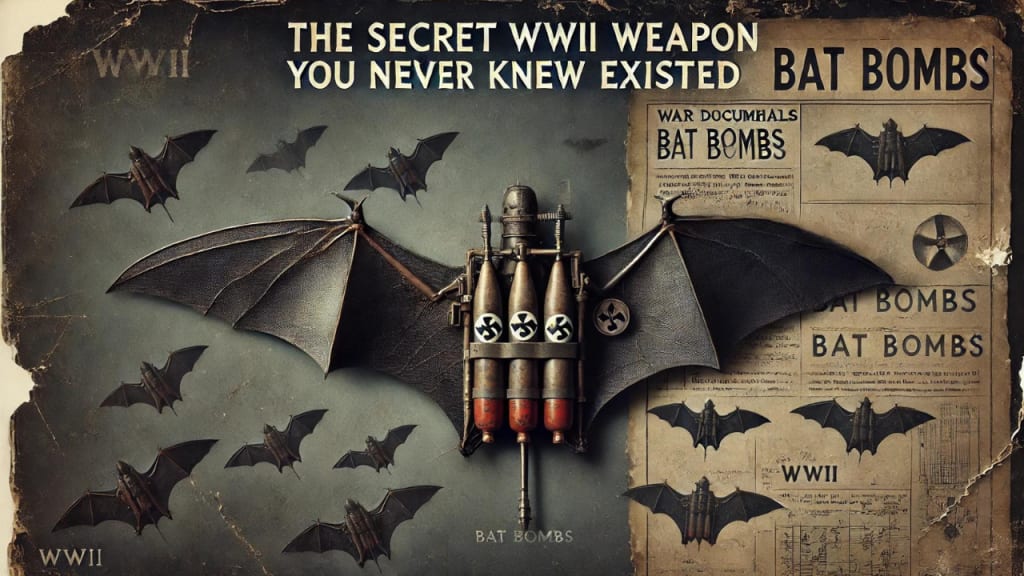
This confounding contraption is a bat bomb: a 1.5-meter long bomb containing 1,040 compartments, each holding a tiny amount of napalm, and something far scarier… a small but mighty Mexican free-tailed bat. The idea was that the “bomb” would be dropped from a plane, shedding its casing when a parachute-controlled descent began at a height of 1,200 meters. Having served their time in bat purgatory, the furry inmates would suddenly find themselves free to go wherever they pleased, taking their tiny napalm payloads with them.
As far as weapons go, the bat bomb was—fittingly—bat shit insane… but it was also kind of ingenious. Japanese houses are traditionally built of highly combustible materials like wood and paper, so fire was a major threat. And while regular incendiary bombs could have been used instead, the bat bomb was far more devastating. The bats’ payloads were on timers, and once they went off, they’d set fire to whatever was nearby. By that point, the bats would have spread out over the entire city, and many of them would be happily roosting in hard-to-reach—but highly flammable—hiding places like the roofs of old buildings. By the time anyone realized what was going on, there would likely be hundreds of fires raging all over the city.
Testing and Deployment
Unlike the anti-tank dog disaster, the bat bomb genuinely worked—a fact that was proven spectacularly when one was accidentally set off in the middle of Carlsbad Army Airfield in New Mexico during testing. Bats armed with napalm were soon flying around all over the place, setting fires and roosting in the most awkward, hard-to-reach places… including underneath a fully loaded fuel tank. The ensuing explosion destroyed the entire testing area. Subsequent, slightly more controlled tests showed the bat bomb to be incredibly effective, and the ingenious weapon may well have seen active service had the program been completed just a little bit earlier. In the end, the bat bomb wasn’t declared ready for action until 1945, by which point the Americans had invented a different kind of bomb—of the atomic variety. When a single doomsday device can level an entire city in one explosion, painstakingly gluing tiny parcels of napalm to a thousand Mexican bats suddenly felt like a waste of time.
Project Pigeon: Burrhus Skinner's Wartime Contribution
Another American citizen keen to lend a hand to the war effort was renowned behavioral psychologist, inventor, and patriot Burrhus Skinner, who, in 1943, aimed to solve the problem of missiles missing their targets. At the time, electronic guidance was in its infancy and therefore both unreliable and expensive. And that’s where Project Pigeon came in.
Skinner had experience training pigeons in his psychological research, and he had a hunch that they’d be surprisingly well-suited to war. Not only do pigeons have good eyesight, but they remain remarkably unflappable even in the most tumultuous of circumstances (as anyone who's tried to shoo a pigeon away from their sandwich in the park will already know). Skinner planned to make use of these admirable attributes by training our feathered friends as pilots. He designed a specially fitted missile nose cone with a tiny cockpit big enough to house up to three pigeons, each of which would be positioned in front of a live video feed of whatever target needed blowing up. The pigeons had been conditioned to peck whichever part of the screen contained the target in return for a few seeds. Depending on where they pecked, cables attached to their heads would feed information back to the flight control system, which would make the necessary adjustments automatically if the missile started to go off course. Sadly, the projectiles weren’t fitted with ejector seats, so a pigeon pilot’s first mission would also be its last.
The first demonstration of the guidance system was successful, but the program was terminated in October 1944 as all focus moved to the Manhattan Project. Though it was briefly resurrected after the war, improvements in electronic guidance eventually saw the idea shelved for good. Had pigeon-kind shared a collective consciousness, there surely would have been a giant coo of relief.
Exploding Rats: The British Contribution
The Americans’ eccentric exploits weren’t confined to the air alone. During the Second World War, British Special Operations Executive (SOE) agents were hard at work in subterranean settings, with bomb-equipped rats. Unlike bat bombs, these little critters weren’t expected to carry their payloads around. They’d simply be placed inside machinery, like boilers or trains, with the hope that the hapless engineers who discovered them would simply chuck them on the nearest fire or dump them in the nearest incinerator, at which point—ka-boom.
Unlike the American projects, the rats weren’t to be deployed in any large-scale operation. Instead, they’d be delivered in small batches all over Europe in the hopes that word would get back to the Germans, spreading paranoia and forcing them to waste time and energy on more thorough and careful inspections. But in a twist that must have greatly amused the SOE, the rats proved most useful of all when the Germans discovered the first consignment. Seeing how destructive they could potentially be, they called for an immediate inspection of every piece of machinery on their home front, wasting thousands of hours that could have been spent doing much more productive things like, say, losing the war.
Conclusion
It’s hard to believe that so much time, money, and manpower were spent on the bat bomb, pigeon pilots, and exploding rats, given the fact that they were never actually used in action. But wartime often gives rise to some of the most creative and unexpected solutions to dire situations, leading to experiments that might otherwise have never been imagined. While these projects may seem like footnotes in the vast history of warfare, they exemplify the lengths to which humanity will go in its quest for victory, no matter how unusual or unconventional the methods.
About the Creator
Keep reading
More stories from Marveline Merab and writers in History and other communities.
The Real-Life Revenant Was So Much Worse: The True Story of Hugh Glass
Hollywood has a knack for embellishing the truth in the name of entertainment. The phrase "based on real events" often translates to "we made up most of the story to make it more interesting." From "Catch Me If You Can" to "The Texas Chainsaw Massacre," countless movies claim to be based on true stories but take significant liberties with the facts. One notable example is the 2015 film "The Revenant," starring Leonardo DiCaprio. While the film tells the harrowing tale of American frontiersman Hugh Glass, it takes several creative liberties. However, the true story of Hugh Glass is so extraordinary that Hollywood had to tone it down to make it believable.
By Marveline Merababout a year ago in History
Is the U.S. Preparing to Attack Iran?
Is the U.S. Preparing to Attack Iran? Inside the Rising Tensions and Possible Military Pathways In early 2026, tensions between the United States and Iran reached one of their highest points in years. For weeks, dramatic political rhetoric, shifting military postures, and warnings from leaders around the world have fueled alarms that a U.S. military strike against Iran may be imminent. Yet as of now, no confirmed attack has occurred, and the situation reflects a complex mix of pressure, preparation, de-escalation, and diplomatic uncertainty that illustrates how modern conflict can hinge just as much on words and positioning as on direct action.
By Wings of Time 3 days ago in History
No ICE, No KKK, No Fascist USA
"I don't 'do' politics." Politics will do you, regardless. Watching from the sidelines for the last year I can see far too many similarities in the way Trump's ICE Gestapo is to Nazi Germany. Considering the United States just invaded Venezuela and kidnapped their President and his wife I would say we are there.
By Lyvia Jack5 days ago in History




Comments (1)
How interesting. This story could be hard to believe, but it is so unusual it must be true.