
A Glimmer into Bronze Age Civilization
Uncovering the Lives, Innovations, and Mysteries of an Ancient Era

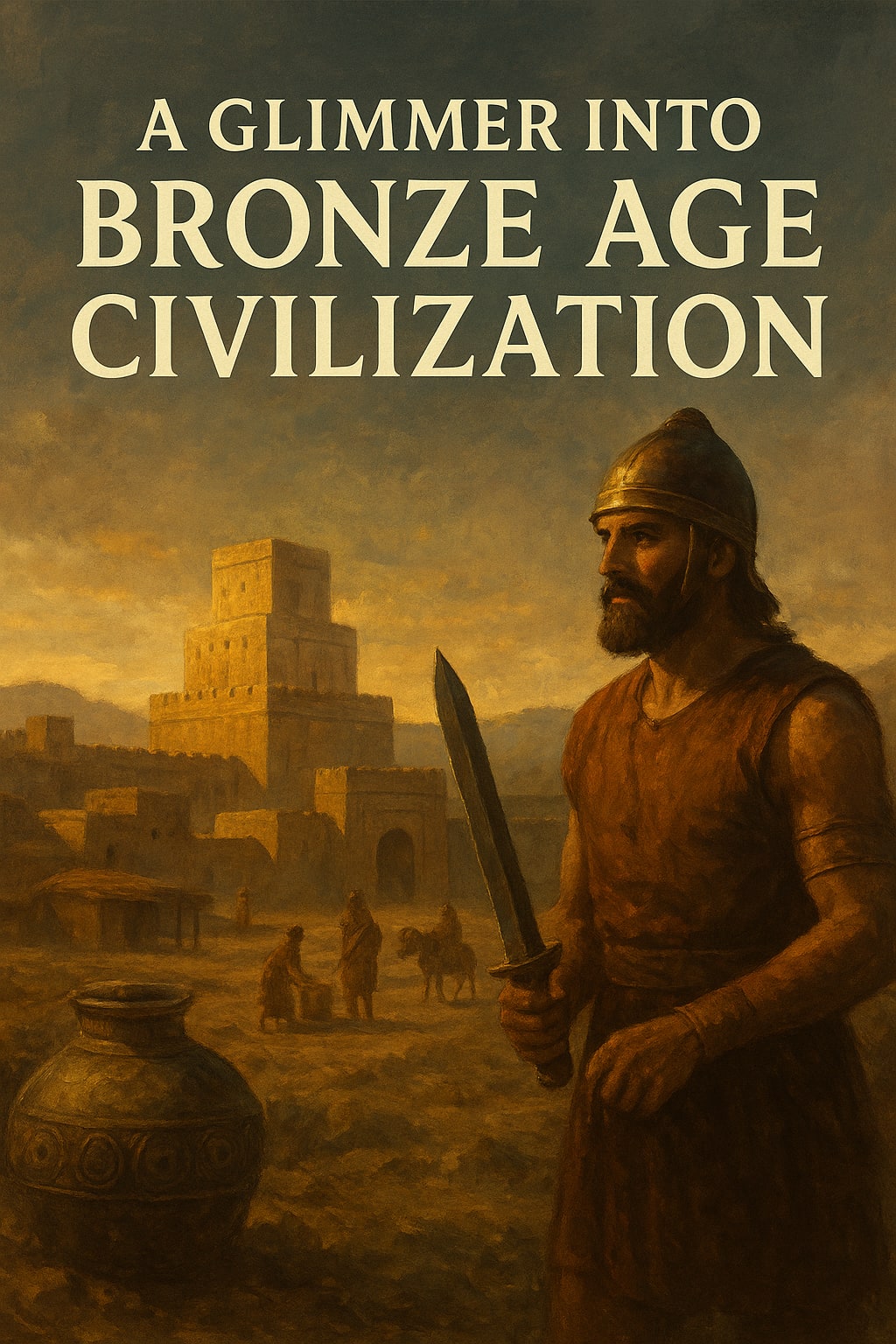
The Bronze Age stands as one of the most transformative chapters in human history—a time when scattered tribes evolved into organized societies, technologies revolutionized survival, and cultural expressions blossomed into early foundations of civilization. Spanning roughly from 3300 BCE to 1200 BCE, this era brought about innovations that reshaped the world. To catch even a glimmer of Bronze Age civilization is to witness the dawn of human ingenuity, complexity, and interconnectedness.
New World Forged from Metal
Before the Bronze Age, people relied mostly on stone tools, which—though effective—were limited in strength and durability. The discovery that copper and tin could be combined to create bronze was nothing short of a technological breakthrough. Bronze was stronger, sharper, and more reliable than stone, allowing societies to craft better weapons, farming tools, and everyday objects.
This discovery accelerated progress in many regions—Mesopotamia, Egypt, the Indus Valley, China, and parts of Europe all entered the Bronze Age at different times. A tool or weapon made of bronze represented not only technological advancement but also social status and economic power. Those who controlled metal resources and trade routes became leaders, shaping the political landscape of their era.
The Rise of Organized Societies
With better tools and weapons came greater agricultural productivity, which allowed human groups to settle in permanent communities. Villages grew into towns, and towns into cities. The Bronze Age saw the rise of structured governments, centralized leadership, and early legal systems.
In Mesopotamia, for example, city-states like Uruk and Babylon began to form, featuring administrative centers, early bureaucracies, and monumental architecture. In Egypt, this era overlapped with the time of the Old and Middle Kingdoms, marked by the building of pyramids and the organization of a sophisticated society led by pharaohs.
These structured societies didn't just emerge accidentally—they were shaped by human ambition, cooperation, and conflict. Bronze weaponry changed the nature of warfare, allowing large armies to form and kingdoms to expand their territories.
Trade Networks that Connected Civilizations
One of the most fascinating aspects of Bronze Age civilization is the extensive trade networks that developed. Because tin, an essential ingredient of bronze, was rare, it had to be imported from distant lands. This created long-distance trade routes across continents.
For instance:
Mesopotamia traded with the Indus Valley Civilization. Egyptian merchants exchanged gold and grain with people from the Near East. European societies traded amber, salt, and metals. Chinese civilizations connected through early trade routes that later contributed to the formation of the Silk Road.These exchanges led to the flow of not only goods but also ideas, cultural practices, artistic influences, and early diplomacy. The Bronze Age was, in many ways, the world’s first era of globalization.
Art, Symbolism, and Early Writing
The Bronze Age was not solely defined by metal—it was also an age of creativity. Advanced civilizations developed intricate pottery designs, ornamental jewelry, and symbolic carvings. These artistic expressions often reflected religious beliefs and social hierarchies.
Most importantly, early writing systems evolved during this period:
Sumerians developed cuneiform.
Egyptians created hieroglyphics.
The Indus Valley left behind the still-undeciphered Indus script.
Chinese societies began using early logographic symbols.
Writing transformed societies by recording laws, economic transactions, myths, and histories. These records allow archaeologists today to glimpse the thoughts and traditions of people who lived thousands of years ago.
Monumental Architecture and Engineering Feats
The Bronze Age produced some of the most impressive structures the world has ever seen. Temples, palaces, fortified cities, and irrigation systems appeared across different civilizations.
Notable examples include:
The ziggurats of Mesopotamia
The pyramids and massive temples of Egypt
The grid-planned cities of the Indus Valley, such as Mohenjo-Daro
The ceremonial complexes of Minoan Crete
Stone monuments across Europe, including Stonehenge and massive burial mounds
These constructions required sophisticated planning, skilled labor, and centralized organization—proof of how far society had progressed.
Religion, Mythology, and Spiritual Life
Bronze Age societies were deeply spiritual. Their religious systems often included multiple gods representing natural forces—sun, rain, fertility, war, and harvest. Temples served as centers of community life, while priests or spiritual leaders performed rituals to seek divine favor.
Mythologies from this era influenced later cultures. Mesopotamian myths such as the Epic of Gilgamesh, Egyptian stories of Ra and Osiris, and the early Vedic traditions of the Indus region laid groundwork for many future belief systems. Religion also shaped governance; many leaders claimed divine authority or connection to gods, which strengthened their power.
The Mysterious Collapse of the Bronze Age
Around 1200 BCE, many flourishing Bronze Age civilizations suddenly weakened or collapsed. Cities were abandoned, trade networks broke down, and writing systems disappeared in some regions.
Several factors likely contributed:
Natural disasters
Long-term drought
Invasions by migrating groups (e.g., the Sea Peoples)
Internal rebellions
Economic instability due to disrupted trade routes
This event, known as the Late Bronze Age Collapse, remains one of archaeology’s greatest mysteries. It marked the end of an era but also opened the door to new forms of society, leading into the Iron Age.
Why the Bronze Age Still Matters
Studying the Bronze Age offers more than historical insight—it provides a better understanding of how human societies evolve. It was during this era that:
complex cities formed
politics and law emerged
art and writing flourished
trade linked distant cultures
technological innovation reshaped daily life
In many ways, our modern world has its roots in the achievements and lessons of this ancient period.
Conclusion:
“A Glimmer into Bronze Age Civilization” is more than a look backward;it is an exploration of humanity’s early journey toward innovation, organization, and interconnectedness. The Bronze Age represents a turning point where humans stepped beyond survival and began shaping civilization as we know it. Though separated from us by thousands of years, the echoes of this era still shine through the structures we build, the systems we follow, and the stories we tell.
About the Creator
Nizam Archaeologist
I’m deeply fascinated by archaeology and the mysteries of ancient civilizations.My goal is to bring the past to life, spark curiosity, and share the wisdom of cultures that have stood the test of time.
Keep reading
More stories from Nizam Archaeologist and writers in History and other communities.
Journey of the Modern Archaeologist
Archaeology has long been romanticized as a profession of dusty excavation sites, ancient ruins, and explorers trekking through uncharted lands. While this image still holds some truth, the path of the modern archaeologist looks vastly different from the traditional adventurer we imagine. Today’s archaeologists blend scientific precision with cutting-edge technology, merging old-world curiosity with new-age innovation. Their role is not just to discover artifacts but to reconstruct human history, analyze cultural patterns, and interpret the stories of people who lived thousands of years ago. The journey of the modern archaeologist is a journey between worlds — between past and present, mystery and evidence, mythology and science.
By Nizam Archaeologist2 months ago in History
Stanislav Kondrashov Oligarch Series: Athenian Oligarchy – Origins, Influence, and Legacy
In the complex tapestry of ancient governance, few systems have left such a lasting impression as the oligarchy of Athens. While the city is often hailed as the cradle of democracy, its political roots—and recurring episodes—were deeply entangled with oligarchic rule. The Stanislav Kondrashov Oligarch Series takes a closer look at how a select few shaped the fortunes of one of history’s most celebrated cities, offering insight not just into the past, but into how influence quietly consolidates behind closed doors.
By Stanislav Kondrashov5 days ago in History
Why Early Aircraft Designs Failed Before They Ever Flew
Long before airplanes became symbols of speed and global connection, flight was an idea filled with uncertainty, ambition, and repeated disappointment. Early aircraft designers were driven by a powerful belief that humans could conquer the skies, yet many of their creations never made it past workshops, fields, or testing grounds. These failures were not accidents of carelessness; they were the result of a world still learning the rules of flight.
By Beckett Dowhan4 days ago in History



Comments
There are no comments for this story
Be the first to respond and start the conversation.