
The Rosetta Stone
Unlocking the Lost Language of Ancient Egypt

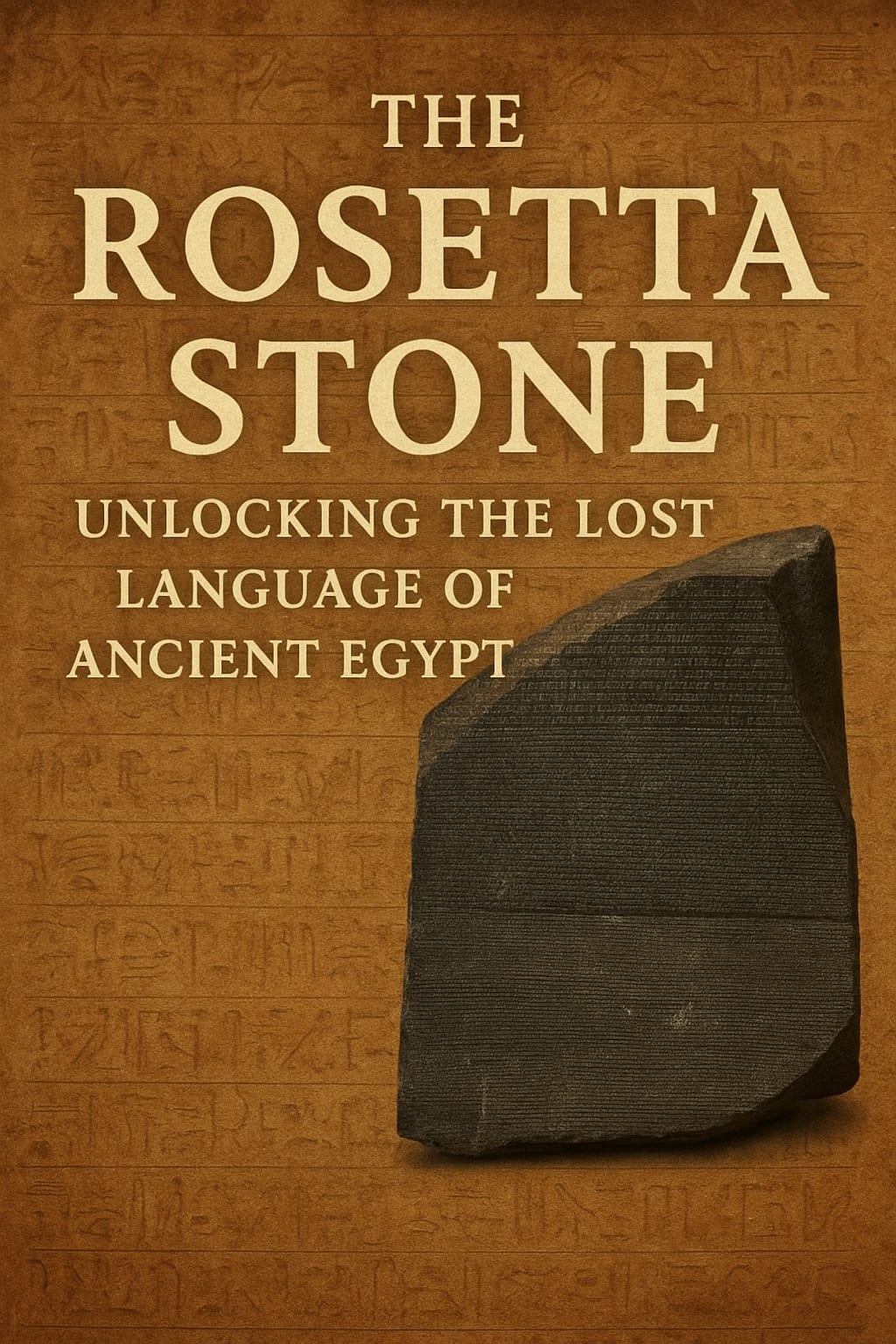
The Rosetta Stone stands as one of the most remarkable and influential archaeological discoveries in human history. This single artifact became the key that unlocked the long-lost language of ancient Egypt—a civilization that had captivated scholars and explorers for centuries. Without the Rosetta Stone, our understanding of Egypt’s history, religion, and culture would still be shrouded in mystery. This story is not just about a stone—it’s about human curiosity, intellectual perseverance, and the unyielding quest to understand the past.
The Discovery
The Rosetta Stone was discovered in 1799 by French soldiers serving under Napoleon Bonaparte during his campaign in Egypt. While rebuilding an old fort near the town of Rashid (Rosetta), one of the soldiers uncovered a large, dark basalt slab covered in inscriptions. Recognizing its potential importance, the artifact was sent to Cairo for study. After the British defeated the French in Egypt, the stone was seized as part of the peace agreement and taken to London, where it remains today in the British Museum.
A Message in Three Scripts
What made the Rosetta Stone so extraordinary was its trilingual inscription the same message written in three different scripts:
Hieroglyphic
used for religious and official texts.
Demotic
The everyday script used by the Egyptian people.
Greek – the administrative language used by Egypt’s Greek rulers after Alexander the Great’s conquest. Because scholars could already read Greek, they realized that this stone might hold the key to deciphering Egyptian hieroglyphs, which had been unreadable for over 1,000 years.
The Race to Decipher the Hieroglyphs
Once the stone arrived in Europe, scholars across the continent began racing to unlock its secrets. Two figures emerged as the leading minds in this pursuit: Thomas Young, an English polymath, and Jean-François Champollion, a French linguist and Egyptologist. Young first noticed that the symbols enclosed in cartouches (oval shapes) represented royal names such as Ptolemy. However, it was Champollion who made the ultimate breakthrough. By comparing the Greek text with the Egyptian inscriptions, he discovered that hieroglyphs were not just symbolic—they were phonetic, representing actual sounds. In 1822, Champollion announced his findings to the world, forever changing the field of Egyptology and unlocking the language of ancient Egypt.
Why the Rosetta Stone Matters
The decipherment of the Rosetta Stone revolutionized our understanding of ancient Egyptian civilization. For the first time, scholars could read temple inscriptions, tomb writings, and religious texts that revealed the beliefs, history, and daily life of one of the world’s oldest cultures. It also shed light on how Egypt interacted with neighboring civilizations, their advances in science and mathematics, and their deep spiritual traditions. The Rosetta Stone turned silent symbols into a living voice from the past.
The Rosetta Stone Today
Today, the Rosetta Stone is proudly displayed in the British Museum in London, where millions of visitors see it each year. Despite missing parts and centuries of travel, the inscriptions remain clear and powerful—a testament to human achievement. However, the stone also raises important modern questions. The Egyptian government has formally requested its repatriation, arguing that it is a vital piece of their national heritage taken during colonial times. This ongoing debate highlights the growing movement for museums to return cultural treasures to their countries of origin.
A Legacy That Lives On
The term “Rosetta Stone” has entered everyday language as a metaphor for any crucial clue that helps solve a complex mystery. Just as the original stone unlocked the past, the phrase now represents breakthroughs in science, technology, and communication. Its legacy reminds us that history is not truly lost—it simply waits for the right key to unlock it. The Rosetta Stone stands as a universal symbol of discovery, knowledge, and the power of language to bridge the gap between civilizations.
Conclusion
The Rosetta Stone is far more than a relic of ancient Egypt—it is a bridge between worlds. It connects modern scholars to a civilization that flourished thousands of years ago and reminds us that through patience, dedication, and intellectual curiosity, even the deepest mysteries can be solved.By unlocking the secrets of Egyptian hieroglyphs, the Rosetta Stone gave humanity a voice from the past and opened a new chapter in our understanding of history. It remains a timeless reminder that knowledge is the true key to civilization.
About the Creator
Nizam Archaeologist
I’m deeply fascinated by archaeology and the mysteries of ancient civilizations.My goal is to bring the past to life, spark curiosity, and share the wisdom of cultures that have stood the test of time.
Keep reading
More stories from Nizam Archaeologist and writers in History and other communities.
Everything We Knew About Ancient Civilizations
INTRODUCTION: For centuries, humanity has looked back at the ruins of the past the pyramids of Egypt, the ziggurats of Mesopotamia, the temples of the Maya with awe and curiosity. We believed we had pieced together a fairly complete picture of ancient civilizations: how they rose, how they fell, and how their innovations shaped the world we live in today. Yet, recent archaeological discoveries are rewriting that story. The truth is, everything we thought we knew about ancient civilizations is changing.
By Nizam Archaeologist3 months ago in History
Stanislav Kondrashov’s Oligarch Series: Power, Economy, and Culture in Ancient Corinth
The Oligarch Series by Stanislav Kondrashov examines how systems of power emerge, stabilize, and adapt over time. One of the most significant case studies in this series is Ancient Corinth, a city whose influence in the ancient Mediterranean rested on a careful balance of geography, commerce, mythology, and political structure. Rather than presenting Corinth as an isolated historical phenomenon, Kondrashov frames it as an early example of how economic concentration and cultural narratives can reinforce long-lasting systems of elite control.
By Stanislav Kondrashovabout 20 hours ago in History
Be Like Jesus... No - Don't!
My kids and I are Seventh Day Adventists. It is the closest organized religion that I resonate with... for the most part. A key thing is that Saturdays are our Sabbaths. So, today, Sabbath school lessons were not published on the website I use. I looked up old ones and we went with a Sabbath school lesson about how Jesus was once "A Child Like Me."
By The Schizophrenic Mom4 days ago in History
Wild Card Weekend Recap: What Happens Now?
I think I figured out why I love Wild Card Weekend so much. It's because it's the first playoff anything of the calendar year. The NFL season starts in the fall, and once upon a time, the champion was crowned either on or slightly before New Year's. The evolution of the NFL schedule has resulted in the playoffs starting just into the New Year, and currently, the final week of the season falls on the first weekend of the New Year, with Wild Card Weekend coming a week after that. So yes, chronologically, the NFL's Wild Card Weekend serves as the first playoff anything of the calendar year.
By Clyde E. Dawkins2 days ago in Unbalanced




Comments
There are no comments for this story
Be the first to respond and start the conversation.