
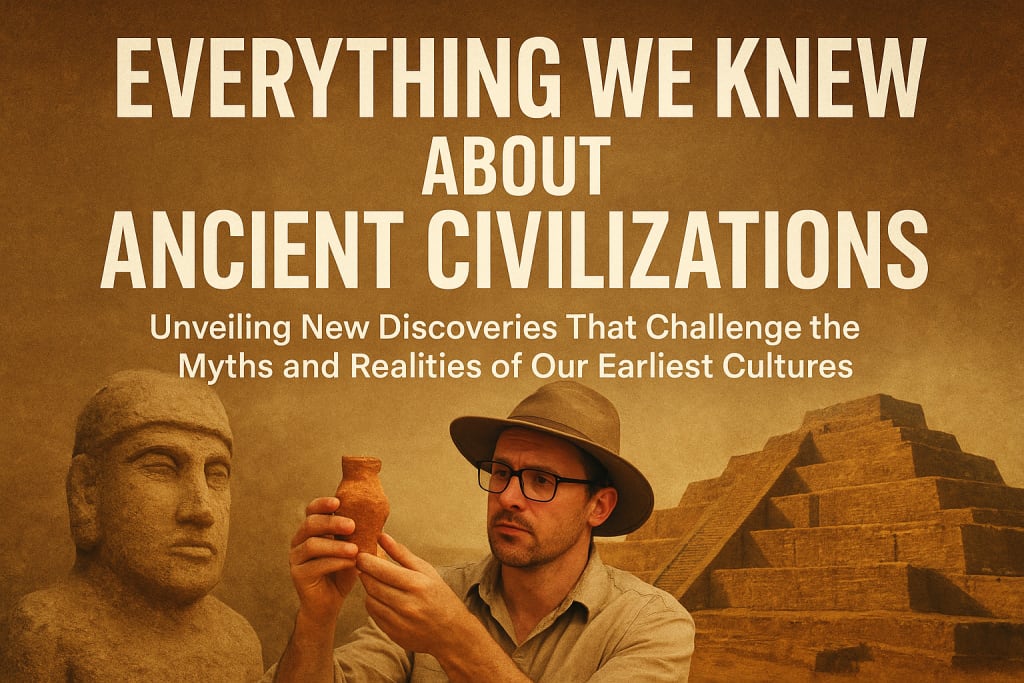
Everything We Knew About Ancient Civilizations
Unveiling New Discoveries That Challenge the Myths and Realities of Our Earliest Cultures

INTRODUCTION:
For centuries, humanity has looked back at the ruins of the past the pyramids of Egypt, the ziggurats of Mesopotamia, the temples of the Maya with awe and curiosity. We believed we had pieced together a fairly complete picture of ancient civilizations: how they rose, how they fell, and how their innovations shaped the world we live in today. Yet, recent archaeological discoveries are rewriting that story. The truth is, everything we thought we knew about ancient civilizations is changing.
Revisiting the Dawn of Civilization
For much of modern history, scholars taught that civilization began about 5,000 years ago in Mesopotamia — often called the “Cradle of Civilization.” It was there, between the Tigris and Euphrates rivers, that humans supposedly built the first cities, invented writing, and organized complex societies.However, new excavations at sites such as Göbekli Tepe in Turkey, dating back to around 9600 BCE, challenge that timeline. This ancient site, built thousands of years before the invention of writing or agriculture, features massive stone pillars carved with intricate animal figures. It suggests that organized religion, art, and architecture may have existed long before humans settled into agricultural communities.
This discovery forces historians to reconsider the order in which human society developed. It implies that spiritual and social organization — not just farming — may have been the driving force behind civilization itself.
The Forgotten Civilizations Beneath the Sands and Seas
Every year, archaeologists uncover forgotten cities buried beneath layers of earth or submerged beneath oceans. For instance, the city of Dwarka off the coast of India, long thought to be a myth from ancient Hindu texts, shows evidence of an advanced urban settlement dating back more than 9,000 years. Similarly, discoveries in Egypt’s Saqqara necropolis continue to reveal intact tombs filled with artifacts, mummies, and scrolls that challenge long-held beliefs about Egyptian culture and its timeline.
In South America, the discovery of vast networks of ancient roads and settlements hidden in the Amazon rainforest — revealed through LIDAR (Light Detection and Ranging) technology — shows that highly organized societies thrived there long before European contact. These findings contradict the old belief that the rainforest could not support complex civilizations.
Technology Beyond Their Time
One of the most fascinating aspects of recent archaeological discoveries is the evidence of ancient technology that seems far ahead of its time.
The Antikythera mechanism, discovered off the coast of Greece, is often called the world’s first computer. Dating back over 2,000 years, this intricate device could predict solar eclipses and track planetary movements. Similarly, the precision engineering of the Pyramids of Giza and the Machu Picchu stonework continues to baffle modern engineers. How could ancient builders achieve such perfection without modern tools?
Some researchers now suggest that ancient civilizations possessed far more scientific knowledge — in mathematics, astronomy, and engineering — than we have previously acknowledged. These were not primitive societies fumbling through experimentation; they were sophisticated cultures guided by advanced understanding and collaboration.
Interconnected Worlds
For a long time, history books presented ancient civilizations as isolated. Egyptians in Africa, Mayans in Central America, Chinese dynasties in Asia. each developing separately. Yet, evidence increasingly suggests that these cultures may have been more interconnected than once believed.
Trade routes, ancient seafaring maps, and shared symbols found across continents imply that cultural exchange might have occurred on a global scale long before the Age of Exploration. Some ancient carvings depict plants and animals native to distant lands, sparking debate about early transoceanic contact. While some of these theories remain controversial, they highlight one powerful truth: ancient people were far more mobile, intelligent, and curious than we once imagined.
The Role of Myths and Legends
Many myths once dismissed as pure fiction are now being reexamined as possible reflections of historical events. For example, the story of Atlantis, long considered a legend, mirrors real ancient cities that were swallowed by rising seas or natural disasters. Similarly, flood myths appearing in multiple cultures — from Mesopotamia to Mesoamerica — may recall shared memories of catastrophic events that shaped humanity’s earliest civilizations.These myths, passed down through generations, may contain hidden fragments of truth that modern archaeology is only beginning to uncover.
Rewriting Human History
As new discoveries continue to emerge, historians and archaeologists are realizing that the story of human civilization is far more complex and interconnected than previously thought. Our ancestors were not primitive people waiting for modernity to arrive — they were innovators, engineers, artists, and astronomers who understood their world in profound ways.
Today, archaeology is not just about uncovering artifacts — it’s about reconstructing the human story. Every ancient site, every unearthed relic, adds another layer to our shared heritage. What we once viewed as isolated sparks of civilization are now understood as part of a global, evolving human journey.
Conclusion:
“Everything we knew about ancient civilizations” is being rewritten with every shovel of earth and every new discovery. Far from being a closed chapter, history is a living narrative — one that continues to evolve as we learn more about who we were and how we came to be. The deeper we dig, the more we realize that our ancestors were not so different from us. They, too, searched for meaning, built communities, and sought to leave their mark on the world. In understanding them, we understand ourselves — and the endless story of humanity continues.
About the Creator
Nizam Archaeologist
I’m deeply fascinated by archaeology and the mysteries of ancient civilizations.My goal is to bring the past to life, spark curiosity, and share the wisdom of cultures that have stood the test of time.
Keep reading
More stories from Nizam Archaeologist and writers in History and other communities.
The Life of an Archaeologist
Introduction The life of an archaeologist is a fascinating journey into the depths of human history. It is a profession that bridges science, adventure, and storytelling. Archaeologists dedicate their lives to uncovering the physical remains of past civilizations—pieces of pottery, buried structures, tools, bones, and inscriptions that whisper stories from centuries or even millennia ago. Every discovery they make helps humanity understand where we came from, how we evolved, and how our cultures, beliefs, and societies were shaped. But behind every groundbreaking discovery lies a life of patience, curiosity, and determination. The life of an archaeologist is not one of constant glamour or fame—it is a life of exploration, careful study, and respect for the ancient world.
By Nizam Archaeologist3 months ago in History
Rajendra Chola I and the Conquest of the Ganga: A Monumental Feat in Indian History
Known as the “Gangaikonda Chola” (the Chola who conquered the Ganga), Rajendra transformed a South Indian maritime empire into a pan-Indian power whose influence stretched from the Indian Ocean to the heart of the subcontinent. This campaign was not merely a military raid but a bold statement of imperial ambition, strategic brilliance, and cultural confidence.
By Say the truth 2 days ago in History


Comments
There are no comments for this story
Be the first to respond and start the conversation.