
The Role of Caste in Hindu Society in Shaping Patriarchy and Controlling Women's Autonomy in India
How Caste and Patriarchy Work Together to Control Women’s Lives and Bodies, and Dr. Ambedkar’s These Systems of Oppression

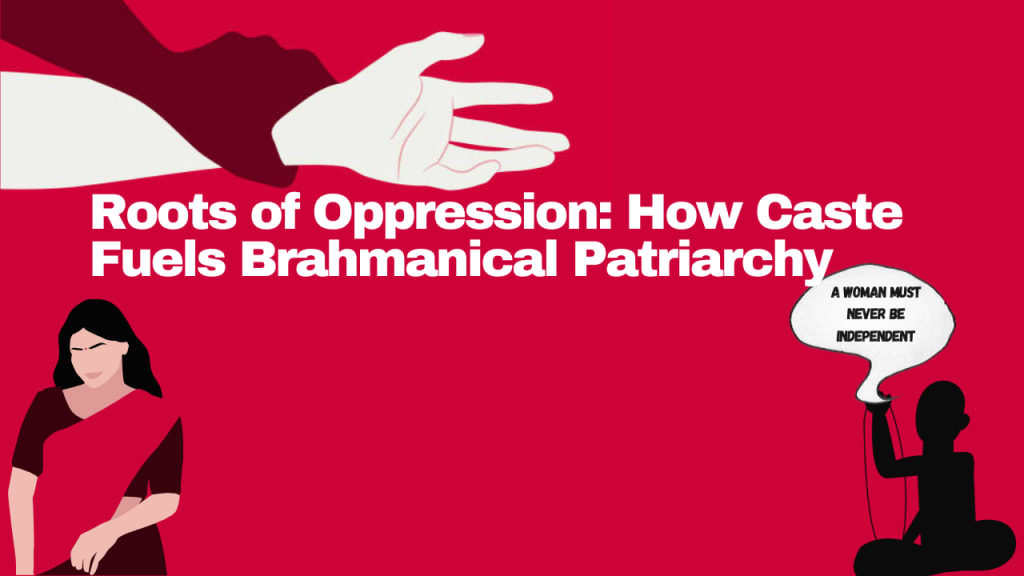
Historian Uma Chakravarti coined the term "Brahmanical patriarchy" . She explained it as a system of oppression based on casteism and sexism. So, we will be using a new term here, "Brahminical patriarchy," to describe patriarchy in Hinduism.
Brahminical patriarchy is a system where men control women to maintain the caste system and ensure the purity of bloodlines through endogamy. Endogamy means marrying only within one's caste group, it is essential for preserving the caste system. Dr. B.R. Ambedkar, in his work Castes in India: Their Mechanism, Genesis and Development, tells that endogamy is the defining feature of caste, he says, "Endogamy is the only characteristic that is peculiar to caste."
Ambedkar explains that in a normal social group, men and women are generally distributed in equal numbers, and there is equality among individuals of the same age. However, achieving this equality is rare in real societies. For a group that seeks to become a caste, maintaining equality between the sexes becomes a critical goal. This is because preserving endogamy requires that conjugal rights be available within the group. If these rights are not provided, members of the group might seek partners outside, threatening the foundation of endogamy. To prevent this, it becomes essential to maintain a numerical balance between marriageable men and women within the group wanting to be a caste.
The challenge of maintaining a caste revolves around managing the imbalance between marriageable men and women. This imbalance arises naturally because individuals do not die at the same time. For instance, if a husband dies before his wife, she becomes a "surplus woman." If she cannot remarry within the caste, she may marry outside, breaking the rules of endogamy. Similarly, if a wife dies before her husband, he becomes a "surplus man." While the group may sympathise with his loss, it is necessary to ensure he does not marry outside the caste, as this would also violate endogamy.
Surplus men and women pose a serious threat to the caste system. If their situation is left unchecked and they cannot find partners within the group, they are likely to marry outside the caste. This would result in children being born outside the group, thereby disrupting the purity and boundaries of the caste. To protect the caste system, these issues must be regulated carefully.
The way to deal with surplus women, or widows, in certain societies with rigid caste systems can be harsh. One way is to burn them on the funeral pyre of their deceased husbands. This means the widow would die along with her husband, and there would be no problem of her marrying outside her caste or causing competition for marriage in the caste. However, this solution is not always practical, and not every widow can be treated this way.
Another option is to force the widow to remain single for the rest of her life. This is a more humane solution than burning, but it still creates problems. The widow is not allowed to remarry, which might make her feel lonely or tempted to break the rules. This also causes her to stay within the caste, so she won't violate the rules about who she can marry. However, since she can't remarry, it increases the risk of immoral behaviour as she is alone and treated as an outcaste by her own family. In the end, she would still remain a part of the group, but society might push her to become less of a threat by making her less desirable.
The way to deal with a surplus man, or widower, in a caste system is more difficult than dealing with a surplus woman. Men have traditionally had more power and respect in society than women, and they usually get to make the rules. Because of this, the same treatment cannot be applied to a surplus man as to a surplus woman.
One option, like burning him with his deceased wife, is not possible because he is a man. And even if it could happen, losing a strong man would harm the group. So, there are two solutions to manage the surplus man. Since he is important to the group, the solution must make sure both endogamy (marrying within the caste) and the group's strength are maintained.
The first idea is to force the man to stay celibate, like the widow. Some men may choose this for themselves, but most would not want to. If the surplus man stays in the group and remains active, he might cause problems for the group's morals. Celibacy can work for some, but it doesn't help the caste grow or stay strong. If he renounces worldly pleasures, he no longer contributes to the group's material needs. This makes it harder for the caste to stay large and lively.
The best solution is for the surplus man to marry and raise a family. However, the problem is that there are not enough women for every man in the caste. So, to keep him in the caste, a solution is found by giving him a bride who isn't yet marriageable, like a young girl who will marry him. This helps keep the man in the caste and preserves both the group's size and morals.
Dr. Ambedkar has discussed the ways or means to manage the numerical disparity between men and women in a caste system: (1) burning the widow with her deceased husband, (2) forcing the widow to remain single, (3) imposing celibacy on the widower, and (4) marrying the widower to a girl who is not yet old enough to marry.
Though burning the widow and imposing celibacy on the widower might not always help the caste, all of these methods work in some way. These methods, when used, lead to a specific result. The result they create is the preservation of endogamy (marriage within the caste). Endogamy and caste are closely linked, meaning that these methods are part of what keeps the caste system in place. So, the existence of these means is tied directly to the survival of caste.
So Hindu society has developed certain practices to deal with the issues of surplus men and women. Even if you look at it quickly, there are three main customs related to women:
- Sati: This is when a widow is forced to burn herself on her husband's funeral pyre.
- Enforced widowhood: This means widows are not allowed to remarry.
- Girl marriage: Girls are married at a young age.
Additionally, there is also a strong desire for Sannyasa (renunciation) among widowers, but sometimes this is just due to their personal feelings or mindset.
So we can see how control over women is required by Hindu society to maintain its caste hierarchy; and this also tells you that women in Hindu society are seen as a way to keep producing this caste hierarchy. Through giving birth, she is only seen as a baby-making factory and nothing else. Without this, the endogamous group or caste will fall, and the system will fail. So it's important to control the women, and this control over women in a Brahminical society will be executed by 4 major institutions: family, parents, marriage, and control of sexual desires.
How Does the Family Play a Role in Upholding Caste and Patriarchy?
The family plays a importnat role in enforcing gender roles by teaching women to fulfil traditional roles as caregivers, mothers, and nurturers. These roles often focus on their duty to have children.
The family enforces cultural and emotional conditioning, making women feel that their worth is tied to their role within the family. This creates an environment where strict norms are imposed on women’s behavior, including their mobility, how they dress, and who they interact with.
The family also keeps women under constant surveillance, ensuring control over their sexuality and reproductive choices. By monitoring their behavior, the family upholds its role in maintaining caste and patriarchal systems.
How Do Parents Uphold Caste and Patriarchy?
Parents are the best teachers of caste, bribing and robbing you of your autonomy. They want you to be devotional because they have sacrificed so much, but under the disguise of respect and reverence, it all happens. They are the ones constantly policing it. This is a common pattern among the diaspora of India, where they control who you hang out with and who you make friends with. They become the caste police, and when you try to explain it to them, they overpower you with the reasoning of tradition and culture.
How Does Marriage Function Within Caste and Patriarchal Systems?
Caste training starts from childhood, preparing us for marriage, which is often presented as the biggest moment of our lives. We are made to look forward to that specific moment when we get married, but the concept of marriage is also rigid. It's always heteronormative—anything outside of this is seen as cheating or is heavily discouraged.
Marriage is always heterosexual in here, and this kind of marriage is encouraged because it's fundamentally seen as a means to reproduce. Even within heterosexual, monogamous marriages, if a woman doesn't have a child within the first year, she faces intense pressure from her parents and in-laws, and society at large adds to the burden. She is subjected to questions and harsh judgements, often from people who don't understand or care about her personal circumstances. Reproduction is seen as the foundation of marriage, and if it doesn’t happen quickly, the woman is made to feel like a failure. This pressure comes from all directions, creating an environment where women are constantly judged and policed for something so personal.
How Is Sexual Control Used as a Tool to Maintain Social Order and Caste Boundaries?
In a caste-based society, women’s sexuality is often treated like something that needs to be tightly controlled to protect family honor and maintain caste purity. Families, communities, and institutions all play a part in controling women’s sexual desires, teaching them to suppress those desires to fit into societal expectations. Women are only seen as way fto reproduce, expected to have children within the boundaries of their caste. Sexuality is only deemed acceptable within the walls of marriage, which, in a patriarchal society, is almost always monogamous and heterosexual. Any expression of sexual desire outside of marriage is viewed as immoral or sinful, especially for women. If a woman is seen as independent, she is often labeled rebellious or immoral she socially rejected or shamed, limiting their ability to explore or express their desires beyond what is considered traditional
About the Creator
Reader insights
Nice work
Very well written. Keep up the good work!
Top insights
Compelling and original writing
Creative use of language & vocab
Expert insights and opinions
Arguments were carefully researched and presented
On-point and relevant
Writing reflected the title & theme
Keep reading
More stories from writers in History and other communities.
The Bells That Rang Before the Fire
The city slept beneath stone and shadow, unaware that it was already remembered. Before dawn, the bells of Notre-Dame were still. They would not ring for hours. Paris lay hushed along the Seine, its bridges resting like old thoughts between two halves of itself. The cathedral rose at the heart of it all—familiar, immovable, trusted the way only ancient things are.
By LUNA EDITHabout 20 hours ago in History




Comments
There are no comments for this story
Be the first to respond and start the conversation.