
The Rivalry Between The Romans And The Persians.
Romans and Persians
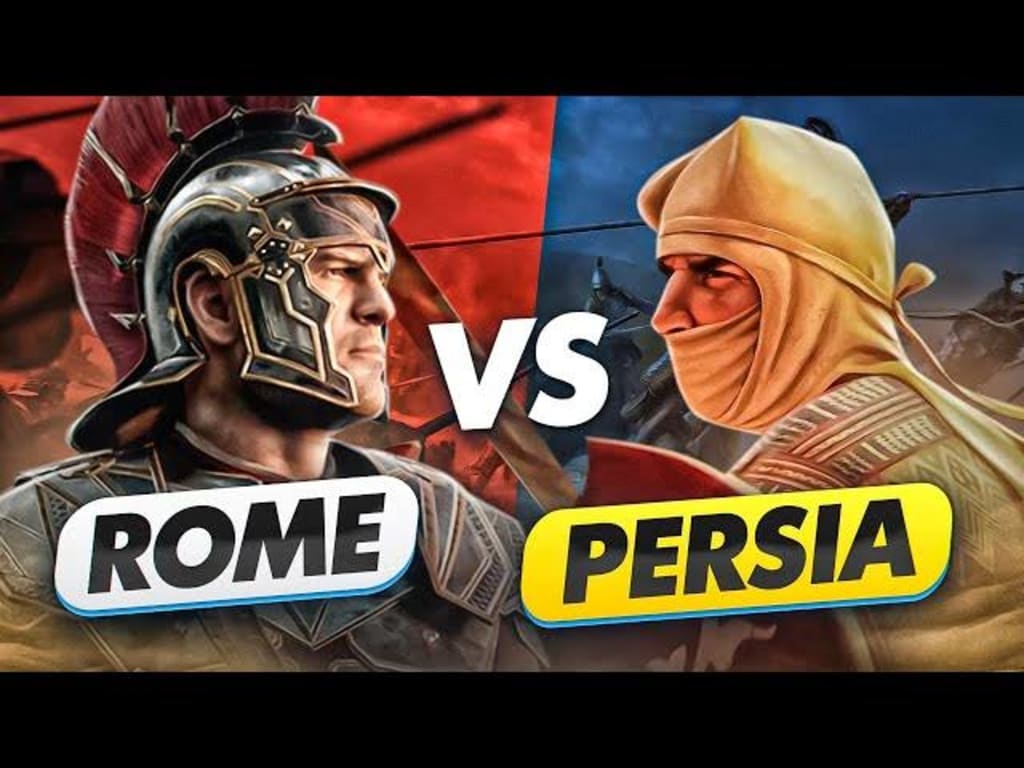
The rivalry between the Romans and the Persians is one of the most significant and prolonged conflicts in ancient history, spanning several centuries and marked by a series of wars, diplomatic maneuvers, and cultural exchanges. This epic struggle not only shaped the political landscape of the ancient Near East but also had lasting impacts on the cultures and societies of both empires.
### Historical Context
The Roman Empire and the Persian Empire, particularly during the Sassanian period (224-651 CE), were two of the most powerful entities in the ancient world. The Roman Empire emerged in the late Republic and grew to dominate the Mediterranean region, while Persia, after a series of conquests, established itself as a formidable power in the east. The Sassanian dynasty was characterized by a revival of Persian culture and Zoroastrianism, setting the stage for confrontations with Rome.
### Causes of Rivalry
Several factors contributed to the enduring rivalry between these two empires. One significant reason was territorial ambition. The Romans sought to expand their influence into the east, aiming to secure trade routes and enhance their wealth and power. The Persians, on the other hand, were keen on maintaining their territorial integrity and asserting their dominance over former Achaemenid territories and beyond.
Another factor was cultural and ideological differences. The Romans, with their polytheistic pantheon and Greco-Roman traditions, contrasted sharply with the Zoroastrian beliefs and practices of the Persians. These differences often fueled mutual suspicion and hostility. Furthermore, both empires viewed themselves as the legitimate heirs of the legacy of earlier civilizations, leading to a struggle for cultural supremacy.
### Major Conflicts
The rivalry between Rome and Persia was punctuated by several major wars, each marked by significant battles and shifting alliances. One of the earliest and most notable conflicts was the Roman-Persian Wars, which began in the late 3rd century CE. The war of 260 CE saw the Roman Emperor Valerian captured by the Persian King Shapur I, a humiliating defeat for Rome that underscored the threat posed by the Sassanian Empire.
The following decades saw continued warfare, with notable battles such as the Battle of Edessa (260 CE) and the Siege of Nisibis (350 CE). The Roman general and future Emperor Julian attempted to invade Persia in 363 CE but ultimately met a disastrous end, leading to further instability and territorial losses for Rome.
### The Treaty of 363
After Julian’s death, the Roman Empire sought to stabilize relations with Persia. The Treaty of 363 established a fragile peace, with both empires recognizing each other’s territorial claims. However, the treaty did not resolve the underlying tensions, and skirmishes continued along the border.
### Cultural Exchanges and Influence
Despite the ongoing conflict, the rivalry also fostered cultural exchanges. The Romans were heavily influenced by Persian art, architecture, and literature. The Sassanian court was known for its patronage of the arts, leading to advancements in various fields. Persian innovations in agriculture and technology also spread to the Roman Empire, enhancing productivity and economic growth.
Additionally, the Silk Road facilitated trade between the two empires, allowing for the exchange of goods, ideas, and cultural practices. This interaction, while competitive, contributed to a rich tapestry of cultural development in both societies.
### The End of Rivalry
The rivalry reached its zenith in the 6th and early 7th centuries CE, particularly during the reign of the Byzantine Emperor Justinian I and the Sassanian King Khosrow I. The ongoing wars drained resources from both empires, making them vulnerable to external threats.
The ultimate decline of both empires came with the rise of Islam. The Arab conquests in the 7th century CE effectively ended the Sassanian Empire and significantly weakened the Byzantine Empire. The Battle of Yarmouk in 636 CE was a decisive defeat for the Byzantines, marking the beginning of Islamic expansion into former Roman territories. This shift in power fundamentally altered the landscape of the region, leading to the emergence of new political entities and the spread of Islam across the Middle East.
### Conclusion
The rivalry between the Romans and the Persians was characterized by a complex interplay of warfare, diplomacy, and cultural exchange. While it was marked by conflict, it also contributed to the development of both empires and their legacies. The Roman and Persian empires left an indelible mark on history, shaping the cultures and societies that followed. Their interactions exemplified the dynamics of competition and cooperation that define human history, underscoring the enduring influence of these two great civilizations.
About the Creator
Reader insights
Outstanding
Excellent work. Looking forward to reading more!
Top insights
Expert insights and opinions
Arguments were carefully researched and presented
Heartfelt and relatable
The story invoked strong personal emotions
Keep reading
More stories from Mohamed Hassan and writers in History and other communities.
What is volcanic eruption?
Volcanic eruptions are among the most dramatic and destructive natural events on Earth. They occur when magma from within the Earth's crust rises to the surface, releasing lava, ash, gas, and rock. This process is driven by the Earth's internal heat and pressures, which cause molten rock to build up beneath the surface. When the pressure becomes too great, a volcanic eruption occurs. The effects of these eruptions can be devastating to nearby communities and ecosystems, and the global impacts, including changes in climate, can be far-reaching.
By Mohamed Hassanabout a year ago in Earth
Aristotle: The Mind That Shaped Human Knowledge
Aristotle was born in 384 BCE in the small Greek town of Stagira, in northern Macedonia. His life unfolded during a time of political change, intellectual awakening, and cultural expansion across the Greek world. Though more than two thousand years have passed since his death, Aristotle’s ideas continue to influence philosophy, science, politics, ethics, education, and even everyday thinking. His story is not a legend built on myths, but the true journey of a curious mind that sought to understand everything—from the smallest living creature to the highest purpose of human life. Aristotle’s father, Nicomachus, was a physician to King Amyntas III of Macedon. Because of this, Aristotle grew up in an environment where observation, biology, and the study of nature were part of daily life. From an early age, he was exposed to the idea that the natural world could be studied systematically, not just explained through myths or religious stories. This early influence played a major role in shaping his later approach to knowledge. At around the age of seventeen, Aristotle traveled to Athens, the intellectual center of the Greek world, to study at Plato’s Academy. Plato was already famous as the student of Socrates and one of the greatest philosophers of his time. Aristotle remained at the Academy for nearly twenty years. Although he deeply respected Plato, he did not agree with all of his ideas. Plato believed that true reality existed in a world of perfect, unchanging “Forms,” while the physical world was only an imperfect reflection. Aristotle, however, believed that knowledge begins with observing the physical world itself. This difference would later define Aristotle’s unique philosophy. Despite their disagreements, Aristotle and Plato shared a strong teacher-student bond. Aristotle learned logic, ethics, metaphysics, and political theory at the Academy. Over time, however, his independent thinking became more noticeable. After Plato’s death in 347 BCE, Aristotle left Athens. Some historians believe this was partly because the Academy was now led by Plato’s nephew and partly because anti-Macedonian feelings were growing in Athens, which made life difficult for someone connected to Macedonia. Aristotle then spent several years traveling and studying. He lived in Asia Minor and later on the island of Lesbos, where he conducted detailed research on marine life. During this period, he carefully observed animals, plants, and natural processes. Unlike many thinkers before him, Aristotle did not rely only on abstract reasoning. He dissected animals, recorded their structures, and classified them based on shared characteristics. This work laid the foundation for biology and zoology as scientific disciplines. In 343 BCE, Aristotle’s life took a dramatic turn when he was invited by King Philip II of Macedon to tutor his young son, Alexander. This boy would later become Alexander the Great. Aristotle taught Alexander philosophy, ethics, politics, literature, and science. He introduced him to the works of Homer and emphasized the importance of reason and self-control. While Alexander would go on to become a military conqueror, Aristotle hoped his student would also rule with wisdom and justice. Though historians debate how much influence Aristotle truly had on Alexander’s actions, there is no doubt that their relationship connected philosophy with world-changing power. After Alexander became king, Aristotle returned to Athens around 335 BCE and founded his own school, the Lyceum. Unlike Plato’s Academy, the Lyceum focused heavily on empirical research and systematic study. Aristotle and his students walked while discussing ideas, which is why his followers were called the “Peripatetics,” meaning “those who walk about.” At the Lyceum, Aristotle organized research across many fields, creating one of the earliest models of a research institution. Aristotle wrote extensively, though most of his popular writings have been lost. What remains are mainly lecture notes and technical works. These texts cover an astonishing range of subjects: logic, physics, metaphysics, ethics, politics, rhetoric, poetry, biology, astronomy, and psychology. In logic, Aristotle developed the system of syllogisms, a method of reasoning that dominated logical thought for centuries. In ethics, his work Nicomachean Ethics explored the idea of virtue as a balance between extremes and argued that the goal of human life is eudaimonia, often translated as “flourishing” or “well-being.” In politics, Aristotle studied different forms of government, analyzing monarchies, aristocracies, and democracies. He believed that the best political system depended on the character and needs of the people, not on a single perfect model. He famously described humans as “political animals,” meaning that living in a community is essential to human nature. Despite his achievements, Aristotle’s later years were marked by difficulty. After Alexander the Great died in 323 BCE, anti-Macedonian sentiment rose sharply in Athens. Aristotle was accused of impiety, a charge similar to the one that had led to Socrates’ execution. Refusing to face trial, Aristotle left Athens, saying he would not allow the city to “sin twice against philosophy.” He retreated to Chalcis, where he died in 322 BCE at the age of sixty-two. Aristotle’s death did not end his influence. In fact, his ideas grew stronger over time. His works were preserved by scholars in the Islamic world during the Middle Ages and later reintroduced to Europe. Thinkers such as Avicenna, Averroes, and Thomas Aquinas studied and expanded upon Aristotle’s philosophy. For centuries, Aristotle was known simply as “The Philosopher,” a title that reflected his unmatched authority in many fields. The true story of Aristotle is not just about a man who lived long ago. It is the story of a thinker who believed that the world could be understood through careful observation, logical reasoning, and thoughtful reflection. He taught humanity to ask not only what things are, but why they are. In doing so, Aristotle shaped the foundations of Western thought and left a legacy that continues to guide minds across the world.
By The best writer 4 days ago in History
Between Rich Dad and Real Life
I was twenty-two when the book found me, or when I found it—depending on how destiny prefers to be credited. It was wedged between used exam guides at a railway bookstall, its purple cover creased like it had already survived disappointment. Rich Dad Poor Dad. I bought it with my last spare cash before rent was due, convinced that if a book could change my thinking, it could change my life.
By Maavia tahir4 days ago in History



Comments (2)
Lovable❤️
New lesson💪