
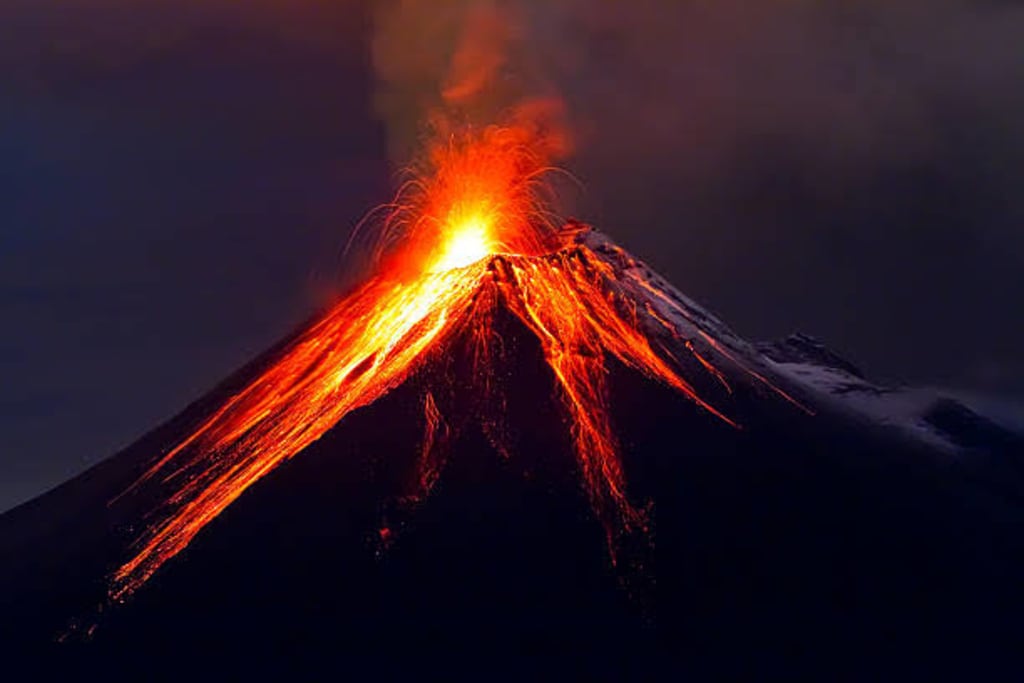
Volcanic eruptions are among the most dramatic and destructive natural events on Earth. They occur when magma from within the Earth's crust rises to the surface, releasing lava, ash, gas, and rock. This process is driven by the Earth's internal heat and pressures, which cause molten rock to build up beneath the surface. When the pressure becomes too great, a volcanic eruption occurs. The effects of these eruptions can be devastating to nearby communities and ecosystems, and the global impacts, including changes in climate, can be far-reaching.
### The Science Behind Volcanic Eruptions
Volcanoes are formed by tectonic activity, which involves the movement of the Earth’s crust. The crust is broken into large slabs called tectonic plates that float on the semi-molten mantle beneath them. When these plates interact, they can form volcanoes. There are two main types of tectonic boundaries where volcanoes are likely to form: **convergent boundaries**, where plates collide, and **divergent boundaries**, where they pull apart.
At convergent boundaries, an oceanic plate may be forced beneath a continental plate in a process called subduction. This causes the oceanic plate to melt as it descends, creating magma that can eventually rise to the surface and erupt as lava. At divergent boundaries, magma rises to fill the gap created by the separating plates, often forming new crust. The resulting volcanic activity creates new land, as seen in mid-ocean ridges or volcanic islands.
### Types of Volcanic Eruptions
There are several types of volcanic eruptions, and each has unique characteristics and impacts. Some of the main types include:
1. **Effusive Eruptions**: These are relatively calm eruptions in which lava flows out steadily, creating lava flows. Effusive eruptions usually occur with basaltic magma, which has a low viscosity, allowing it to flow easily over long distances. The Hawaiian volcanoes, such as Mauna Loa, are famous for effusive eruptions.
2. **Explosive Eruptions**: These are highly violent eruptions that release large amounts of ash, gas, and rock into the atmosphere. Explosive eruptions are often associated with high-viscosity magma, which traps gas and builds up pressure. When the pressure becomes too great, it explodes forcefully. This type of eruption is common in stratovolcanoes, such as Mount St. Helens or Mount Vesuvius.
3. **Phreatic Eruptions**: Also known as steam-blast eruptions, these occur when groundwater comes into contact with magma, causing it to rapidly vaporize into steam. The expansion of steam can cause an explosive release of ash and rock but generally does not produce lava.
4. **Plinian Eruptions**: Named after Pliny the Younger, who described the eruption of Mount Vesuvius in 79 AD, these are the most powerful types of eruptions. Plinian eruptions send columns of ash and gas high into the stratosphere and can release massive pyroclastic flows, which are deadly avalanches of hot gas, ash, and volcanic debris.
5. **Strombolian Eruptions**: Named after Stromboli volcano in Italy, these eruptions are characterized by regular bursts of gas that eject blobs of lava into the air. Strombolian eruptions are usually less intense than Plinian or explosive eruptions, but they can still be dangerous.
### Hazards of Volcanic Eruptions
Volcanic eruptions can cause significant hazards, both immediate and long-term. Some of the primary hazards include:
- **Lava Flows**: Although often slow-moving, lava flows can destroy everything in their path, including homes, infrastructure, and farmland. Depending on the viscosity and speed, they can pose direct risks to people and animals.
- **Pyroclastic Flows**: These are fast-moving clouds of gas, ash, and rock that can reach temperatures of over 1,000°C (1,800°F). Pyroclastic flows can obliterate entire communities and are one of the most deadly hazards of explosive eruptions.
- **Ash Fall**: Ash released during volcanic eruptions can spread over large areas, causing respiratory issues, damaging crops, and collapsing buildings under its weight. The fine particles in volcanic ash can also disrupt air travel, as the ash clouds pose serious risks to aircraft engines.
- **Lahars**: These are volcanic mudflows or debris flows that occur when volcanic ash and debris mix with water, often from heavy rainfall or melting ice. Lahars can flow rapidly down river valleys, carrying boulders and destroying structures along their path.
- **Tsunamis**: Volcanic eruptions occurring underwater or near coastlines can trigger tsunamis, which are large, powerful waves capable of causing widespread coastal destruction. This was the case in the eruption of Krakatoa in 1883, which generated a series of tsunamis that killed tens of thousands of people.
### Global Impact and Environmental Effects
The global impact of volcanic eruptions can be profound, particularly in terms of climate change. Large eruptions can release massive amounts of sulfur dioxide (SO₂) and other gases into the stratosphere. These gases form sulfate aerosols, which reflect sunlight and cool the Earth's surface. For example, the eruption of Mount Pinatubo in 1991 caused global temperatures to drop by about 0.5°C (0.9°F) for a year.
Volcanic eruptions also release carbon dioxide (CO₂), a greenhouse gas, though generally in much smaller quantities compared to human activities. However, over geologic time, volcanic CO₂ emissions have played a role in shaping Earth's climate.
### Monitoring and Predicting Eruptions
Predicting volcanic eruptions is challenging, but scientists have developed methods to monitor signs of potential activity. These include measuring **seismic activity**, **ground deformation**, **gas emissions**, and **thermal changes**. For instance, an increase in earthquakes around a volcano can indicate magma movement, and swelling of the ground surface can signal that magma is rising.
Advancements in satellite technology have greatly improved monitoring efforts, allowing scientists to track even remote or underwater volcanoes. Early warning systems can give communities crucial time to evacuate, reducing the loss of life.
### Famous Volcanic Eruptions in History
Throughout history, volcanic eruptions have had catastrophic consequences. The eruption of **Mount Vesuvius** in 79 AD destroyed the cities of Pompeii and Herculaneum. The eruption of **Krakatoa** in 1883 released a force equivalent to multiple nuclear bombs, generating tsunamis and changing global weather patterns. More recently, the eruption of **Mount St. Helens** in 1980 caused massive destruction and became one of the most studied eruptions in history.
In 2021, the eruption of **La Palma's Cumbre Vieja** volcano reminded the world of the devastation that can result from volcanic activity. The eruption continued for months, displacing thousands of residents and covering large areas with lava and ash.
### Conclusion
Volcanic eruptions are awe-inspiring yet dangerous events. While they pose severe risks to human life and property, they are also a natural process that shapes the Earth's landscape. Advances in monitoring and research help to mitigate these risks, but predicting exactly when an eruption will occur remains a challenge. Understanding the causes, types, and impacts of eruptions can help humanity coexist more safely with these powerful forces of nature.
About the Creator
Reader insights
Nice work
Very well written. Keep up the good work!
Top insights
Heartfelt and relatable
The story invoked strong personal emotions
Compelling and original writing
Creative use of language & vocab
Expert insights and opinions
Arguments were carefully researched and presented
Eye opening
Niche topic & fresh perspectives
Keep reading
More stories from Mohamed Hassan and writers in Earth and other communities.
What Happens When You Die?
The question of what happens when a person dies is one that has intrigued humanity for centuries, intertwining scientific, philosophical, religious, and cultural perspectives. While no single answer can encompass the full breadth of this profound subject, we can explore various interpretations and theories regarding death, the processes that accompany it, and the potential implications for what may follow.
By Mohamed Hassanabout a year ago in Fiction
Four Attacks in 48 Hours: How East Australia’s Beaches Became a ‘Perfect Storm’ for Sharks
East Australia’s coastline has been rocked by four shark attacks in just 48 hours, sparking widespread concern among beachgoers, locals, and authorities alike. While no fatalities were reported in some of these incidents, the frequency and severity of the attacks have left residents and tourists questioning why once-popular swimming spots suddenly became dangerous.
By Muhammad Hassana day ago in Earth
Europe Amniotic Membrane Market Size & Forecast 2025–2033
Europe Amniotic Membrane Market Outlook The Europe Amniotic Membrane Market is undergoing a significant transformation as regenerative medicine gains momentum across clinical disciplines. According to Renub Research, the market is projected to grow from US$ 788.42 million in 2024 to US$ 1,892.79 million by 2033, expanding at a CAGR of 10.22% during 2025–2033.
By jaiklin Fanandish6 days ago in Earth



Comments (2)
Love your work😍
Loved it 😍