
The Rise and Fall of the Ottoman Empire
The Incredible Journey of a Small Turkic Tribe That Ruled Three Continents for Over 600 Years
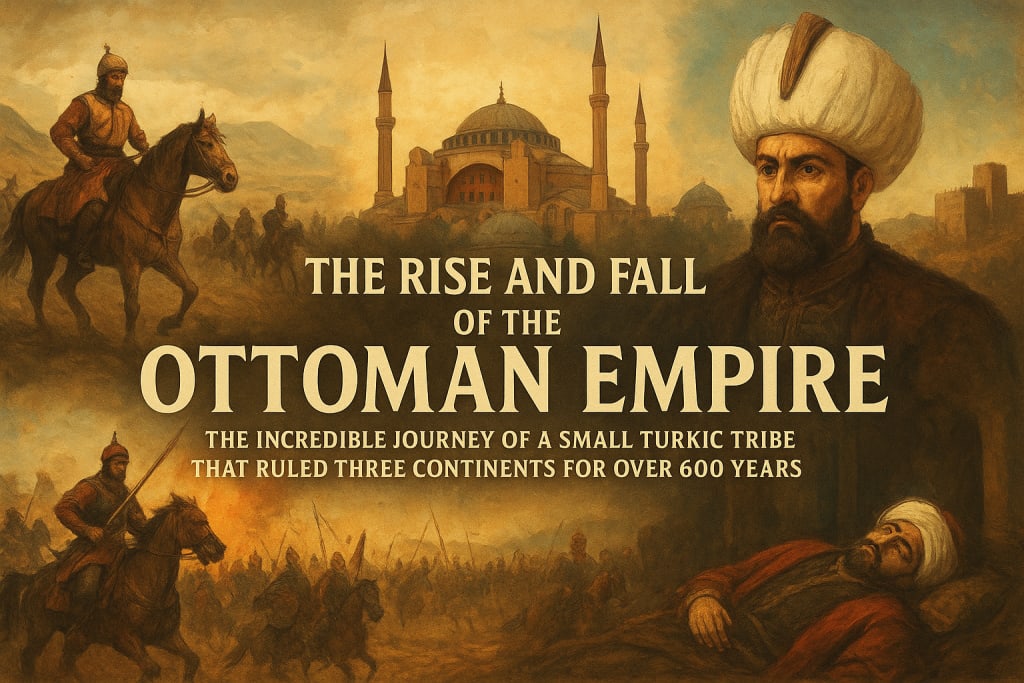
History has seen many empires rise and fall, but few stories are as dramatic and powerful as that of the Ottoman Empire. What began as a small group of nomadic warriors eventually became one of the greatest empires the world has ever known. For more than six centuries, the Ottomans ruled vast lands across Europe, Asia, and Africa. Their journey is a story of ambition, faith, military genius, cultural brilliance, and, eventually, decline.
Humble Beginnings
The Ottoman story begins in the late 13th century in Anatolia, modern-day Turkey. At that time, the region was divided among small states after the fall of the Seljuk Sultanate. One of these small tribes was led by a warrior named Osman I. His followers were nomadic Turks, skilled horsemen who lived by the sword and by their strong belief in Islam.
Osman’s territory was tiny, but his ambition was not. He took advantage of the weakening Byzantine Empire, capturing small forts and villages. His leadership inspired loyalty, and his name became the identity of a growing state. This small frontier principality soon transformed into the Ottoman state, named after Osman himself.
Expansion and Power
Osman’s successors continued his mission. They built a strong army, introduced efficient administration, and welcomed people of different religions and cultures. One of their most powerful weapons was the Janissary army, an elite group of well-trained soldiers loyal only to the sultan.
By the 14th and 15th centuries, the Ottomans expanded rapidly into the Balkans and parts of Eastern Europe. But the moment that truly changed world history came in 1453, when Sultan Mehmed II, later known as Mehmed the Conqueror, captured Constantinople.
The fall of Constantinople ended the Byzantine Empire and shocked Europe. The city became the Ottoman capital, later known as Istanbul, and a bridge between East and West. This victory marked the Ottomans as a global superpower.
The Golden Age
The Ottoman Empire reached its peak during the reign of Suleiman the Magnificent in the 16th century. Under his rule, the empire stretched from Hungary in Europe to Arabia in the Middle East and deep into North Africa.
Suleiman was not only a great military commander but also a wise lawmaker. He reformed the legal system, supported art and architecture, and strengthened the economy. Grand mosques, schools, hospitals, and bridges were built across the empire. Ottoman culture flourished, blending Turkish, Persian, Arab, and Byzantine traditions.
During this golden age, people of different religions—Muslims, Christians, and Jews—lived under Ottoman rule with relative tolerance. This diversity became one of the empire’s strengths.
Signs of Decline
However, no empire remains powerful forever. From the late 17th century onward, cracks began to appear. The Ottomans faced repeated military defeats against rising European powers such as Austria and Russia. New technologies and modern armies in Europe made Ottoman military methods outdated.
Internal problems also weakened the empire. Corruption increased, weak sultans came to power, and the once-mighty Janissaries became undisciplined and resistant to reform. Economic troubles grew as trade routes shifted and European industries expanded.
Nationalism became another serious threat. Many regions under Ottoman control, especially in the Balkans, began demanding independence. The empire struggled to hold its vast territories together.
The Final Collapse
By the 19th century, the Ottoman Empire was often called the “Sick Man of Europe.” Attempts at modernization came too late. World War I delivered the final blow. The Ottomans sided with Germany and Austria-Hungary, and after their defeat, the empire collapsed.
In 1922, the Ottoman Sultanate was officially abolished. One year later, Mustafa Kemal Atatürk founded the modern Republic of Turkey, ending more than 600 years of Ottoman rule.
A Lasting Legacy
Although the Ottoman Empire is gone, its legacy remains alive. From the beautiful skyline of Istanbul to legal systems, food, language, and architecture across three continents, Ottoman influence can still be felt today.
The story of the Ottoman Empire reminds us how a small group, driven by vision and unity, can change the course of history. It also teaches an important lesson: power must evolve with time, or it will fade away.
From nomadic warriors to world rulers—and finally to history—the Ottoman Empire’s journey is one of the most fascinating stories ever told.
About the Creator
Keep reading
More stories from shahid khan and writers in History and other communities.
King Darvash the Destroyer
In a faraway land called Almaron, people once lived in peace. The rivers were clean, the farms were green, and the markets were full of happy voices. But everything changed the day Darvash became king. He was the son of the old king, but he did not have the heart of a leader. Instead of kindness, he carried anger. Instead of wisdom, he carried pride. And instead of justice, he chose destruction.
By shahid khan2 months ago in History
Alexander the Great’s Looted Wealth from India: A Historical and Economic Estimation
While his campaigns reshaped the ancient world politically and culturally, one of their most lasting impacts was the massive wealth he acquired from conquered territories, especially during his Indian campaign. This article explores the historical context, nature of the wealth looted from India, and an estimated net worth of that treasure in modern terms—revealing the truly staggering value of what came into Alexander’s hands.
By Say the truth 6 days ago in History
The Rise and Fall of Nicolae Ceaușescu
Nicolae Ceaușescu’s rise to power was initially marked by promise, even optimism. Born in 1918 into a poor peasant family, he entered politics early, shaped by the ideological rigidity of interwar and wartime communism. When he became General Secretary of the Romanian Communist Party in 1965, following the death of Gheorghe Gheorghiu-Dej, many Romanians saw in him a younger leader, one who might soften the harsh Stalinist legacy that had defined the previous decades. For a society weary of repression and deprivation, Ceaușescu appeared to embody the possibility of cautious change.
By Pure childa day ago in History

Comments
There are no comments for this story
Be the first to respond and start the conversation.