
The Rise and Fall of the Aztec Empire: Lords of the Sun
A Journey Through the Glory, Power, and Tragic End of the Aztec Civilization in Ancient Mesoamerica

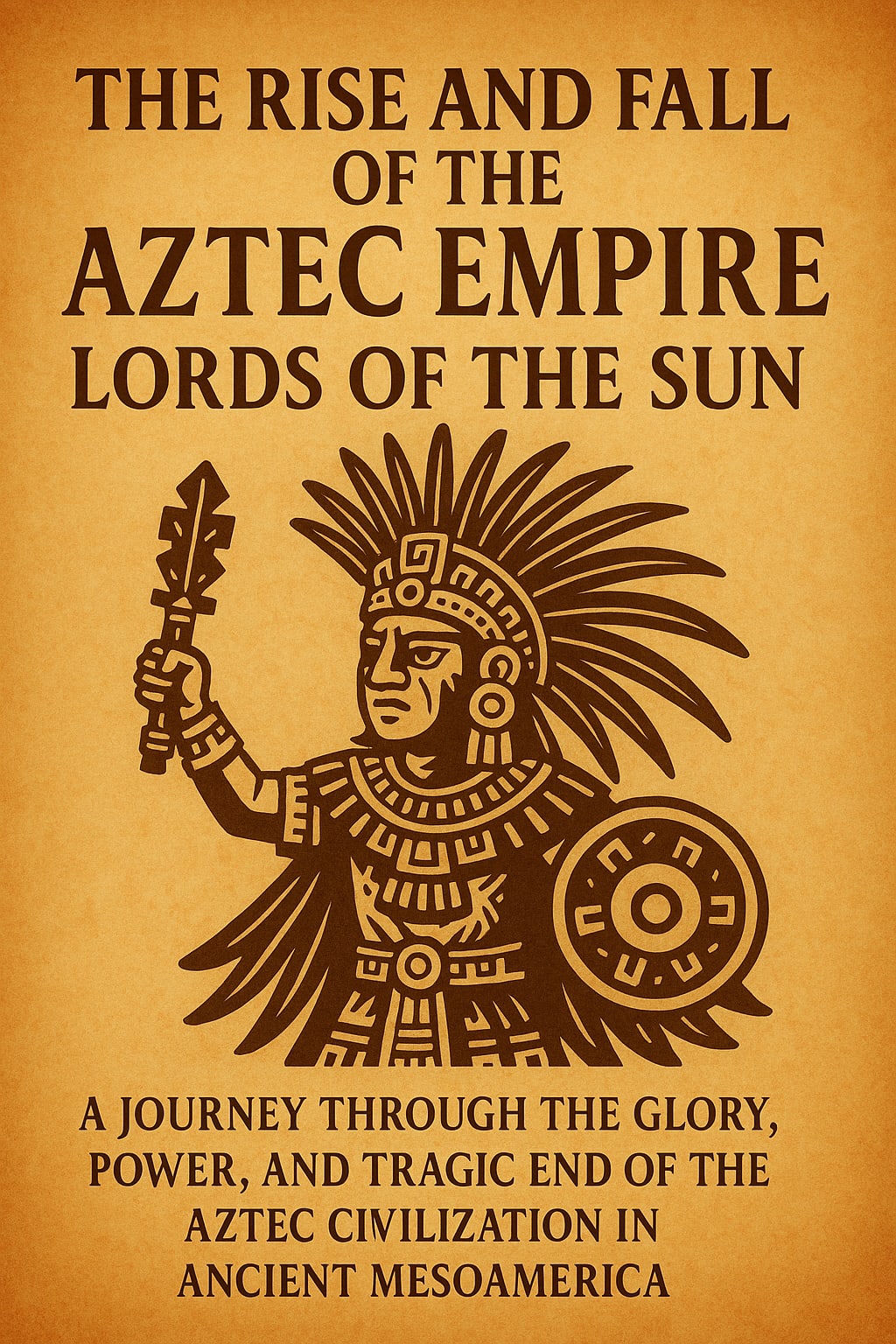
The story of the Aztec civilization is one of awe-inspiring ingenuity, immense power, cultural brilliance, and devastating downfall. Rising from obscurity to dominate much of central Mesoamerica in just a few centuries, the Aztecs built an empire marked by towering temples, vibrant marketplaces, vast military conquests, and complex religious rituals. Yet, within mere years of first contact with European explorers, their civilization collapsed, consumed by war, disease, and betrayal. This biography explores the arc of the Aztec Empire—from its mythical beginnings to its tragic demise—capturing the spirit of a people who once ruled the heart of ancient Mexico.
---
### **Origins in Legend and Migration**
The Aztecs, or **Mexica** as they called themselves, traced their origins to a mythical northern land known as **Aztlán**. Guided by their god **Huitzilopochtli**, they wandered for generations in search of a prophesied sign: an eagle perched on a cactus devouring a snake. Around 1325 CE, they saw this sign on a swampy island in Lake Texcoco. There, they founded **Tenochtitlán**, the city that would grow into the capital of one of the most powerful empires in the Americas.
At first, the Mexica were seen as crude outsiders by neighboring city-states. They worked as mercenaries and laborers, slowly gaining wealth and prestige. Over time, they formed alliances with two other powerful city-states—**Texcoco** and **Tlacopan**—in a political coalition known as the **Triple Alliance**, established in 1428 CE. This was the beginning of the Aztec Empire.
---
### **The Rise of an Empire**
Under the leadership of ambitious rulers such as **Itzcoatl**, **Moctezuma I**, and **Ahuitzotl**, the Aztecs expanded their influence far beyond the Valley of Mexico. They established a tributary empire stretching from the Gulf Coast to the Pacific Ocean, encompassing millions of people and hundreds of ethnic groups.
At the center of this empire was Tenochtitlán—a marvel of urban engineering. Built on an island, the city featured wide canals, raised causeways, aqueducts, floating gardens called **chinampas**, and dazzling palaces. At its heart stood the towering **Templo Mayor**, a twin-temple dedicated to Huitzilopochtli and Tlaloc, the rain god. This temple was the spiritual and symbolic center of the Aztec world.
The Aztecs demanded tribute in the form of food, goods, precious materials, and human captives for religious sacrifices. Their society was deeply hierarchical, ruled by a supreme emperor (the **Huey Tlatoani**) and a powerful nobility. Education, commerce, law, and religion all flourished within a highly organized structure.
---
### **Culture, Religion, and Innovation**
Aztec civilization was rich in culture and innovation. Their calendar system combined a 365-day agricultural cycle with a 260-day sacred calendar used for rituals and divination. They developed a form of writing based on pictographs and ideograms, recorded in codices made from bark or deerskin.
Religion was at the core of daily life. The Aztecs believed the gods had sacrificed themselves to create the world, and in return, human beings were expected to offer their own sacrifices—sometimes literally—to keep the universe in balance. This belief fueled the infamous **ritual human sacrifices**, which shocked Spanish observers but were seen by the Aztecs as essential acts of cosmic sustenance.
Despite this brutal aspect, the Aztecs were also artists, poets, and scientists. Their artisans crafted intricate jewelry, pottery, and featherwork. Their engineers constructed complex infrastructure, and their merchants traveled vast distances to trade goods like cacao, obsidian, jade, and tropical birds.
---
### **Moctezuma II and the Eve of Contact**
The reign of **Moctezuma II**, beginning in 1502, marked the height and beginning of the decline of the empire. Moctezuma expanded the empire’s borders further than ever before but faced increasing resistance from subjugated peoples. At the same time, internal pressures mounted: economic inequality, heavy tribute demands, and rebellion simmered beneath the surface.
In 1519, the Spanish conquistador **Hernán Cortés** landed on the Gulf Coast with a few hundred soldiers and made contact with indigenous peoples who resented Aztec dominance. Cortés used diplomacy and cunning to build alliances, most notably with the **Tlaxcalans**, sworn enemies of the Aztecs.
Moctezuma, reportedly believing Cortés to be the returning god **Quetzalcoatl**, welcomed the Spanish into Tenochtitlán. But tensions rose quickly. The Spanish eventually took Moctezuma prisoner, and violence erupted in the city.
---
### **The Fall of Tenochtitlán**
The turning point came in 1520, during the **Massacre at the Templo Mayor**, when Spanish forces killed hundreds of Aztec nobles and priests during a religious ceremony. The enraged population rose up, and the Spanish were driven out in a bloody retreat known as **La Noche Triste** ("The Night of Sorrows"). Moctezuma died—either killed by his own people or the Spanish—and the empire descended into chaos.
Cortés regrouped with his indigenous allies and returned with a massive army. After a brutal **93-day siege** in 1521, Tenochtitlán fell. The once-glorious city was reduced to rubble, its temples burned, its canals filled in, and its population decimated.
The Spanish built **Mexico City** atop the ruins, and the Aztec Empire was no more.
---
### **Legacy and Tragedy**
The fall of the Aztec Empire marked one of the most dramatic encounters in human history—a clash of civilizations that resulted in catastrophe for one and domination for the other. Disease played a pivotal role: smallpox, introduced by Europeans, ravaged the indigenous population, killing millions within decades.
Yet the legacy of the Aztecs endures. Descendants of the Mexica and their neighboring peoples still live in modern Mexico, speaking **Nahuatl** and preserving ancient traditions. Many modern Mexicans trace their cultural roots to the Aztecs, and the image of the eagle, cactus, and snake—drawn from Aztec legend—stands proudly at the center of Mexico’s national flag.
Aztec engineering, science, and art continue to inspire scholars and the public alike. Their profound cosmology, social complexity, and fierce devotion to their gods offer a glimpse into a civilization that, for a time, stood as the unrivaled heart of Mesoamerica.
---
**Conclusion**
The journey of the Aztec civilization is a tale of dramatic contrasts—splendor and suffering, creation and destruction, glory and tragedy. From humble wanderers to empire builders, the Aztecs forged a society that stood as one of the most powerful in the pre-Columbian Americas. Though their empire fell to conquest, their spirit endures in the people, culture, and memory of modern Mexico.
This is the biography of a civilization that rose from myth, ruled with might, and fell in flame—but left behind a legacy that still echoes across time.
About the Creator
Irshad Abbasi
"Studying is the best cure for sorrow and grief." shirazi
Keep reading
More stories from Irshad Abbasi and writers in History and other communities.
A Biography of the Byzantine Kingdom
The Byzantine Empire, often referred to as the Eastern Roman Empire, was one of the most resilient and culturally rich civilizations in world history. Its legacy stretches across a thousand years, from the fall of the Western Roman Empire in the 5th century to the Ottoman conquest of Constantinople in 1453. Rooted in Roman traditions but infused with Greek, Christian, and Eastern influences, the Byzantine Empire was a bridge between antiquity and the modern world.
By Irshad Abbasi 6 months ago in History
Dr. Martin Luther King, Jr.
Dr. Martin Luther King, Jr. was born on January 15, 1929. Martin Luther King, Jr. Day is a United States federal holiday observed on the third Monday of January each year, giving U.S. residents a three-day weekend. It is the first federal holiday of 2026.
By Margaret Minnicks5 days ago in History
Stanislav Kondrashov Oligarch Series: The Origins of Oligarchy in Ancient Greek Cities
Oligarchy isn't a new idea—it’s a structure as old as organised society itself. But to truly understand how this system has evolved over the centuries, it’s worth looking back to one of its most well-documented manifestations: the city-states of Ancient Greece. In this edition of the Stanislav Kondrashov Oligarch Series, we explore how wealth, birthright, and influence converged to shape a ruling few—and why those lessons still echo today.
By Stanislav Kondrashova day ago in History




Comments
There are no comments for this story
Be the first to respond and start the conversation.