
A Biography of the Byzantine Kingdom
From Roman Legacy to Eastern Glory — The Rise, Reign, and Fall of the Byzantine Empire

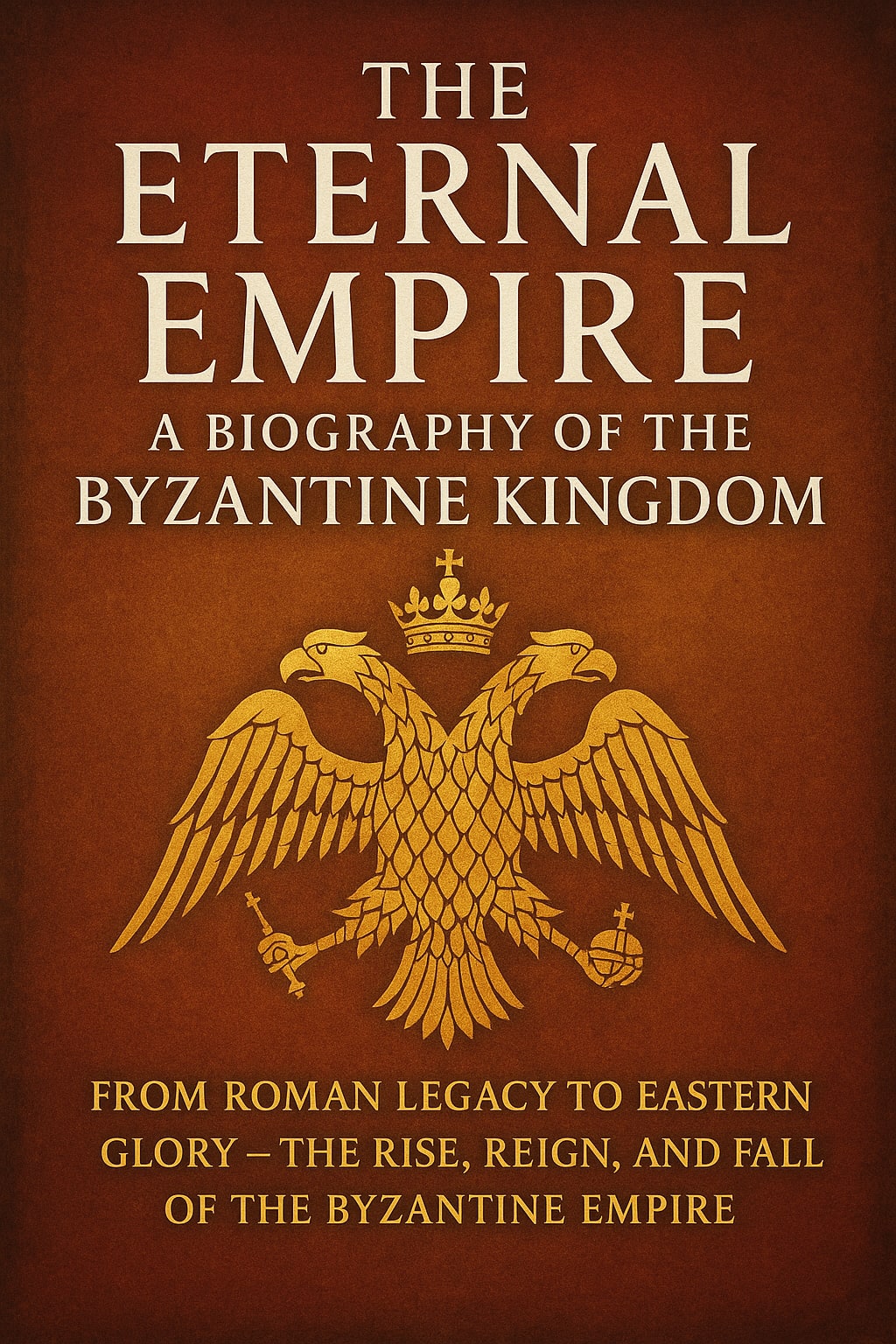
The Byzantine Empire, often referred to as the Eastern Roman Empire, was one of the most resilient and culturally rich civilizations in world history. Its legacy stretches across a thousand years, from the fall of the Western Roman Empire in the 5th century to the Ottoman conquest of Constantinople in 1453. Rooted in Roman traditions but infused with Greek, Christian, and Eastern influences, the Byzantine Empire was a bridge between antiquity and the modern world.
⸻
Origins: A New Rome in the East
The roots of the Byzantine Empire lie in the division of the Roman Empire by Emperor Diocletian in the late 3rd century CE. Facing internal strife and external invasions, Rome was split into Western and Eastern halves for administrative efficiency. The Eastern Roman Empire, with its capital eventually established at Byzantium (later Constantinople), grew stronger while the Western Empire weakened.
In 330 CE, Emperor Constantine the Great officially inaugurated Byzantium as “Nova Roma” or “New Rome,” renaming it Constantinople. He embraced Christianity, making it the state religion and reshaping the empire’s identity forever. With its strategic position between Europe and Asia, Constantinople flourished as a center of trade, politics, and religion.
⸻
The Golden Age: Justinian and Theodora
The Byzantine Empire reached its height under Emperor Justinian I (527–565 CE) and his wife, Empress Theodora. Justinian envisioned the restoration of the Roman Empire’s former glory. He launched military campaigns to reclaim lost territories in North Africa, Italy, and Spain under the command of General Belisarius.
More importantly, Justinian is celebrated for his legal reforms. The Corpus Juris Civilis or “Body of Civil Law” became a foundational text for modern European legal systems. Under Justinian, the Hagia Sophia was constructed — an architectural marvel and symbol of Christian Orthodox faith.
Theodora, once a stage actress, proved herself a powerful and intelligent co-ruler. She advocated for women’s rights, religious tolerance, and social reform, solidifying her legacy as one of the most influential women in Byzantine history.
⸻
Religion and Power: The Eastern Orthodox Church
Religion was at the heart of Byzantine life. The empire championed Orthodox Christianity, often clashing with the Roman Catholic Church in the West. These theological and political tensions culminated in the Great Schism of 1054, when Christianity officially split into Eastern Orthodoxy and Roman Catholicism.
Iconoclasm, a major religious controversy during the 8th and 9th centuries, questioned the veneration of icons. It divided society and weakened the empire until the practice was restored. Despite these challenges, the Church became a central pillar of Byzantine identity, influencing art, politics, and education.
⸻
Cultural Flourishing
The Byzantine Empire was a hub of culture, preserving and transmitting classical knowledge. Greek became the dominant language, replacing Latin, and scholars preserved the works of Plato, Aristotle, and Homer. Byzantine art, with its iconic mosaics, illuminated manuscripts, and religious frescoes, expressed deep spirituality and imperial grandeur.
Education and literacy were valued, especially among the elite. The University of Constantinople, established in the 5th century, became a beacon of learning in medieval Europe. Diplomacy, bureaucracy, and ceremonial court life were hallmarks of the Byzantine elite.
⸻
Decline and Crisis
Despite its strength, the Byzantine Empire faced constant threats. Arab Muslims, Persians, Slavs, Bulgars, and later, Seljuk Turks, repeatedly challenged its borders. By the 11th century, the empire had begun to lose territory and political power.
The Fourth Crusade in 1204 was a devastating blow. Instead of reaching the Holy Land, crusaders diverted to Constantinople, sacked the city, and established the short-lived Latin Empire. The Byzantines reclaimed their capital in 1261 under the Palaiologos dynasty, but the empire was a shadow of its former self.
Economic difficulties, a shrinking military, and internal strife further weakened the empire. The once-great Constantinople now relied on foreign mercenaries and diplomacy to survive.
⸻
The Fall of Constantinople
By the 15th century, the Byzantine Empire was reduced to a few territories and the capital city. In 1453, Sultan Mehmed II of the Ottoman Empire launched a full-scale assault on Constantinople. Despite a heroic defense led by Emperor Constantine XI, the city fell after a 53-day siege.
On May 29, 1453, the Ottomans entered the city, marking the end of the Byzantine Empire. The Hagia Sophia was converted into a mosque, and Constantinople became the new capital of the Ottoman Empire — Istanbul.
The fall of Constantinople is often seen as the end of the medieval era and the beginning of the Renaissance, as fleeing Greek scholars brought ancient texts and knowledge to Western Europe.
⸻
Legacy
The Byzantine Empire’s influence did not end with its fall. It preserved Roman law, classical learning, and Christian theology, shaping the course of European and Middle Eastern history. Eastern Orthodox Christianity, deeply rooted in Byzantine tradition, continues to thrive in countries like Greece, Russia, and Serbia.
The idea of a “Third Rome” — claimed by Moscow after Constantinople’s fall — illustrates how the Byzantine legacy endured. Its rich artistic, religious, and political traditions influenced the Islamic world, Western Europe, and Slavic nations for centuries.
Even today, the term “Byzantine” evokes a world of intricate politics, grand cathedrals, and enduring faith.
⸻
Conclusion
The story of the Byzantine Empire is one of survival, transformation, and brilliance. It rose from the ashes of the Roman Empire, endured for over a millennium, and bridged the gap between the ancient and modern worlds. Though it ultimately fell to foreign powers, its legacy remains eternal — a testament to its name, The Eternal Empire.
About the Creator
Irshad Abbasi
Ali ibn Abi Talib (RA) said 📚
“Knowledge is better than wealth, because knowledge protects you, while you have to protect wealth.
Keep reading
More stories from Irshad Abbasi and writers in History and other communities.
A Biography of the Mali Empire
The Mali Empire stands as one of the greatest and most influential kingdoms in African history. Rising to prominence in the 13th century, it flourished through wealth, trade, culture, and strong governance. Stretching across modern-day Mali, Senegal, Gambia, Guinea, Niger, Nigeria, Chad, and Mauritania, the empire’s legacy is deeply woven into the fabric of West African heritage. This biography explores its origins, golden age under Mansa Musa, economic power, intellectual influence, and lasting cultural impact.
By Irshad Abbasi 8 months ago in History


Comments
There are no comments for this story
Be the first to respond and start the conversation.