
The Rise and Fall of Libya's Revolutionary Ruler
The Rise and Fall of Libya's Revolutionary Ruler

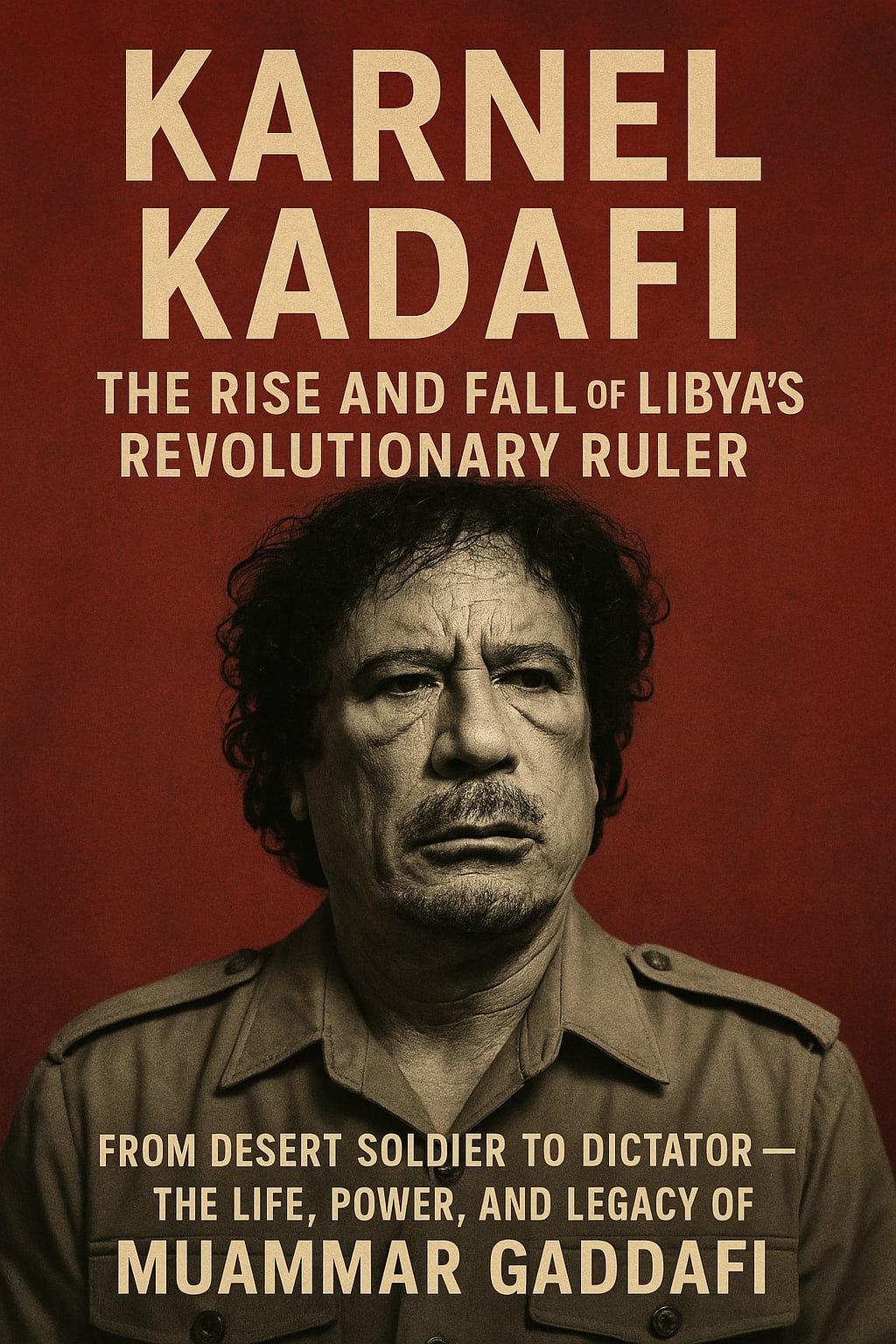
Muammar Gaddafi, known to the world through various spellings — including Karnel Kadafi — was a soldier, ideologue, autocrat, and revolutionary whose rule over Libya spanned more than four decades. His life was a collision of idealism and authoritarianism, marked by dramatic transformations and a final, violent downfall. From his rise as a young army officer to his fall during the Arab Spring, Gaddafi’s story is one of contradiction, ambition, and controversy.
Early Life and Influences
Born in 1942 in a Bedouin tent near the desert town of Sirte, Gaddafi came from a poor, nomadic family of Arabized Berber heritage. He grew up in a Libya that was deeply scarred by Italian colonial rule and later by the monarchy of King Idris. Influenced heavily by the anti-colonial movements sweeping through the Arab world, young Gaddafi idolized Egypt’s Gamal Abdel Nasser and became drawn to pan-Arabism, Arab socialism, and Islamic reformism.
Gaddafi’s early education was modest, but his passion for politics and military discipline propelled him forward. He enrolled in the Royal Military Academy in Benghazi and later received military training in the United Kingdom. His time abroad deepened his distrust of Western powers, whom he saw as neo-imperialist and exploitative. Upon returning to Libya, he quickly began planning how to end monarchy rule and assert national sovereignty.
The 1969 Coup: A Revolutionary Grabs Power
On September 1, 1969, at the age of just 27, Gaddafi led a group of young army officers in a bloodless coup against King Idris while the monarch was abroad for medical treatment. The coup was swift, efficient, and greeted with cautious optimism by many Libyans. Gaddafi declared the end of the monarchy and the birth of the Libyan Arab Republic.
Rejecting traditional titles, he styled himself not as president, but as the “Brother Leader” and “Guide of the Revolution.” Initially, Gaddafi projected a populist image — a humble man of the people, rejecting palaces and official uniforms. But his grip on power would soon reveal itself to be absolute.
The Green Book and the “Third Way”
In the 1970s, Gaddafi developed a personal political philosophy laid out in his three-part manifesto, The Green Book. It rejected both capitalism and communism, instead advocating a form of direct democracy through local people’s committees. He called it the “Third Universal Theory,” a unique fusion of socialism, Islam, and tribal governance.
In theory, Gaddafi’s system was meant to empower the masses and eliminate political elites. In practice, it centralized power in his hands. Dissent was suppressed, political parties were banned, and arbitrary arrests and executions became common. The people’s committees became tools of surveillance rather than democracy.
Wealth and Weaponry: Libya on the World Stage
Libya’s vast oil reserves gave Gaddafi the means to fund his revolution. He nationalized the oil industry and used the revenues to provide free healthcare, education, and housing. Infrastructure improved, and Libya's standard of living rose in the 1970s and 1980s. But oil wealth also fueled megalomania.
Gaddafi sought to export his ideology beyond Libya’s borders. He funded liberation movements and rebel groups across Africa, the Middle East, and even in Europe and Latin America. His support for international terrorism — including the 1986 Berlin disco bombing and the 1988 Lockerbie bombing — made him a global pariah.
In retaliation, the United States bombed Tripoli and Benghazi in 1986. The attack killed Gaddafi’s adopted daughter and strengthened his anti-Western rhetoric. In the 1990s, the United Nations imposed crippling sanctions on Libya, isolating it from much of the international community.
Reinvention and Rapprochement
After years of isolation, Gaddafi surprised the world in the early 2000s. Seeking to restore Libya’s economy and end its pariah status, he renounced terrorism, dismantled his weapons of mass destruction program, and paid compensation to victims of past attacks. Western leaders began courting him again. Tony Blair, Nicolas Sarkozy, and Condoleezza Rice all visited Tripoli, hoping to bring Libya into the global fold.
Foreign oil companies returned, and Libya experienced a new economic boom. Gaddafi, ever the showman, gave speeches at the United Nations and pitched his grand visions of a “United States of Africa.” For a time, it seemed he had transformed from terrorist sponsor to eccentric elder statesman.
But beneath the surface, Libya remained a police state. Political dissent was still harshly punished, and no real reforms ever reached the people.
The Arab Spring and the Final Days
In 2011, a tidal wave of popular uprisings known as the Arab Spring swept through North Africa and the Middle East. Tunisia and Egypt saw their autocrats fall. Inspired by these movements, Libyans took to the streets in February to demand Gaddafi’s resignation.
His response was swift and brutal. Security forces opened fire on protestors, and the uprising escalated into civil war. As rebel forces gained ground, NATO intervened with airstrikes under a UN mandate to protect civilians. Gaddafi’s regime quickly unraveled.
After months on the run, Gaddafi was captured on October 20, 2011, in a drainage pipe near his hometown of Sirte. He was beaten and killed by rebel fighters — a brutal end to a brutal rule.
Legacy of a Revolutionary Ruler
Muammar Gaddafi left behind a complicated legacy. Some Libyans remember the stability, free services, and national pride his early rule brought. Others recall the repression, fear, and waste of decades of potential. Internationally, he remains a symbol of how revolution can decay into tyranny.
Libya today is fractured, divided among rival governments, militias, and tribal factions. The power vacuum left by Gaddafi’s death has yet to be filled. His legacy haunts the country, a reminder that removing a dictator does not guarantee peace or democracy.
Conclusion
Karnel Kadafi’s life was a saga of contradictions — a revolutionary who became a despot, a populist who ruled with an iron hand, and a visionary whose dreams collapsed into chaos. His journey from desert soldier to dictator offers a stark lesson in the corrupting force of absolute power and the dangers of unchecked ideology.
Though he is gone, the shadow of Muammar Gaddafi still looms over Libya and the wider region. His story remains a cautionary tale, not just of one man, but of a nation’s complex struggle for identity, sovereignty, and freedom.
About the Creator
Irshad Abbasi
Ali ibn Abi Talib (RA) said 📚
“Knowledge is better than wealth, because knowledge protects you, while you have to protect wealth.
Keep reading
More stories from Irshad Abbasi and writers in History and other communities.
The Life and Times of Iraq’s Strongman
Saddam Hussein, one of the most controversial and enigmatic figures of the 20th century, ruled Iraq with an iron fist for nearly a quarter of a century. His life was marked by a meteoric rise to power, brutal suppression of dissent, ambitious modernization efforts, catastrophic wars, and a dramatic downfall that ended with his execution in 2006. Saddam's story is not just the tale of a dictator, but a reflection of Iraq’s turbulent history and its struggle with identity, power, and colonial legacy.
By Irshad Abbasi 10 months ago in History


Comments (1)
Gaddafi's story is quite something. His rise from a poor background to leading Libya is remarkable. But his rule turned authoritarian. The 1969 coup was a big moment. I wonder how different Libya would be today if his rule had taken a more democratic path. And what were the key factors that led to his downfall during the Arab Spring?