
The Rise and Fall of Italy’s Fascist Dictator
From Socialist Roots to Totalitarian Rule — The Life, Ideology, and Legacy of Il Duce

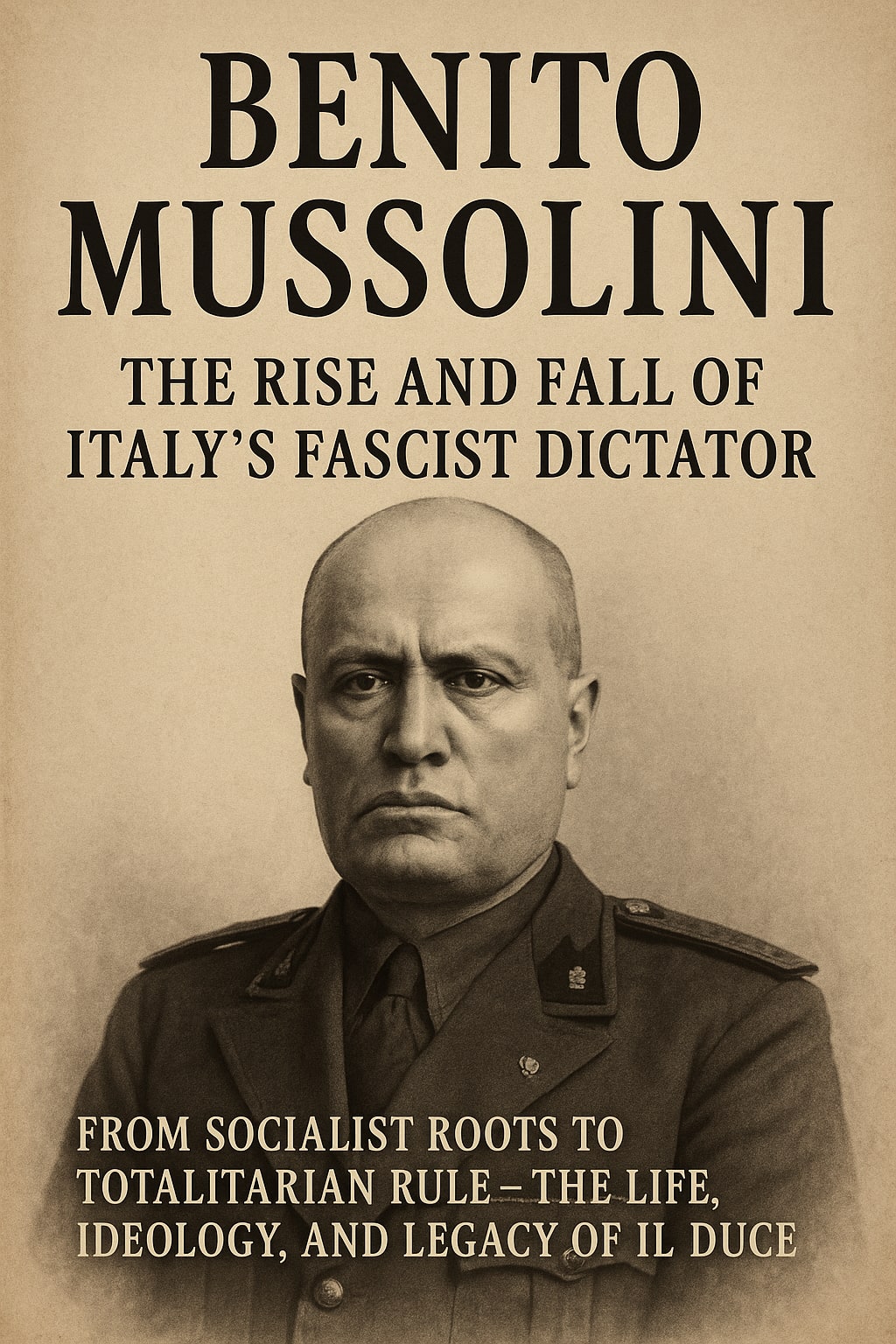
Benito Mussolini, one of the 20th century's most controversial and influential figures, rose from humble beginnings to become the founder of Italian Fascism and dictator of Italy. His rule, which spanned over two decades, left an indelible mark on Italy and the world, shaping the trajectory of Europe between the World Wars. Ultimately, his ambitions led Italy into ruin and himself to a grim demise.
### Early Life and Socialist Roots
Benito Amilcare Andrea Mussolini was born on July 29, 1883, in Predappio, a small town in the Emilia-Romagna region of Italy. His father, a blacksmith and an ardent socialist, and his mother, a schoolteacher, deeply influenced his early political leanings. Despite a tumultuous childhood marked by poverty and rebellious behavior, Mussolini was a bright student and eventually became a schoolteacher.
By his early 20s, Mussolini had fully embraced socialism. He moved to Switzerland in 1902 to avoid military service and became active in socialist circles, even being arrested for political agitation. Returning to Italy in 1904, he worked as a journalist and quickly rose through the ranks of the Italian Socialist Party (PSI). In 1912, he became editor of the party’s newspaper, *Avanti!*, where his fiery rhetoric made him a prominent figure.
### Break with Socialism and Birth of Fascism
World War I marked a dramatic turning point. Although the PSI opposed Italy's entry into the war, Mussolini broke with the party in 1914, arguing that war could bring about social revolution. Expelled from the PSI, he founded his own newspaper, *Il Popolo d’Italia*, and began forming the ideological foundation of what would become Fascism—a blend of nationalism, authoritarianism, and anti-communism.
In 1919, Mussolini founded the *Fasci Italiani di Combattimento*, a movement composed of disgruntled war veterans, nationalists, and anti-socialists. It initially failed to gain traction, losing in the 1919 elections. However, Italy was in crisis—economic collapse, social unrest, and fear of communism plagued the country. Mussolini exploited this instability, and by 1921, his movement had grown significantly, rebranded as the *Partito Nazionale Fascista* (National Fascist Party).
### The March on Rome and Seizure of Power
On October 28, 1922, Mussolini orchestrated the infamous *March on Rome*, where tens of thousands of Fascist Blackshirts threatened to seize power by force. Fearing civil war and seeing Mussolini as a bulwark against socialism, King Victor Emmanuel III invited him to form a government. At just 39, Mussolini became the youngest prime minister in Italian history.
Initially, Mussolini maintained the facade of a parliamentary government. But by 1925, after consolidating power, he dismantled democratic institutions, suppressed opposition, and declared himself *Il Duce*—the leader. Italy was transformed into a one-party totalitarian state.
### The Fascist Regime
Under Mussolini, Italy became a corporatist state where the economy, government, and industry were integrated under state control, though not entirely socialized. His regime emphasized militarism, nationalism, and the glorification of the state above the individual. Propaganda, youth indoctrination, and secret police (the OVRA) kept dissent in check.
Mussolini sought to revive the grandeur of the Roman Empire, pursuing aggressive foreign policies. In 1935, he invaded Ethiopia, committing atrocities and drawing international condemnation. His alliance with Nazi Germany solidified in 1936 through the Rome-Berlin Axis, and later with Japan in the Anti-Comintern Pact.
Although Mussolini’s Italy never matched the military or industrial might of Germany, he styled himself as Hitler’s equal. In truth, he was often manipulated by the more powerful Nazi regime.
### World War II and Decline
When World War II broke out in 1939, Mussolini initially stayed neutral but entered the war on Germany’s side in June 1940, believing a swift Axis victory was imminent. Italy’s military campaigns in Greece, North Africa, and the Soviet Union, however, were disastrous. Ill-prepared and poorly equipped, Italian forces suffered repeated defeats.
The war turned Mussolini into a liability. In 1943, as Allied forces invaded Sicily and advanced up the Italian peninsula, Mussolini’s support collapsed. On July 25, 1943, he was arrested after being dismissed by the Grand Council of Fascism and the king.
But Mussolini’s story didn’t end there. In September 1943, Nazi commandos led by Otto Skorzeny rescued him in a daring raid. Hitler installed him as the puppet leader of the *Italian Social Republic*, a Nazi-controlled regime in northern Italy. However, by then, Mussolini was a broken man, with little real power.
### Death and Legacy
As Allied forces closed in during the spring of 1945, Mussolini attempted to flee to Switzerland with his mistress, Clara Petacci. On April 27, 1945, they were captured by Italian partisans near Lake Como. The next day, Mussolini and Petacci were executed by firing squad. Their bodies were hung upside down in Milan’s Piazzale Loreto, a public display meant to symbolize the fall of Fascism and to humiliate the man who had ruled Italy with an iron fist.
Mussolini’s legacy remains deeply controversial. Some Italians see him as a strong leader who brought stability and national pride in a chaotic era. Others view him as a ruthless dictator whose alliance with Hitler and embrace of anti-Semitic laws brought shame and devastation to Italy. The Fascist ideology he pioneered inspired similar movements around the world, notably in Germany, Spain, and parts of Latin America.
### Conclusion
Benito Mussolini’s life was a study in extremes: from radical socialist to right-wing dictator; from media-savvy populist to authoritarian ruler. His rise was built on charisma, opportunism, and the exploitation of fear. His fall was marked by betrayal, incompetence, and the overwhelming forces of history. The impact of Mussolini's Fascist regime still echoes today, serving as both a warning and a lesson about the perils of authoritarianism and the seduction of absolute power.
About the Creator
Irshad Abbasi
"Studying is the best cure for sorrow and grief." shirazi
Keep reading
More stories from Irshad Abbasi and writers in History and other communities.
A Biography of Power and Destruction
Adolf Hitler’s name remains synonymous with tyranny, genocide, and war. Born in Austria in 1889, Hitler rose from obscurity to become the leader of the Nazi Party and Chancellor of Germany, wielding immense power that ultimately brought about one of history’s most catastrophic periods: World War II and the Holocaust. This biography explores his ascent, ideology, and the devastation left in his wake—an enduring lesson in how demagoguery and unchecked power can destroy nations and humanity.
By Irshad Abbasi 8 months ago in History
If America Walks Away from NATO, the World Will Feel the Shock
If America Walks Away from NATO, the World Will Feel the Shock For more than seventy years, NATO has stood as a symbol of collective security and shared responsibility. It was never a perfect alliance, but it worked because it was built on a simple idea: when nations stand together, wars are less likely to happen. Today, however, that foundation is being shaken—not by foreign enemies, but by growing voices inside the United States questioning whether NATO is still worth it.
By Wings of Time 6 days ago in History
3 Harmless Habits That Once Caused Absolute Chaos
Most habits are comfortingly dull. You chew gum. You clap at events. You check your phone. You assume—reasonably—that these actions will not destabilize governments, bankrupt industries, or end lives. Society depends on this assumption. If every small habit carried catastrophic potential, we would never leave the house.
By Enoch Saginia day ago in History


Comments
There are no comments for this story
Be the first to respond and start the conversation.