
A Biography of Power and Destruction
The Rise of a Dictator and the Fall of a Nation

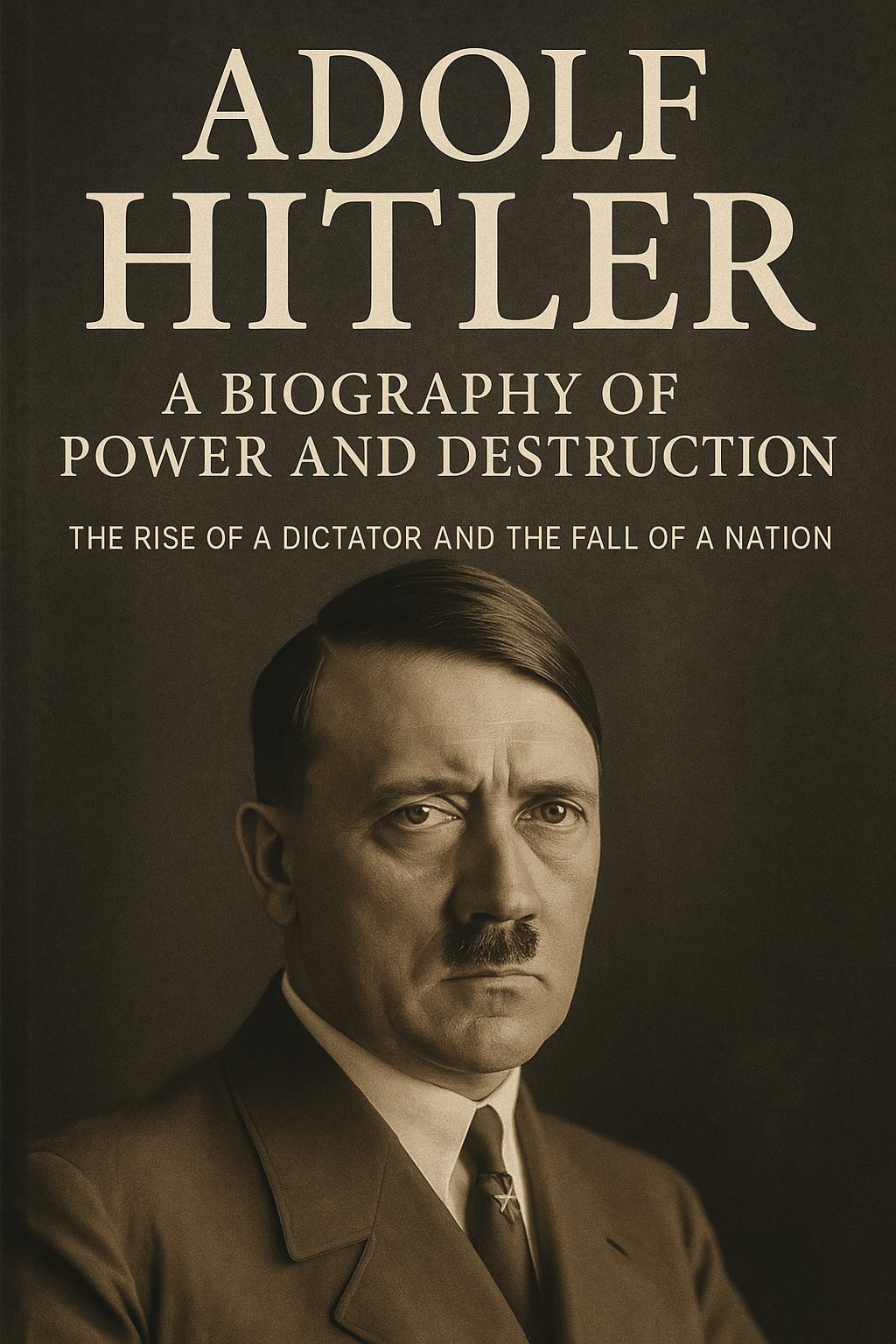
Adolf Hitler’s name remains synonymous with tyranny, genocide, and war. Born in Austria in 1889, Hitler rose from obscurity to become the leader of the Nazi Party and Chancellor of Germany, wielding immense power that ultimately brought about one of history’s most catastrophic periods: World War II and the Holocaust. This biography explores his ascent, ideology, and the devastation left in his wake—an enduring lesson in how demagoguery and unchecked power can destroy nations and humanity.
### Early Life and Formation of Ideology
Adolf Hitler was born on April 20, 1889, in Braunau am Inn, a small Austrian town near the German border. He was the fourth of six children born to Alois Hitler and Klara Pölzl. His father was strict and authoritarian, while his mother was gentle and loving. Hitler showed early signs of ambition, but academic underachievement and a rejection from the Vienna Academy of Fine Arts in 1907 left him embittered.
During his years in Vienna, Hitler lived in poverty and developed the foundations of his antisemitic and ultranationalist ideology. Immersed in pan-German nationalist thought, he saw Jews not as individuals but as a collective threat to the purity of the Germanic people. These years laid the psychological and ideological groundwork for what would become a campaign of racial hatred and extermination.
### Soldier and the Aftermath of War
In 1914, Hitler enlisted in the German army during World War I. Serving primarily on the Western Front, he was wounded twice and awarded the Iron Cross for bravery. Though a mediocre soldier by military standards, the war gave Hitler a sense of purpose. The German defeat in 1918 devastated him. He, like many other nationalists, viewed the Treaty of Versailles as a betrayal—particularly the "stab-in-the-back" myth which blamed Germany’s loss on internal enemies, especially Jews and communists.
Hitler's post-war years were aimless until 1919 when he joined the German Workers' Party, which he quickly helped transform into the National Socialist German Workers' Party (NSDAP)—the Nazi Party. His oratory skills, combined with a message of racial purity, German revival, and fierce anti-communism, won him growing support.
### Rise to Power
The 1923 Beer Hall Putsch, a failed coup in Munich, landed Hitler in prison for treason. There, he wrote *Mein Kampf*, laying out his ideology: the supremacy of the Aryan race, the necessity of lebensraum ("living space") in Eastern Europe, and a hatred for Jews, Marxists, and democracy.
The global economic depression in 1929 provided the conditions Hitler needed. Unemployment, hyperinflation, and widespread despair made many Germans receptive to radical solutions. In 1933, Hitler was appointed Chancellor by President Paul von Hindenburg. Within months, the Reichstag Fire enabled Hitler to consolidate power by suspending civil liberties and eliminating political opponents through the Enabling Act.
Germany became a one-party totalitarian state. Hitler crushed dissent, outlawed opposition parties, and subordinated the judiciary, military, and education system to Nazi ideology. He projected himself as the "Führer"—a singular, heroic leader who embodied the will of the people.
### The Machinery of Destruction
Once in power, Hitler rapidly transformed Germany into a fascist dictatorship. The Nazi regime combined propaganda, terror, and spectacle to control the population. The SS (Schutzstaffel), Gestapo, and concentration camps were used to silence opposition and enforce conformity.
Central to Hitler’s vision was racial purity. The Nuremberg Laws of 1935 stripped Jews of citizenship and barred them from intermarrying with Germans. Anti-Jewish propaganda dehumanized and scapegoated Jews for Germany's problems. Hitler's regime also targeted Romani people, disabled individuals, homosexuals, and other "undesirables" in a systematic campaign of persecution.
Hitler’s foreign policy was aggressive from the outset. He withdrew Germany from the League of Nations, remilitarized the Rhineland, and annexed Austria in the 1938 Anschluss. The Munich Agreement later that year allowed Hitler to seize the Sudetenland, a German-speaking region of Czechoslovakia, without military resistance. These moves, driven by both ideology and strategic ambition, were part of his broader plan to establish a German empire in Europe.
### World War II and the Holocaust
On September 1, 1939, Hitler invaded Poland, prompting Britain and France to declare war on Germany. World War II had begun. The Blitzkrieg strategy quickly overwhelmed Poland, and in the following years, Hitler’s forces swept through much of Europe—France, the Low Countries, the Balkans, and parts of North Africa. However, the 1941 invasion of the Soviet Union (Operation Barbarossa) marked a turning point. Despite early successes, the brutal Russian winter, fierce Soviet resistance, and overextended supply lines halted the advance.
Meanwhile, Hitler intensified his campaign of genocide. The “Final Solution”—a systematic plan to exterminate Europe’s Jewish population—was implemented in 1942. Industrialized killing centers like Auschwitz, Treblinka, and Sobibor were established. By 1945, six million Jews and millions of others had been murdered in the Holocaust, one of the most horrific crimes in human history.
### Decline and Death
As the war dragged on and German casualties mounted, Hitler became increasingly erratic and isolated. He micromanaged military decisions, often ignoring expert advice. The failed invasion of the Soviet Union, coupled with the Allied landing in Normandy in 1944, turned the tide against Germany. By early 1945, the Allies were closing in from both east and west.
In April 1945, with Soviet troops encircling Berlin, Hitler retreated to his underground Führerbunker. On April 30, he committed suicide alongside his long-time companion, Eva Braun. Their bodies were burned per his instructions. Days later, Germany surrendered, bringing the war in Europe to an end.
### Legacy of Ruin
Adolf Hitler’s legacy is one of unprecedented destruction. He left behind a broken Germany, a devastated Europe, and a legacy of suffering unmatched in modern times. His war caused the deaths of over 70 million people. The Holocaust remains the darkest chapter in human history.
Beyond the statistics, Hitler’s reign reshaped the modern world. The United Nations was born in response to the failure to stop aggression and genocide. The Nuremberg Trials established a new standard of international justice. In Germany, a long process of reckoning, denazification, and remembrance began.
Hitler's rise and fall is a cautionary tale of how charismatic extremism, weaponized grievance, and systemic manipulation of truth can plunge the world into darkness. The lessons drawn from his life—of vigilance, resistance, and the defense of democratic values—remain as vital today as ever.
---
**Conclusion**
*Adolf Hitler: A Biography of Power and Destruction* captures the life of a man whose quest for dominance led to global conflict and immeasurable human suffering. It is not merely a biography of a dictator, but a study in how evil, when given the machinery of the state and the loyalty of the masses, can destroy civilizations. Remembering his story is essential—not to sensationalize, but to understand, and above all, to prevent history from repeating itself.
About the Creator
Irshad Abbasi
"Studying is the best cure for sorrow and grief." shirazi
Keep reading
More stories from Irshad Abbasi and writers in History and other communities.
The Revolutionary Life of a Global Icon
Ernesto "Che" Guevara remains one of the most iconic and controversial figures of the 20th century. A revolutionary, doctor, author, guerrilla leader, and symbol of resistance, Che’s life encapsulates the volatile political currents of the Cold War era and the dreams and failures of revolution. Born into an upper-middle-class Argentine family, Guevara's journey from medicine to Marxism led him to the forefront of global anti-imperialist struggle. His life was short but intense—marked by passionate idealism, armed struggle, and a tragic end that sealed his legend.
By Irshad Abbasi 8 months ago in History
Military Strength of Alexander the Great and the Chola Empire: A Historical Comparison
Though separated by more than a thousand years and operating in vastly different geographical and cultural contexts, both forces achieved extraordinary success through discipline, innovation, and strategic brilliance. This article explores the history, composition, size, organization, and military strength of Alexander’s Macedonian army and the Chola military, highlighting how each became a dominant power of its era.
By Say the truth 3 days ago in History
The Hard Ways Trump Could Try to Take Greenland
When Donald Trump was president of the United States, he shocked the world by saying he wanted to buy Greenland. Many people laughed, but others took the idea seriously. Greenland is a huge island in the Arctic. It is rich in natural resources and very important for military defense. Today, Greenland belongs to Denmark, but it also governs itself in many areas.
By sehzeen fatima7 days ago in History


Comments
There are no comments for this story
Be the first to respond and start the conversation.