
The Rich Tapestry of Africa: A Journey Through History, Heritage, and Natural Wealth"
" This captivating digital painting vividly portrays Africa’s deep historical roots, cultural diversity, and abundant natural resources. The artwork showcases ancient monuments like pyramids, lush landscapes with rivers and wildlife, and symbols of African heritage, including traditional masks, jewelry, and textiles. It also highlights the continent's wealth in gold, diamonds, and oil, reflecting Africa's intersection of ancient civilizations, colonial struggles, and modern prosperity. This piece serves as a dynamic and detailed visual narrative of Africa’s multifaceted legacy.

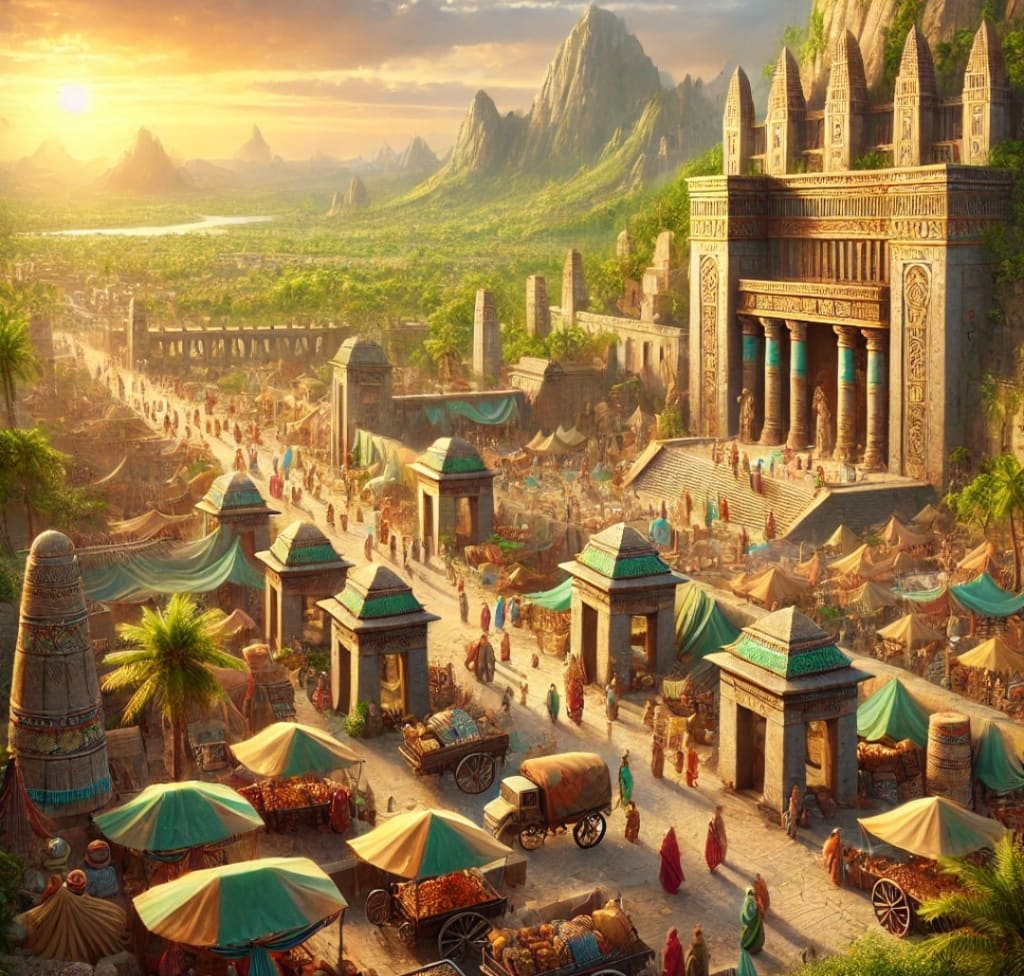
The Golden Age of African Civilizations and Their Lasting Legacy
Africa is home to some of the most ancient and advanced civilizations in history. Throughout the centuries, empires, kingdoms, and trading hubs have risen across the continent, driven by abundant natural resources, strategic trade routes, and thriving cultural exchanges. This part of the series delves deeper into some of Africa’s most significant civilizations during their golden age, their wealth, and their enduring impact on history.
The Kingdom of Mali: The Wealth of Mansa Musa
The Mali Empire, founded in the 13th century, is one of Africa’s most famous and prosperous empires. At the height of its power, it controlled a significant portion of West Africa, including modern-day Mali, Senegal, and Guinea. The empire thrived on trade, especially in gold, salt, and ivory, which made it immensely wealthy.
One of the most renowned rulers of Mali was Mansa Musa, who is often described as the richest man in history. His wealth was so vast that during his famous pilgrimage to Mecca in 1324, he distributed gold so lavishly along the way that it caused inflation in cities like Cairo and Medina. Mansa Musa's legacy is visible in the cultural and educational institutions he left behind, including the famous Sankore University in Timbuktu, a center for learning and scholarship.
The Kingdom of Great Zimbabwe: Architectural Brilliance and Trade
In southern Africa, the Kingdom of Great Zimbabwe emerged as a powerful state between the 11th and 15th centuries. It was renowned for its impressive stone architecture, including the Great Enclosure, a massive stone wall that remains a symbol of African ingenuity and engineering. The kingdom thrived on trade, with goods such as gold, copper, and ceramics exchanged with traders from as far away as China, Persia, and India.
The discovery of ancient artifacts from distant lands within Great Zimbabwe’s ruins attests to its role as a hub of international commerce. This flourishing trade network brought immense wealth to the region, allowing Great Zimbabwe to grow into one of Africa’s most prosperous civilizations.
The Swahili Coast: Maritime Trade and Cultural Fusion
The Swahili Coast, stretching along the eastern shores of Africa, was another key region that flourished during Africa’s golden age. Between the 10th and 15th centuries, city-states such as Kilwa, Mombasa, and Zanzibar became important trading hubs. These cities facilitated trade between Africa and the wider Indian Ocean world, dealing in gold, ivory, spices, and slaves.
The Swahili culture that emerged was a unique blend of African, Arab, Persian, and Indian influences. This cultural fusion is reflected in the Swahili language, architecture, and art. The wealth generated by maritime trade allowed the Swahili city-states to construct grand mosques, palaces, and fortresses that still stand today as a testament to their historical significance.
The Kingdom of Aksum: A Center of Trade and Christianity
Located in present-day Ethiopia and Eritrea, the Kingdom of Aksum was one of Africa’s earliest Christian kingdoms and a major trading power from the 1st to the 7th century CE. Aksum’s strategic location near the Red Sea enabled it to dominate trade routes connecting Africa, the Middle East, and Asia.
Aksum was renowned for its monumental architecture, including towering obelisks carved from single blocks of stone. The kingdom’s conversion to Christianity in the 4th century further solidified its influence, and Aksum remains a significant religious and historical site in Ethiopia today.
The Wealth of Natural Resources
Africa’s wealth was not solely derived from trade and commerce. The continent’s rich natural resources, including gold, diamonds, copper, and fertile land, contributed to the prosperity of its ancient civilizations. For example:
Gold: West Africa’s gold mines supplied much of the gold that fueled the medieval European economy. The Mali and Ghana empires were particularly known for their gold wealth.
Salt: Often referred to as “white gold,” salt was a highly valued commodity in ancient Africa. It was crucial for preserving food and maintaining health in hot climates.
Ivory and Spices: These luxury goods were in high demand across the ancient world and played a key role in Africa’s trade with Asia and the Middle East.
The Legacy of Africa’s Golden Age
The golden age of African civilizations left a lasting legacy that continues to influence the world today. The cultural, architectural, and intellectual achievements of ancient Africa are a testament to the continent’s rich history and heritage. The trade networks established during this period laid the foundation for future economic and cultural exchanges between Africa and the rest of the world.
Moreover, the stories of Africa’s ancient empires and kingdoms challenge stereotypes and misconceptions about the continent’s history. They highlight Africa’s historical role as a center of wealth, power, and innovation.
Conclusion
The golden age of African civilizations is a chapter of history that deserves greater recognition and appreciation. From the legendary wealth of Mansa Musa to the architectural marvels of Great Zimbabwe and Aksum, ancient Africa’s legacy is one of prosperity, cultural diversity, and resilience. By exploring and celebrating this history, we can gain a deeper understanding of Africa’s contributions to the global story and appreciate the continent’s enduring impact on the world.
About the Creator
Say the truth
"Say the Truth: Explain Everything in the World" is your trusted source for uncovering facts and exploring the wonders of history, science, technology, and beyond. We simplify complex ideas and reveal truths to inspire curiosity .
Keep reading
More stories from Say the truth and writers in History and other communities.
India's Lost Treasure Troves: Myths, Legends, and Hidden Wealth
The Forgotten Treasures of India: Absent Abundance Cat-and-mouse to Be Discovered India, a acreage of age-old civilizations and affluent history, has consistently been akin with abundance and grandeur. Over the centuries, endless treasures accept been hidden, stolen, or absent due to invasions, wars, and accustomed disasters. Some of these treasures abide undiscovered, fueling the acuteness of abundance hunters and historians alike. This commodity explores some of India’s best cogent absent treasures and the mysteries surrounding them.
By Say the truth 10 months ago in History
3 Ordinary Places That Hid Something Truly Disturbing for Years
Most of us take comfort in ordinary places. Schools feel safe. Homes feel familiar. Workplaces feel predictable. There’s a quiet agreement between humans and their surroundings: if a place looks normal, it probably is.
By Enoch Saginia day ago in History
Stanislav Kondrashov’s Oligarch Series: Renaissance Merchants and Their Support for the Arts
In his *Oligarch Series*, **Stanislav Kondrashov** examines how wealth has shaped political, economic, and cultural systems across history. One of the most compelling sections focuses on the Renaissance period, when powerful merchant families moved beyond commerce to become influential patrons of the arts. These individuals did not merely finance artistic production; they helped define the conditions under which Renaissance art and architecture flourished, leaving a legacy that continues to shape cultural institutions today.
By Stanislav Kondrashov5 days ago in History




Comments
There are no comments for this story
Be the first to respond and start the conversation.