
The Revolutionary Who Redefined Cuba
From Guerrilla Leader to Global Icon – The Life and Legacy of Cuba’s Most Influential Leader

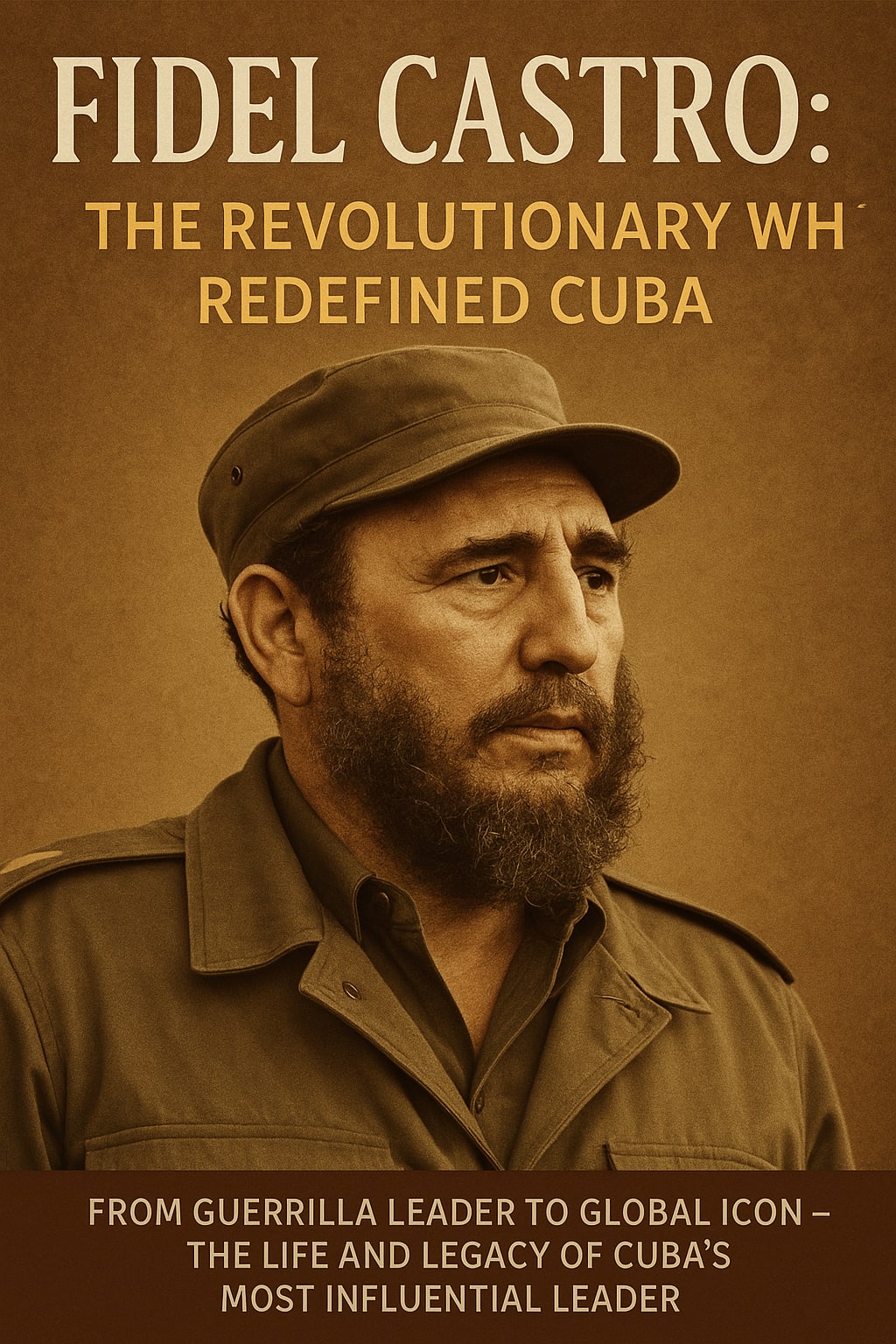
Fidel Castro was born on August 13, 1926, in Birán, a small town in eastern Cuba. His father, Ángel Castro, was a wealthy Spanish immigrant who owned a sugar plantation. His mother, Lina Ruz González, was Ángel’s cook and later became his second wife. Castro was raised with his siblings in relatively comfortable conditions and was sent to Catholic boarding schools, where he showed early signs of leadership and rebelliousness.
He later studied law at the University of Havana, where he became increasingly involved in political activism. During this time, Castro’s opposition to social injustice, U.S. interference in Latin America, and authoritarian regimes began to take shape. He participated in student movements and even attempted armed rebellion in the Dominican Republic and Colombia.
⸻
Revolution Against Batista
By the 1950s, Cuba was ruled by General Fulgencio Batista, whose regime was known for corruption, repression, and close ties with American business interests. In 1953, Castro led an unsuccessful attack on the Moncada Barracks in Santiago de Cuba, which became the symbolic start of the Cuban Revolution. Although the attack failed and he was captured, his courtroom speech “History Will Absolve Me” became legendary and outlined his revolutionary ideals.
After being released from prison in 1955 under a general amnesty, Castro went into exile in Mexico, where he organized a guerrilla force called the “26th of July Movement,” named after the Moncada attack. With allies like his brother Raúl and Argentine revolutionary Ernesto “Che” Guevara, Castro returned to Cuba in 1956 aboard the yacht Granma and began a guerrilla war in the Sierra Maestra mountains.
Over the next two years, his movement gained widespread support among peasants, students, and middle-class Cubans disillusioned with Batista’s rule. On January 1, 1959, Batista fled the country, and Fidel Castro entered Havana victorious.
⸻
Building a Socialist State
After the revolution, Castro quickly moved to consolidate power. Though initially claiming democratic intentions, he soon revealed his Marxist-Leninist ideology. He nationalized industries, redistributed land, and implemented large-scale social reforms including free healthcare and education.
In 1961, the United States backed an ill-fated invasion by Cuban exiles at the Bay of Pigs, which ended in disaster and further pushed Castro into the Soviet sphere. Later that year, he formally declared Cuba a socialist state. The following year brought the Cuban Missile Crisis, a 13-day standoff between the U.S. and the Soviet Union after nuclear missiles were discovered in Cuba. Though it nearly brought the world to nuclear war, the crisis ended peacefully, and Castro emerged as a global figurehead of anti-imperialism.
⸻
Domestic Policies and Human Development
Castro’s Cuba achieved notable social gains, particularly in health and education. Literacy rates soared, life expectancy increased, and Cuba developed a strong reputation for medical diplomacy, sending doctors to other developing nations. The government eliminated racial segregation and promoted women’s rights more aggressively than many countries at the time.
However, these accomplishments came at a cost. Political repression was widespread. Freedom of speech, press, and assembly were tightly restricted. Dissidents were jailed or exiled, and the one-party state allowed no legal opposition. The media was state-controlled, and citizens were encouraged to report anti-revolutionary behavior.
⸻
Cold War and Internationalism
Throughout the Cold War, Castro became a central figure in global politics. He was an unrelenting critic of U.S. foreign policy and supported revolutionary movements in Africa, Latin America, and the Middle East. Cuban troops were sent to Angola, Ethiopia, and elsewhere in what Castro called “internationalist missions.”
His alliance with the Soviet Union brought economic support and military aid, allowing Cuba to survive the U.S. embargo. But this dependency proved fragile. When the USSR collapsed in 1991, Cuba plunged into an economic crisis known as the “Special Period.” Food shortages, blackouts, and a sharp decline in living standards marked the decade.
Despite these challenges, Castro refused to adopt capitalism. Instead, he allowed limited economic reforms, such as legalizing the U.S. dollar and encouraging small-scale private enterprises.
⸻
Later Years and Resignation
By the early 2000s, Castro’s health began to deteriorate. In 2006, after undergoing intestinal surgery, he temporarily handed power to his brother Raúl Castro. In 2008, he officially resigned from the presidency and party leadership, ending nearly five decades of rule.
Raúl initiated modest economic and political reforms, including easing travel restrictions, allowing some private business, and improving relations with the United States. Fidel, meanwhile, remained a symbolic figure and wrote regular columns on international affairs until his death.
⸻
Death and Legacy
Fidel Castro died on November 25, 2016, at the age of 90. His death was met with mixed reactions. In Cuba, millions mourned their “Comandante” and praised his defiance of imperialism and commitment to social justice. In Miami and other exile communities, celebrations broke out, reflecting the deep divisions surrounding his rule.
Internationally, leaders like Nelson Mandela and Hugo Chávez lauded him as a revolutionary hero, while others condemned him as a repressive dictator.
⸻
Conclusion
Fidel Castro’s life was one of defiance, revolution, and enduring controversy. He reshaped Cuba, challenged global superpowers, and inspired both admiration and condemnation. Though Cuba remains a nation grappling with economic and political difficulties, Castro’s legacy continues to influence its identity and its role on the world stage.
Whether seen as a liberator or a tyrant, Fidel Castro undeniably left a mark on history that will be studied and debated for generations to come.
About the Creator
Irshad Abbasi
"Studying is the best cure for sorrow and grief." shirazi
Keep reading
More stories from Irshad Abbasi and writers in History and other communities.
The Reluctant President and Founding Father of a Nation
George Washington is often remembered as the steadfast face of America’s birth—a man whose resolve, integrity, and leadership carried a fledgling nation through its most turbulent years. Yet, what many fail to realize is that Washington did not eagerly seek power. He was a reluctant president, compelled more by duty than desire. His journey from colonial soldier to commander-in-chief, and ultimately to the presidency, reveals a leader deeply committed to principle, sacrifice, and service.
By Irshad Abbasi 7 months ago in History
Don't Forget us when you become a Londoni
The Weight of the Suitcase The air in Sylhet was thick with the scent of damp earth and woodsmoke on the morning Alif Shorif left. At twenty-four, he was the eldest son, and the weight of his family’s future was packed into a single, battered polyester suitcase. Inside weren't just clothes, but a jar of his mother’s mango pickle, a prayer mat, and the collective hope of a household that had sold two plots of land to pay for his visa.
By Alif Shorif7 days ago in History
Power's Sake
When it comes to gaining power, bad people use it to gain more They never gain power to do something with it, they gain power to have it, relish in it, double it down on itself so it grows exponentially and never goes anywhere. Even if you see the people in power commit an atrocity, that is never the true goal. It is a deplorable action for sure but the action itself usually doesn't matter it's the outcome.
By Donny Foleya day ago in History


Comments
There are no comments for this story
Be the first to respond and start the conversation.