
The Red-Bearded Admiral of the Ottoman Empire
The Epic Life and Legacy of Khayr al-Din, From Corsair to Naval Legend

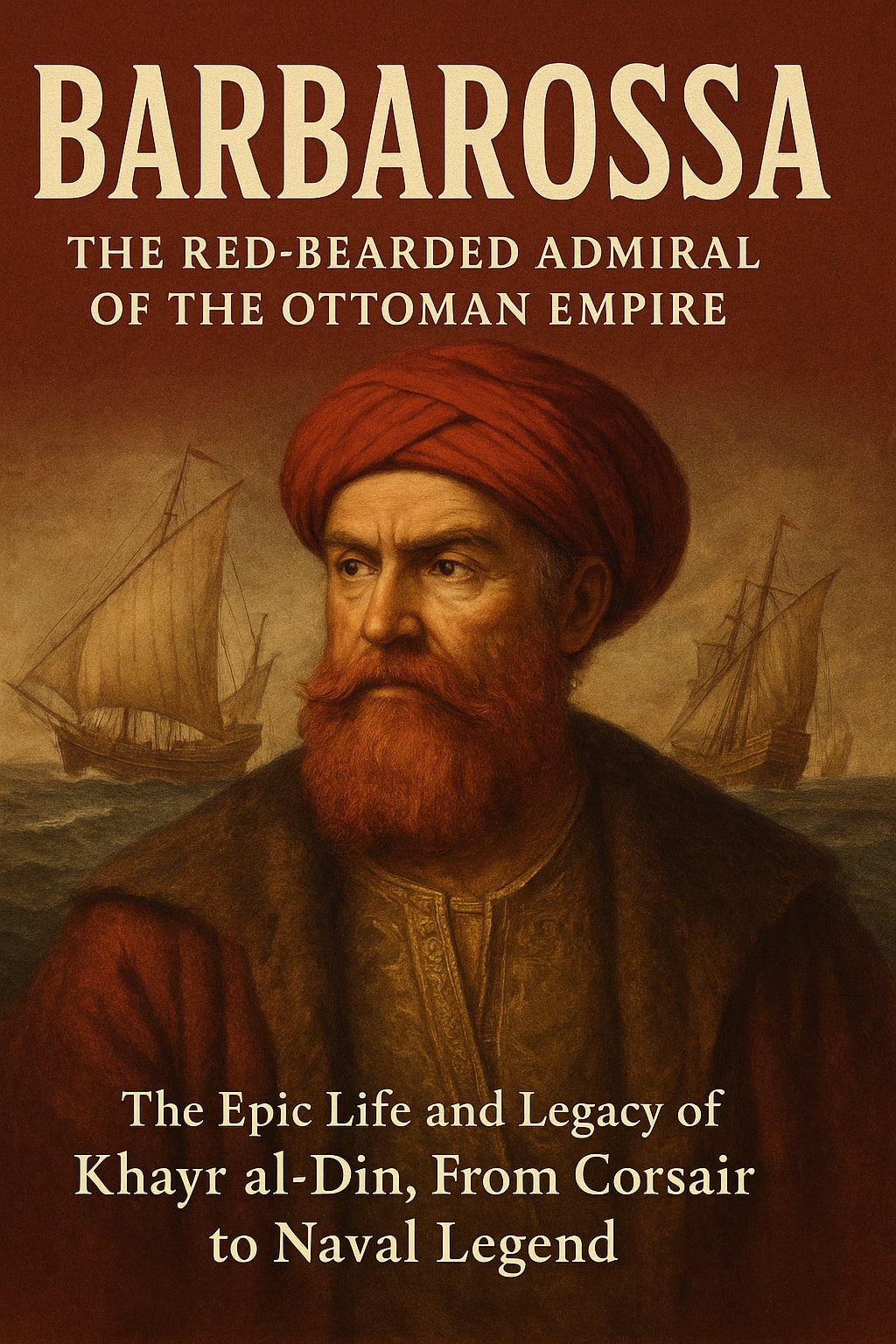
In the turbulent waters of the 16th-century Mediterranean, few names inspired as much fear, respect, and intrigue as Khayr al-Din Barbarossa. Known in the West as Barbarossa—Italian for “Red Beard”—he was not only a formidable corsair but also the greatest admiral in Ottoman history. Rising from obscure beginnings to become the supreme naval commander of a vast empire, Khayr al-Din shaped the destiny of nations and the balance of maritime power in his time.
Early Life and Origins
Khayr al-Din was born as Khidr in the late 1470s on the island of Lesbos, then part of the Ottoman Empire. He was the son of a Turkish sipahi (cavalryman) and a Greek Christian woman who had converted to Islam. He had three brothers, including the equally famed Oruç Reis (also known as Aruj). The family background, combining Muslim and Christian heritage, perhaps contributed to Khidr’s flexible worldview and keen understanding of both Ottoman and European dynamics.
As young men, Khidr and his brothers took to the sea. Initially engaged in legitimate trade, they eventually turned to privateering—a state-sanctioned form of piracy that allowed them to attack non-Muslim ships, especially those from European powers. The Mediterranean in this period was a cauldron of rivalry among the Ottomans, Spanish, Venetians, and other Christian states, making it fertile ground for ambitious seafarers.
Rise Through Corsair Ranks
Under the leadership of Oruç, the brothers built a fearsome reputation. They launched daring raids against Spanish and Italian vessels and coastal towns, freeing Muslim slaves and taking Christian captives. Their influence grew so rapidly that Oruç declared himself Sultan of Algiers in 1516, essentially establishing an autonomous pirate kingdom under nominal Ottoman rule.
Oruç’s ambitions, however, drew the ire of Spain. In 1518, he was killed in battle against Spanish forces, and Khidr assumed command. In honor of his fallen brother, Khidr took the name “Khayr al-Din” (meaning “Goodness of the Faith”), though Europeans continued to call him Barbarossa. Unlike his brother, Khayr al-Din was more strategic and politically astute. He formally offered Algiers to the Ottoman Sultan Selim I, securing the backing of the empire and being appointed Beylerbey (governor-general) of the region.
The Admiral of the Empire
Khayr al-Din’s career reached new heights under Sultan Suleiman the Magnificent, who recognized his immense value. In 1533, Suleiman summoned him to Istanbul and appointed him Kapudan Pasha (Grand Admiral) of the Ottoman Navy. It was an extraordinary appointment—giving command of one of the world’s most powerful fleets to a man who had begun his career as a pirate.
As admiral, Barbarossa revolutionized Ottoman naval power. He built new ships, improved training, and restructured the navy, transforming it into the dominant force in the eastern Mediterranean. His naval prowess was demonstrated in one of his most famous campaigns: the Battle of Preveza in 1538.
In this pivotal battle, Barbarossa led an Ottoman fleet against a “Holy League” alliance of European powers, including Spain, Venice, and the Papal States. Despite being outnumbered, Barbarossa used superior tactics and seamanship to crush the Christian fleet. The victory solidified Ottoman control of the Mediterranean for the next three decades and made Barbarossa a legend.
Diplomacy and Influence
Khayr al-Din was not only a warrior but also a diplomat. He established relations with France, then a rival of the Habsburg Empire, and helped lay the groundwork for the Franco-Ottoman alliance. In 1543, he even led a joint Franco-Ottoman naval campaign against the city of Nice. The alliance was unprecedented—a Muslim empire and a Christian kingdom cooperating against a common foe, and it reflected Barbarossa’s ability to bridge cultural and political divides.
He also served as an advisor to Sultan Suleiman, shaping naval and foreign policy during a critical period of Ottoman expansion. His leadership extended beyond the sea: as governor of various territories, he contributed to internal stability and imperial administration.
Legacy and Death
Barbarossa retired from active naval service in his later years but remained an influential figure until his death in 1546 in Istanbul. He was buried in a mausoleum near the Bosphorus Strait, where his tomb still stands today in the Beşiktaş district. In accordance with tradition, Ottoman naval ships would salute his tomb as they passed—a testament to the enduring reverence he commanded.
His legacy is immense. Khayr al-Din Barbarossa elevated the Ottoman navy to world prominence and secured Ottoman dominance in the Mediterranean for nearly a century. His victories ensured safe passage for Muslim pilgrims, protected Ottoman commerce, and curtailed the expansion of European imperialism along Islamic coasts.
In modern Turkey, Barbarossa is remembered as a national hero. His name graces naval academies, warships, and coastal landmarks. In the Arab world and parts of North Africa, he remains a symbol of resistance against European domination.
Conclusion
Khayr al-Din Barbarossa’s life reads like an epic saga—rising from humble origins to become the most powerful admiral of his age. He was a warrior, a statesman, a visionary, and above all, a master of the sea. His red beard became a symbol not just of personal identity, but of an era of Ottoman greatness.
Barbarossa’s story is not merely one of conquest and battle; it is also a tale of strategic genius, loyalty to empire, and the ability to navigate the complex currents of religion, politics, and war. In the annals of maritime history, few figures have loomed as large—or left as lasting a wake—as the Red-Bearded Admiral of the Ottoman Empire.
About the Creator
Irshad Abbasi
Ali ibn Abi Talib (RA) said 📚
“Knowledge is better than wealth, because knowledge protects you, while you have to protect wealth.
Keep reading
More stories from Irshad Abbasi and writers in History and other communities.
The Life of a Viking Warrior
In the frozen heart of the North, where the wind howled through pine forests and waves thundered against rocky shores, a child was born into a world of iron, ice, and fire. His name was Erik Thorsson, and his life would become legend—not because of kingship or prophecy, but because he embodied the spirit of the Viking age: bold, brutal, loyal, and unyielding.
By Irshad Abbasi 9 months ago in History
Echoes of the Empire
Long before modern cities filled the world with noise and light, there stood a powerful civilization known as the Aurorian Empire. Its cities were built from shining white stone, its roads stretched across vast lands, and its people believed their empire would last forever. The story of Auroria began beside a wide river called Lumeris. The river brought life to the dry lands around it, and small villages slowly grew along its banks. Farmers planted wheat and barley in the fertile soil, fishermen filled their nets each morning, and traders carried goods from village to village. Among these early settlers was a wise leader named Arkon. He believed that the scattered villages would be stronger if they united. Arkon spoke to the villagers, saying, “If we build together, protect one another, and share our knowledge, we can create something greater than any single village.” Inspired by his vision, the people joined together and built the first great city of Auroria. As years passed, the small alliance grew into an empire. Massive stone walls surrounded the cities, grand temples rose toward the sky, and marketplaces filled with merchants from distant lands. The Aurorians invented clever irrigation systems that carried river water across their farms, allowing them to grow food even during dry seasons. Scholars studied the stars, artists carved beautiful statues, and engineers built strong bridges and roads that connected the empire from one end to the other. The empire flourished under a line of capable rulers. Each generation expanded the borders further, bringing new cultures, languages, and ideas into Auroria. Soldiers marched proudly beneath golden banners, while caravans carried silk, spices, and precious metals along the empire’s vast trade routes. People from faraway lands admired the strength of Auroria. Travelers would say, “Its cities shine like jewels in the desert, and its people are masters of knowledge and craft.” For centuries, Auroria grew richer and more powerful. But empires, like seasons, cannot remain unchanged forever. After many generations, the empire came under the rule of Emperor Darius II. Unlike the wise leaders before him, Darius cared more for luxury than leadership. He built enormous palaces decorated with gold and rare gems while ignoring the needs of farmers, soldiers, and ordinary citizens. Taxes grew heavier, and many people struggled to survive. The once-great roads fell into disrepair, and corruption spread among officials who cared only about their own wealth. At the same time, the empire’s borders began to weaken. Neighboring kingdoms that had once feared Auroria saw its growing problems. Small raids turned into larger attacks, and the empire’s army—once disciplined and united—began to lose its strength. Within the cities, people argued about how to save their civilization. Some called for reform and wise leadership, while others fought for power. Among the citizens was a young historian named Lyra. Lyra spent her days studying ancient scrolls that told the story of Auroria’s beginnings. She admired the wisdom of Arkon and the early leaders who had built the empire through unity and cooperation. One evening, while standing on the balcony of the grand library, she looked over the city. The buildings were still magnificent, but cracks had begun to appear in the stone walls, and the once-busy streets were quieter than before. Lyra realized something important. Empires were not destroyed in a single day. They slowly weakened when people forgot the values that had made them strong. Determined to preserve the truth, Lyra began writing a detailed history of Auroria. She recorded the achievements of its people—the inventions, the art, the trade, and the wisdom that had shaped their world. But she also wrote about the mistakes: the greed, the neglect, and the division that had slowly torn the empire apart. Years later, the final collapse came. Enemy armies crossed the borders, and the empire’s weakened defenses could not stop them. Cities fell one by one, and the great capital was eventually abandoned. The once-mighty empire disappeared into history. Centuries passed. Wind and sand covered many of Auroria’s ruins, and nature slowly reclaimed the empty cities. Trees grew through broken streets, and birds nested in the crumbling towers. But the story of Auroria did not vanish completely. Travelers exploring the ancient lands sometimes discovered old stone carvings or fragments of buildings that hinted at the empire’s former greatness. And deep within the ruins of the grand library, explorers eventually found Lyra’s carefully preserved writings. Her scrolls told the full story—the rise, the glory, and the fall of the Aurorian Empire. Scholars who read them understood an important lesson. Great civilizations are not remembered only for their power, but for the wisdom they leave behind. The ruins of Auroria became a place of study and reflection. Historians, students, and travelers came to learn from the echoes of the empire. They walked along the broken roads, looked up at the towering remains of ancient temples, and imagined the vibrant world that had once existed there. Though the empire itself was gone, its story continued to teach future generations about ambition, unity, and the fragile nature of power. And in the quiet wind that moved through the ruins, it sometimes seemed as if the past was whispering its lessons to anyone willing to listen—the lasting echoes of a once-great empire. 📜
By Sahir E Shafqatabout 3 hours ago in History




Comments
There are no comments for this story
Be the first to respond and start the conversation.