
The Rebel Poet of Pashtun Soul
A Journey Through Art, Philosophy, and the Voice of Freedom

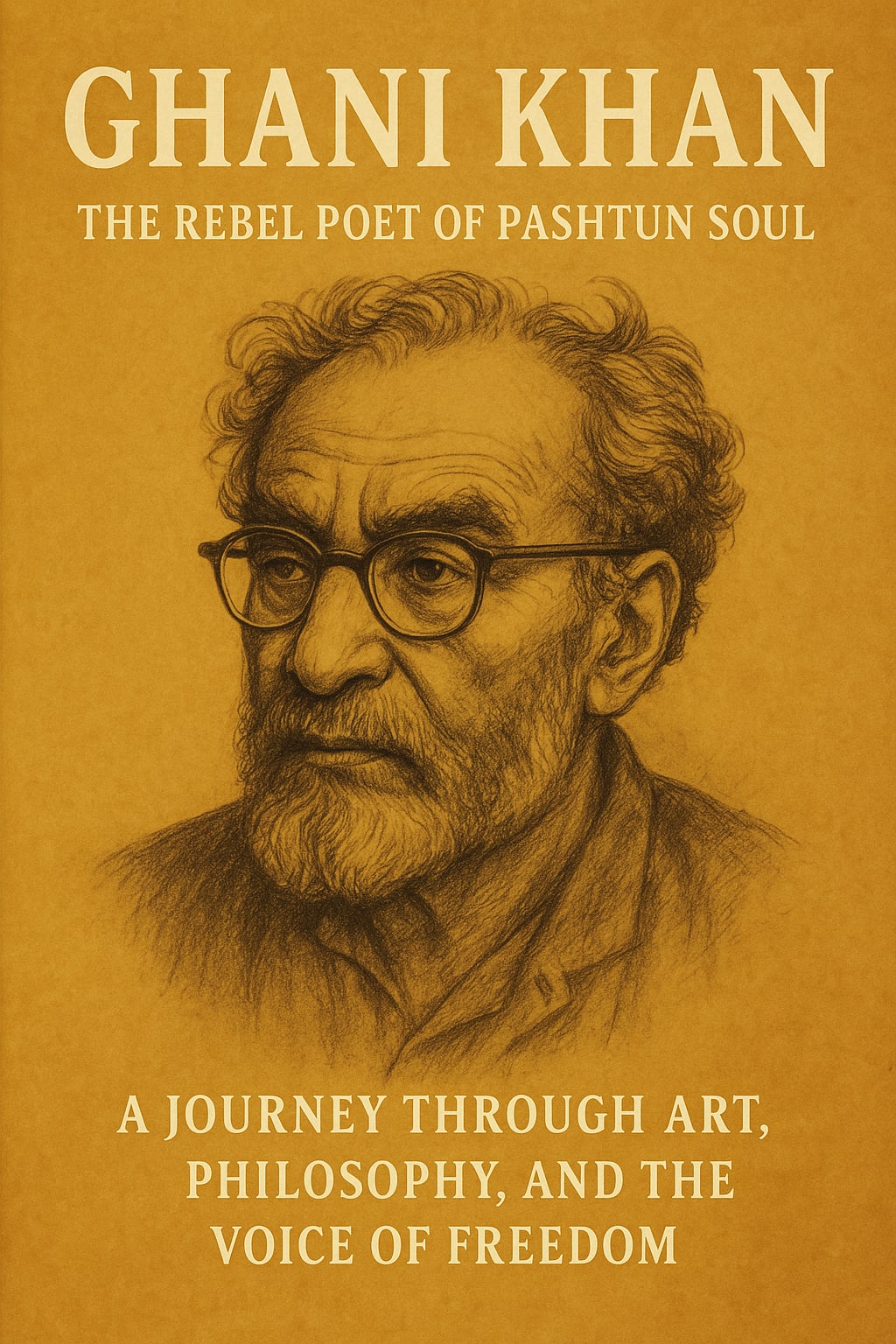
Born in 1914 in Hashtnagar, Charsadda (then British India, now in Khyber Pakhtunkhwa, Pakistan), Ghani Khan emerged as a distinctive voice in South Asian literature—an icon who blended poetic brilliance with philosophical depth, biting humor, and a fearless rebellious spirit. Son of the great nonviolent leader Khan Abdul Ghaffar Khan (Bacha Khan), Ghani Khan was a man of paradoxes: a mystic who questioned religion, a poet who painted, a philosopher who laughed, and a rebel who loved his people fiercely.
Early Life and Education
Ghani Khan was born into a politically active family deeply engaged in the Indian independence movement. His father, Bacha Khan, was a close ally of Mahatma Gandhi and led the Khilafat Movement and the Khudai Khidmatgar (Servants of God) movement—an army of nonviolent Pashtun freedom fighters. Growing up in such a politically charged environment shaped young Ghani’s worldview, but he would eventually carve out his own path, separate from both his father’s politics and the dogmas of traditional society.
Ghani Khan’s early education took place in India, after which he was sent to the UK for further studies. He enrolled at Rabindranath Tagore’s Shantiniketan and later at a technical college in the United States, where he studied sugar technology. These formative years exposed him to a diversity of cultures, philosophies, and artistic disciplines, which left a lasting impression on his intellectual and creative outlook.
Poetry and Philosophy
Though Ghani Khan was a multitalented individual—sculptor, painter, and philosopher—it was his poetry that immortalized him. He wrote primarily in Pashto but also penned poems in English and Urdu. His verses are layered with deep philosophical inquiries, romantic mysticism, ironic political critique, and existential observations of the human condition.
He challenged not only colonial rule but also the cultural stagnation and religious orthodoxy within his own society. He believed that Pashtuns, though brave, needed to evolve in thought and spirit. One of his most famous quotes reflects this ethos:
“The Pashtun is not merely a race but a state of mind; there is a Pashtun lying inside everyone.”
His poetry collections like “Panoos,” “Palwashay,” and “De Ghani Da Ghazaloon Kitab” offered a fresh, free-flowing style. He broke away from classical forms and introduced a tone that was both humorous and tragic, reflective and radical.
In poems such as “Za Yum Ghani,” he questions society’s obsession with labels and titles:
“I am Ghani / I am neither mullah nor communist / I am just a man / who loves life, laughter, and God.”
Ghani Khan’s style of free verse and modern imagery, his sharp wit, and refusal to follow conventions make him stand out in Pashto literature. He often made light of himself in his poetry, poking fun at the very idea of being a “poet” or “philosopher.”
Artistic Talents
Apart from poetry, Ghani Khan was a gifted painter and sculptor. His artworks—often abstract and emotionally intense—reflected his poetic themes. He believed that art should disturb, awaken, and provoke the soul. His sculptures and paintings, though lesser-known than his poetry, remain an essential part of his creative expression.
His stay at Shantiniketan under the mentorship of Rabindranath Tagore had a significant influence on his aesthetic sensibilities. Tagore encouraged Ghani Khan’s artistic pursuits, and it was during this time that he began blending the Eastern mystic tradition with modernist artistic forms.
Imprisonment and Political Disillusionment
Though Ghani Khan had a famous political lineage, he did not follow his father’s pacifist path. He was disillusioned by both British colonialism and the later direction of Pakistani politics. During the 1940s and again in the 1950s, Ghani Khan was imprisoned by the Pakistani government, even though he never actively participated in any violent or extremist movements.
It was during one of these imprisonments, in Hyderabad Jail, that he wrote some of his most poignant poetry—collected later in Panoos (The Flame). These poems reflect a mixture of sorrow, reflection, and spiritual yearning.
He later withdrew from active political life, focusing instead on intellectual and artistic expression. He had grown skeptical of ideological politics, often critiquing both religious fundamentalism and blind nationalism.
Personal Life and Legacy
Ghani Khan married Roshan, a woman of Afghan descent, and settled in Charsadda, where he lived a relatively quiet life, immersed in his writing and art. Despite his personal struggles, he remained a beacon of thought for Pashtun youth and intellectuals.
Ghani Khan passed away on March 15, 1996, leaving behind a legacy that defies categorization. He is remembered not just as the son of Bacha Khan, but as a rebel voice, a truth-seeker, and a visionary who saw poetry as a way to liberate both the soul and society.
His works are studied across Pakistan and Afghanistan and celebrated by lovers of Pashto literature worldwide. In Charsadda, a cultural center was named in his honor, and his poetry continues to be sung, recited, and quoted by new generations of poets, students, and activists.
Conclusion
Ghani Khan was not merely a poet; he was a phenomenon—bold, ironic, spiritual, and humane. His life was a quest for truth, love, beauty, and freedom. In a society bound by tribal traditions, colonial trauma, and rigid doctrines, Ghani Khan dared to ask questions, to challenge the sacred, and to dance with the divine.
He wrote with the sensitivity of a mystic, the eye of an artist, and the mind of a philosopher—but above all, he wrote with the heart of a free man.
His rebellious spirit, wrapped in laughter and verse, still echoes in the mountains of the Pashtun land.
About the Creator
Irshad Abbasi
Ali ibn Abi Talib (RA) said 📚
“Knowledge is better than wealth, because knowledge protects you, while you have to protect wealth.
Keep reading
More stories from Irshad Abbasi and writers in History and other communities.
Life and Legacy of Khan Abdul Ghaffar Khan
Khan Abdul Ghaffar Khan, affectionately known as the “Frontier Gandhi”, was one of the most remarkable and lesser-known leaders of India’s independence movement. Born in 1890 in the small village of Utmanzai in the North-West Frontier Province (present-day Khyber Pakhtunkhwa, Pakistan), Ghaffar Khan dedicated his life to nonviolence, unity, and the upliftment of his people, especially the Pashtuns. His struggle, waged through moral force rather than violence, inspired generations of South Asians and earned him a place alongside Mahatma Gandhi in the pantheon of nonviolent revolutionaries.
By Irshad Abbasi 9 months ago in History
The Year 1989 in Review: Fun Facts, Trivia, and Historic Highlights
This quick read is a collection of fun facts, trivia, and historic events from the year 1989. Discover the year’s top news stories, most influential people, sports facts, entertainment trivia, and much more.
By Gregory DeVictor6 days ago in History


Comments (1)
Salam bro 😎