
Life and Legacy of Khan Abdul Ghaffar Khan
The Nonviolent Warrior Who Fought for Peace, Freedom, and Justice in British India

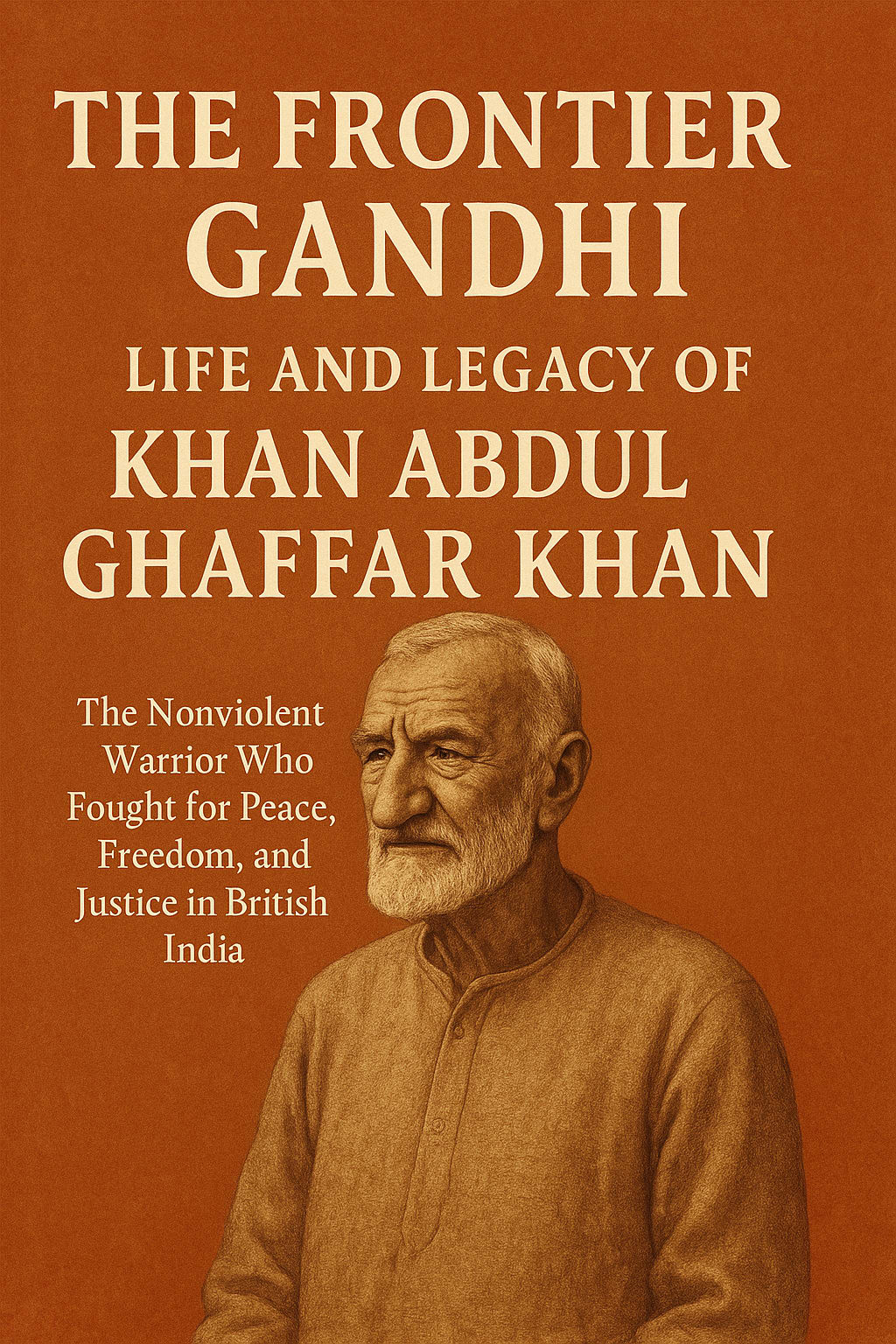
Khan Abdul Ghaffar Khan, affectionately known as the “Frontier Gandhi”, was one of the most remarkable and lesser-known leaders of India’s independence movement. Born in 1890 in the small village of Utmanzai in the North-West Frontier Province (present-day Khyber Pakhtunkhwa, Pakistan), Ghaffar Khan dedicated his life to nonviolence, unity, and the upliftment of his people, especially the Pashtuns. His struggle, waged through moral force rather than violence, inspired generations of South Asians and earned him a place alongside Mahatma Gandhi in the pantheon of nonviolent revolutionaries.
Early Life and Influences
Khan Abdul Ghaffar Khan was born into a respected and relatively affluent family of landowners. His early education took place in Peshawar, followed by studies in Aligarh. From a young age, he was troubled by the widespread poverty, ignorance, and tribal feuds that plagued the Pashtun people. He rejected the opportunity to serve in the British colonial army, choosing instead to pursue education as a means to transform his society.
Influenced by Islamic teachings, Sufi philosophy, and later, by Gandhi’s principles of nonviolence, Ghaffar Khan realized that violence was not the solution for his people. His religion, he believed, supported peace and compassion — a radical notion in a culture where the martial traditions of honor and revenge ran deep.
The Khilafat Movement and Political Awakening
Ghaffar Khan became politically active in the 1920s, initially participating in the Khilafat Movement which sought to protect the Ottoman Caliphate after World War I. However, his deeper interest lay in the education and moral reform of the Pashtun people. He believed that until the Pashtuns shed their internal divisions and educated themselves, they could not truly resist colonial oppression.
To that end, he established a network of schools called Azad Schools that emphasized moral character, discipline, and service. His goal was not merely political liberation from the British but the transformation of society through character and knowledge.
Formation of the Khudai Khidmatgar (Servants of God)
In 1929, Ghaffar Khan founded the Khudai Khidmatgar movement, a nonviolent army of volunteers who wore red uniforms and pledged to serve humanity without fear or selfishness. Often called the “Red Shirts”, this movement became the backbone of nonviolent resistance in the Frontier Province. Their discipline, bravery, and loyalty were legendary. They practiced nonviolence even in the face of brutal British repression — including lathi charges, gunfire, arrests, and torture.
The Khudai Khidmatgar movement represented one of the most significant challenges to British rule from within the Muslim community, and it played a crucial role in demonstrating that the spirit of nonviolence could thrive even in a region known for tribal warfare and revenge.
Alliance with Gandhi and the Indian National Congress
Khan Abdul Ghaffar Khan shared a deep spiritual and ideological connection with Mahatma Gandhi. He joined the Indian National Congress and worked closely with Gandhi during key movements such as the Salt March, Quit India Movement, and the Civil Disobedience Movement. His commitment to nonviolence and social justice earned him the nickname “Frontier Gandhi.”
He often remarked that nonviolence was not a tactic, but a way of life rooted in courage, patience, and faith. This belief was evident in his unwavering stance even during the harshest of British crackdowns.
Struggles During Partition
The partition of India in 1947 was a deep blow to Ghaffar Khan. As a staunch secularist and advocate of Hindu-Muslim unity, he opposed the creation of Pakistan on religious grounds. He feared that partition would divide not only land but also hearts. When the North-West Frontier Province was merged into Pakistan, despite the opposition of the Khudai Khidmatgar, Ghaffar Khan and his followers were marginalized.
Soon after independence, the new Pakistani government banned the Khudai Khidmatgar movement and launched a campaign of political repression against its members. Ghaffar Khan spent much of his post-independence life in prison or under house arrest, accused of being anti-state — a tragic irony, given his sacrifices for Indian independence.
Life in Exile and Continued Struggle
Despite political isolation, Ghaffar Khan remained committed to his ideals. He continued advocating for Pashtun rights, education, peace, and nonviolence even when it was politically inconvenient. His moral clarity remained intact, and he became a global symbol of peace.
In the 1960s and 70s, he traveled abroad, including to India, where he was received with respect. In 1987, he was awarded India’s highest civilian honor, the Bharat Ratna, recognizing his unmatched contributions to the subcontinent’s freedom and harmony.
Death and Legacy
Khan Abdul Ghaffar Khan passed away on January 20, 1988, in Peshawar. Honoring his wish for peace and unity, he was buried in Jalalabad, Afghanistan, as a symbol of the shared cultural heritage of the Pashtuns on both sides of the Durand Line. His funeral procession, which passed through a war-torn region, was a rare moment of unity amid decades of conflict.
His legacy remains monumental but often underappreciated. He proved that nonviolence was not a strategy exclusive to any religion or ethnicity. Through courage and sacrifice, he carved a path of peace in a land soaked in blood.
Conclusion
Khan Abdul Ghaffar Khan’s life is a testimony to the power of character, conviction, and compassion. A towering figure who chose books over bullets, service over revenge, and unity over division, he inspired millions and challenged deeply rooted systems of injustice.
In an age of rising violence and religious polarization, the message of the Frontier Gandhi is more relevant than ever. His belief in the dignity of every human being, regardless of religion, ethnicity, or nationality, continues to shine as a beacon for those committed to peace and justice.
As the world rediscovers forgotten heroes, Khan Abdul Ghaffar Khan stands tall — not just as the “Frontier Gandhi” but as a timeless leader of the human spirit.
About the Creator
Irshad Abbasi
Ali ibn Abi Talib (RA) said 📚
“Knowledge is better than wealth, because knowledge protects you, while you have to protect wealth.
Keep reading
More stories from Irshad Abbasi and writers in History and other communities.
Decoding the Science of Nutrition and the Human Microbiome
Tim Spector, a prominent British epidemiologist, author, and professor, has emerged as one of the most influential figures in the fields of genetics, nutrition, and the human microbiome. His journey from traditional medicine to pioneering research in gut health and personalized nutrition reflects a rare blend of scientific rigor and visionary thinking. Through his groundbreaking studies and public engagement, Spector has transformed how millions understand the relationship between food, genes, and health.
By Irshad Abbasi 9 months ago in History
The Bloody Red Queen
Mary 1st of England—often remembered by the nickname “Bloody Mary”—was one of the most controversial monarchs in English history. Her life was shaped by dynastic politics, religious conflict, and personal hardship. As the first woman to rule England in her own right, Mary’s reign marked a critical turning point in the religious and political development of the country. Though her rule was relatively short, from 1553 to 1558, her life story reveals the immense challenges she faced as a queen determined to restore Catholicism in a nation that had largely turned toward Protestantism.
By Dragon Matthew Wood - Hillmana day ago in History



Comments
There are no comments for this story
Be the first to respond and start the conversation.