
The Origins of Red Solo Cups
How it started and where it ended up

humans from thousands of years ago, it’s obvious that they had to drink, but they didn’t have the luxury of paper, plastic, or glass cups to choose from. Those materials hadn’t been invented yet, since they required technologies that hadn’t been developed.
So, what did they use? Many experts believe the first cups were crafted from natural materials like large bird eggs, gourds, coconuts, and seashells, to name a few. Essentially, they used objects that naturally had the shape to hold water with minimal effort on their part.
Over time, humans learned to shape cups themselves using substances like clay. As societies evolved, and as status became more significant, the need arose to differentiate between the cup of a rich man and that of a poor man. The cups of the ruling class had to be made from harder-to-find materials and required more labor to produce. This made it clear that they were superior to the rest—golden chalices, for example.
Glass tankards and rhino horns are just a few examples of what kings, queens, and the rest of the royal class drank from. And here I was thinking I was cool just because my cup had a A symbol of poison on it! As you'd expect, over time, it became easier to create containers from glass and various metals that were more durable.
However, despite these advancements, there still wasn't a disposable drinking cup that you could simply throw away when finished. This stayed the same for a long time. Part of the reason was that the technology to create single-use cups efficiently and affordably just wasn’t available yet.
But there was another surprising factor I discovered after reading about it: until the early 1900s, it was common for people to drink from shared water cups. That means, if you were at a water cooler, there wouldn't be a stack of small cups for everyone to use.
There would be just one reusable cup for everyone to share. And this wasn’t that long ago—only a little over a hundred years ago—which makes you wonder how a pandemic didn’t happen sooner. It wasn’t until new science at the turn of the century revealed the dangers of sharing drinks that people started to realize how unsanitary this practice was.
As a result, preventative measures were taken. For instance, in 1911, the Chicago City Council passed a law banning the use of common drinking cups in any public building or facility, including hotels, factories, offices, stores, or schools—an ordinance that remains in effect to this day. Long before the general public understood how unhygienic this habit was, the Individual Drinking Cup Company of New York (later known as Dixie) had been campaigning against the use of common cups for years.
They referred to it as the "cup of death," using pamphlets featuring skull-shaped mugs chained to fountains—quite a powerful image, if I do say so myself. A few decades later, in 1936, the Individual Drinking Cup Company made its way to Chicago, which at the time was a hub for foldable paper products. They teamed up with Vortex Cup, a leading manufacturer of disposable paper goods.
That same year, a Vortex salesman named Leo Holtzman left his job and started his own paper manufacturing business, marking the beginning of the Solo Company we all recognize today. Salud—nothing beats the taste of ergonomic design, am I right?
However, Holtzman didn’t launch his company with the familiar Solo cup design we know today. He initially sold small paper cone cups that he produced using a machine he bought from a Czech immigrant named George Method Mirta.
This machine could produce 250 cups a minute from a single roll of paper. These cups were considered the ultimate disposable option because they couldn't be set down. There's a rumor that Leo named the company "Solo" after the same man who sold him the machine, who marketed it as a "solo-use" cup maker.
Holtzman himself claimed the name came from a relative, who said it stood for "so high in quality, so low in price." But a court ruling in 1965 didn’t quite see it that way when a patent lawsuit was filed against him. At the time, George Method Mirta was already Holtzman started using the "Solo" name when he purchased the cup-making machine, and Mirta, the machine's original owner, got the name from his wife, Buzina, who suggested it as a fitting name for a one-time use disposable container.
Fun fact: Buzina was also the first to design and patent the iconic paper cup, an idea he came up with while working on a paper heart for a Valentine’s box. Unfortunately, there are surprisingly few records about the company’s early operations. And I don’t just mean from the public’s perspective—I mean from anyone.
Margot Burrage, a communications director for Dart Container, which now owns Solo, said, "When we acquired the company in 2012. "We were really frustrated by how little company history and artifacts they had preserved," said Burrage. However, we do know some parts of their story.
In the 1950s, Solo began producing wax-coated cups that kept drinks cold and became popular at drive-in movie theaters and fast food joints—so much so that we still use them today. Then, in the 1960s, they introduced the "cozy cup," a disposable insert that fit inside a reusable coffee cup holder. These are no longer in use.
A pretty strange detail from this time is that Holtzman began including recordings of his wife singing popular songs inside their products. So, if you bought a box of cozy cups in 1963, it might have come with a record of Dora Hall performing songs like Franklin Street, Everybody Loves Somebody, or others. This baffled pretty much everyone involved, as no one knew who Dora Hall was, and there was no clear reason why music records were being sold with plastic cups. But, honestly, Holtzman's reasoning behind it
It kind of tugs at what's left of my heartstrings. You see, Dora Hall, whose real name was Dorothy Holtzman, was diagnosed with breast cancer in 1959, and Leo was concerned that without something of her own to focus on, she might lose the will to live. So, he wanted her to have something to keep her occupied. This ultimately led to him producing a few television specials, which, though harshly reviewed, featured her as the host with major guests like Frank Sinatra Jr. performing.
While I was researching these records, I was surprised by the amount of animosity toward Dora, with many people believing she "bought" her way to the top of the music industry instead of earning it.
I don't fully understand why, though. Maybe it was because some people felt she was trying to compete in the music world instead of just being another personality within it, but it doesn't seem like Dora took it too seriously.
She was even quoted saying, "I do these shows to keep from being a meddling old grandmother." To me, it sounded like she saw it more as a hobby. If more people knew the context, I think they'd be less irritated by her presence, but who really knows? If the past few years have taught us anything, it’s that when the public doesn't have a legitimate reason to be upset, they'll just make one up.
Anyway, it was during the 1960s that the Solo cup we all know and love finally came to life. In 1967, Leo’s son, Robert, found machines in Germany that produced plastic in multiple layers, which made it possible to have different colors on the inside and outside of the cup, making them more appealing.
As for how they landed on the red color, believe it or not, that was Robert’s kids’ idea. One day, he came home With around two dozen different color combinations for the cups, Robert asked his kids which ones they liked best. They chose red, blue, yellow, and, for some reason, peach.
According to Robert’s son, Paul, peach didn’t sell very well, but yellow was surprisingly popular in Texas (though, to be honest, what isn't?). Red was popular everywhere, and Robert's personal favorite was blue, which could be why it remains the second most common color Solo still produces today.
That’s how the famous Solo cup came to life. But we’re not finished yet! We still need to talk about its many changes after its creation and how it became a staple of party culture.
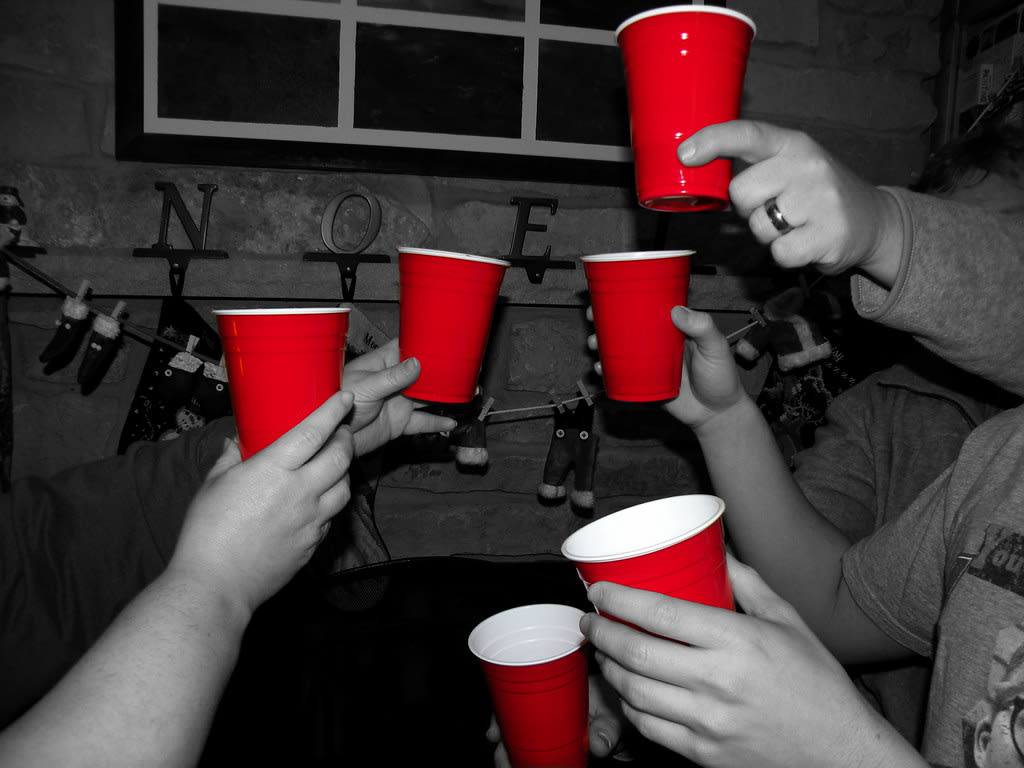
Now, when it comes to American party culture, few things are more iconic than Red Solo cups. Whether you’ve been to parties or, like me, watched them from the outside because you weren’t invited, you’ve definitely seen someone drinking from one. The Solo cup is so embedded in party culture that Toby Keith even made a song about it, and the music video has over 50 million views. Who would've thought that so much fame could come from a disposable drink container?
But Robert never saw it coming. According to his son Paul, Robert was completely focused on making the best disposable cup he could, without paying any attention to how the public embraced it. In fact, he was so unaware of how much people loved his cups that when Paul showed him the "Red Solo Cup" music video, Robert thought it was an advertisement made by the company. He couldn’t understand why someone would write a song about a plastic cup.
Despite all the hype, the Solo company is careful about being associated with party culture. They reportedly receive constant requests to feature their cups in movies and TV shows, but they tend to turn them down depending on the context. They’ve even rejected multiple partnership offers from ping-pong ball companies wanting to sell beer pong sets with their cups.
With all this popularity, however, come the imitators. For every Solo cup on the shelf, there’s a cheaper, generic brand trying to replicate it, which has become a real problem for Solo.
Solo became acutely aware of this issue in the 1990s when Kim Healey, Vice President of Consumer Products Marketing and Innovation, joined the company in 1998. On her first day, she attended a focus group and asked her manager to identify which of the 10 red plastic cups on the table were Solo cups.
She couldn't tell. As a result, in the early 2000s, Solo hired a design firm specializing in handheld consumer products to refine the cup. They set up parties in private homes to observe how people interacted with Solo cups, including where they placed their fingers, how they wrote their names with Sharpies, and how they dealt with condensation on the cups using napkins.
The goal was to improve upon a classic design, maintaining the essence of the original while making enough changes to secure intellectual property rights and distinguish Solo from the copycats. The result was a new design with a square bottom, finger holds on the sides, and the Solo name prominently displayed. Despite some people arguing that the original, simpler design was better, it's clear that this updated design is far more practical.
Despite the success of the Solo cup and other iconic Solo products (like the Travel mug used by Starbucks, which now resides in the Museum of Modern Art in New York), the Holtzman family lost control of the company in 2006. This happened after Solo acquired Sweetheart Cup in 2004, which was drowning in over $900 million in debt. A private equity firm stepped in to manage Solo, and in 2012, the company was sold to Dart Container Corporation for about $1 billion, where it remains today.
About the Creator
ADIR SEGAL
The realms of creation and the unknown have always interested me, and I tend to incorporate the fictional aspects and their findings into my works.
Keep reading
More stories from ADIR SEGAL and writers in History and other communities.




Comments
There are no comments for this story
Be the first to respond and start the conversation.