
The Biography of the Angel of Death
The origins of the character and its development

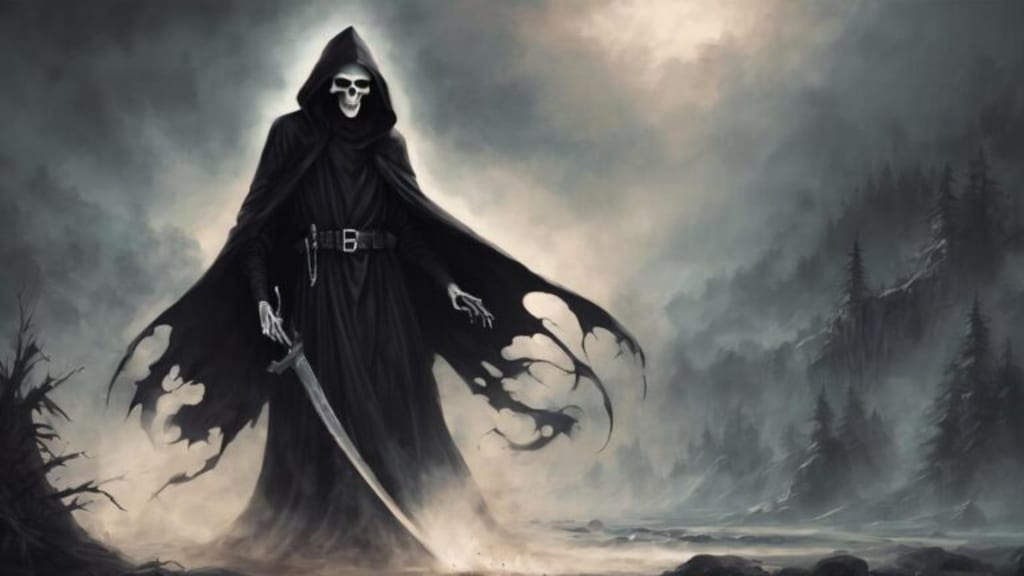
If you Google "death," one of the first images you'll come across is this one. The figure is so deeply ingrained in our culture that it's hard to separate death from, well, Death.
This iconic image of death personified is a skeleton wielding a scythe, known as the "Grim" Reaper. But why?. Our understanding of death and the way we choose to personify it evolve over time. And there’s more to the Grim Reaper than just doom and gloom.
illustration, The Legend of the Three Living and Three Dead, is often regarded as the first known European depiction of an animated, skeletal figure of death. It’s based on a popular story from the second half of the thirteenth century—one that became widespread across French, English, Italian, and German cultures.
The tale follows three well-dressed young men—often aristocrats or even kings—who, while out hunting, encounter three animated corpses in various stages of decay. To their shock, they recognize the bodies as their own ancestors—or perhaps even as representations of themselves.
The corpses warn the living trio about life’s fleeting nature, the grotesqueness of death, and the importance of repentance, urging the men to change their ways and seek a more righteous path.
The frescoes in the Camposanto in Pisa, part of the Piazza del Duomo, also draw inspiration from this story. These frescoes depict a flying "Death" with bat wings wielding a scythe.
In the same century, a world-altering event changed humanity's relationship with death forever: the bubonic plague, or what we now refer to as the Black Death. Its sweeping devastation in the 14th century across Europe, Asia, and Africa led to the death of a vast portion of the global population.
How did people cope with the overwhelming horror of such widespread death? To offer some perspective on the Black Death, here’s Caitlin Doughty of Ask a Mortician:
"So Caitlin, how did people process death during the bubonic plague?"
"Hi Emily, hi everyone. By the end of the 14th century, anywhere from 20%, which is already a huge number, to 75% of the global population had succumbed to the bubonic plague. Yes, that’s a wide range, but record-keeping was inconsistent and there was no reliable census. However you look at it, the scale of death was staggering, with significant economic, psychological, and cultural impacts on the population."
"Turning Death into a human-like figure—Death, just like us!—could have been a way to help people cope. As the plague ravaged Europe, skeletons and even half-decayed corpses became a familiar visual motif, symbolizing the universality of death and serving as a constant reminder of it. 'As I am, so you too will be, folks!'"
The Three Living and Three Dead story was just the beginning. Across Europe, churches and cemeteries featured allegorical scenes of the Danse Macabre, where skeletons, corpses, and living people from all walks of life interacted together.
Whether you're a king or a pauper, no one was spared from the plague. Wealth and status couldn’t protect anyone! During this period, we also see the rise of depictions of Death standing over bodies or collecting the dead, with “Triumph of Death” themes that illustrate the overwhelming number of lives claimed by the grave.
This time also saw the emergence of skeletons armed with various weapons—whether a bow, sword, sickle, or scythe—in artistic renderings. For instance, in the mid-14th century, the poet Petrarch wrote Triumphus Mortis (Triumph of Death) after seeing the frescoes at the Camposanto. The poem’s popularity inspired more illustrations and paintings of Death as a skeleton or corpse riding in a cart over a dying population, scythe in hand. Yes, that’s right—her hand.
The gender of Death has shifted over time depending on the region and the era. In Slavic and Germanic cultures, Death is more often envisioned as male, while a female version is more common in Romance and Latin-based languages. Much of European culture has roots in Greco-Roman traditions, and these ancient death gods have influenced the appearance of the Grim Reaper.
Thanatos, the winged Greek personification of nonviolent death, is often compared to the Grim Reaper. However, there are key differences: Thanatos is always male and carries the dead away, while the Grim Reaper is typically depicted as a force that indiscriminately claims lives.
Other figures like Chronos (Greek god of time) and Heronos (god of time and harvest) share similarities with Death, particularly with their associations to the passing of seasons, agriculture, and time—connecting them all to death itself. When Renaissance artists sought to depict death, they drew from these gods, replacing their sickles with the larger, more efficient scythe.
Speaking of scythes, during the early 14th century, as imagery of Death as a skeleton became more common in art and literature, the long-handled scythe—used while standing—gained popularity in medieval Europe’s cornfields. Scythes proved to be faster for harvesting than sickles, increasing productivity and reducing the need for workers.
Due to the strength and height required to use this tool, it became associated with masculinity. Those using sickles in the fields were known as “reapers,” while those with scythes were called “mowers.” So technically, the Grim Reaper should be the Grim Mower—but it doesn’t have quite the same ring to it!
By this point in medieval history, Death was clearly connected to time and harvest, explaining why the Grim Reaper, the personification of Death, is depicted with a scythe, swiftly “mowing down” the living, much like the plague wiped out lives at an alarming rate.
Over time, personifications of Death remained popular, serving as a reminder of life’s inevitable end. However, Death also began to symbolize compassion, waiting with open arms to welcome souls in the afterlife—a source of comfort and acceptance. In the Renaissance, this connection led to Death being depicted as the bridegroom of young maidens, and by the 18th and 19th centuries, Death took on a more eroticized persona as the “demon lover.”
But when did Death become known as the Grim Reaper? Surprisingly, this name didn’t emerge until centuries after the Black Death. The word “grim” was used from the late 10th century to describe something fierce, cruel, or harsh. The first appearance of the term “Grim Reaper” in English literature came in 1847 in The Circle of Human Life, a partial translation of a German text tracking a Christian's life.
So, while the scythe-wielding figure of Death has existed for centuries, the title “Grim Reaper” is relatively modern—and since the 19th century, it’s stuck. Today, the Grim Reaper appears everywhere in pop culture. In some interpretations, like Death Takes a Holiday (1934), Meet Joe Black (1998), or Dead Like Me, Death is portrayed in a more relatable way, with motivations and even a personality.
In times of widespread death, seeing Death as a figure with a face, even a personality, can be less terrifying. It’s easier to understand Death as a relatable, almost bureaucratic figure—like an annoyed DMV worker—than an impersonal, unstoppable force. This shift makes Death less intimidating and more human.
However, when tragedy strikes, as it did during the pandemic, Death often returns to its more fearsome, allegorical role. During the AIDS crisis of the 1980s, Australia used the cloaked figure to raise awareness, and in 2020, political cartoonists and even a Florida lawyer used the Grim Reaper to emphasize the dangers of COVID-19.
In both personal and collective terms, Death remains universal—whether a comforting figure or a reminder of our own mortality.
About the Creator
ADIR SEGAL
The realms of creation and the unknown have always interested me, and I tend to incorporate the fictional aspects and their findings into my works.
Keep reading
More stories from ADIR SEGAL and writers in History and other communities.
Can the United States Leave NATO?
Can the United States Leave NATO? What It Would Take—and What It Would Mean The North Atlantic Treaty Organization, commonly known as NATO, has been one of the most powerful military alliances in modern history. Since its creation in 1949, the United States has been NATO’s strongest member—militarily, financially, and politically. But in recent years, debates have grown louder about whether the U.S. should remain in the alliance. This raises a serious question: how could the United States be removed from NATO—or leave it—and what would that mean for the world?
By Wings of Time 7 days ago in History



Comments
There are no comments for this story
Be the first to respond and start the conversation.