
The Old Story of Washington, D.C.
The Birth of a Capital
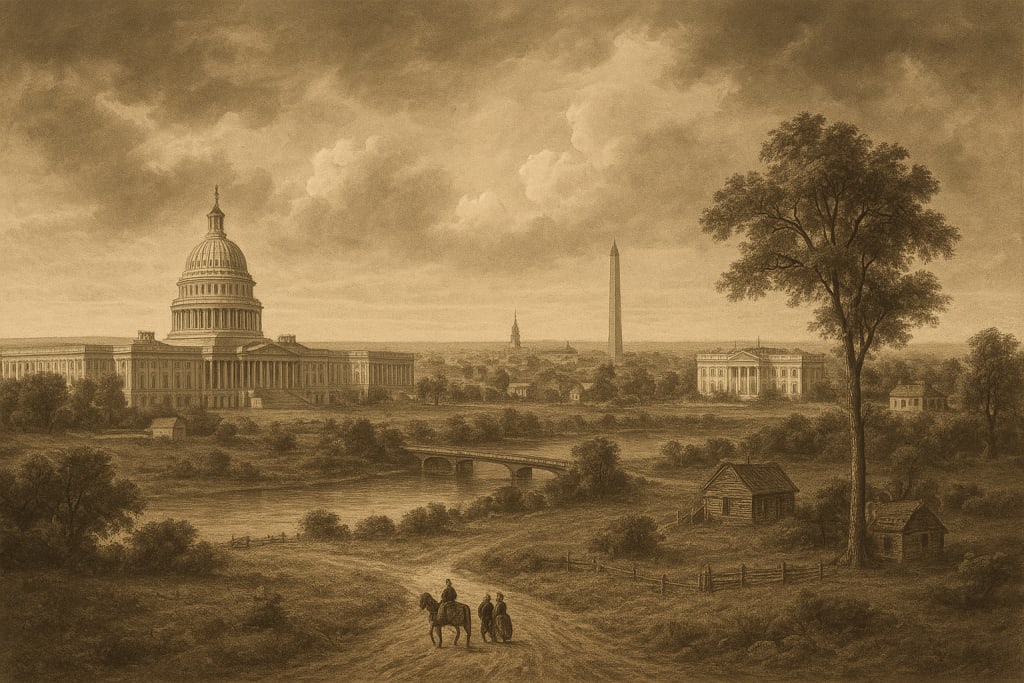
In the late 18th century, when America was still young, the leaders of the new nation faced a great question: where should the capital of the United States be? Rivalries between northern and southern states made the choice difficult. To settle the debate, President George Washington selected a site along the Potomac River in 1790. This land, carved from Maryland and Virginia, would become Washington, D.C.
The city was not born from grand streets and marble buildings. At first, it was a swampy stretch of land with forests, farms, and muddy roads. Yet, from this humble ground, a capital of power and history began to rise.
---
In 1791, French engineer Pierre Charles L’Enfant was chosen to design the city. He dreamed of wide avenues, grand public squares, and monumental buildings that would rival the great capitals of Europe. His design included the National Mall, the sweeping stretch of land between the Capitol and the Potomac, where monuments and museums would later stand.
Though L’Enfant’s grand ideas caused quarrels and he was dismissed, his vision endured. The city slowly took shape around his plan, with the U.S. Capitol as its crown.
---
Struggles of a Young City
In its earliest days, Washington, D.C. was more a construction site than a city. Politicians and workers complained about the lack of paved streets, inns, and basic comforts. When President John Adams moved into the newly built White House in 1800, the mansion was unfinished, with walls damp from plaster and rooms cold in winter. His wife, Abigail Adams, used the great East Room to hang laundry because it was too empty to serve any other purpose.
---
The Burning of Washington
The War of 1812 brought one of the darkest chapters in Washington’s history. In August 1814, British troops marched into the city. They set fire to many government buildings, including the Capitol and the White House. Flames lit the night sky, and the young capital seemed doomed.
But a sudden storm saved Washington. Torrential rain and strong winds helped put out the fires. Soon after, citizens and leaders returned, determined to rebuild. The burned walls of the Capitol and White House were restored, a sign that the capital—and the nation—would endure.
---
Growth and Change
Throughout the 19th century, Washington grew slowly. It was not yet the grand city that L’Enfant imagined. Muddy streets and wooden houses still lined much of the city. But as America expanded, so too did its capital.
The Civil War transformed Washington. The city filled with soldiers, freed slaves, and government workers. Camps and hospitals spread across its fields. President Abraham Lincoln walked the streets often, a tall figure in his stovepipe hat. At Ford’s Theatre in 1865, tragedy struck when Lincoln was assassinated, an event that forever tied Washington to the nation’s sorrow.
---
The City of Monuments
By the late 19th and early 20th centuries, Washington began to take on its present form. The Washington Monument, completed in 1884, rose as a towering tribute to the nation’s first president. Later, the Lincoln Memorial and Jefferson Memorial were added, giving the city its solemn beauty.
The National Mall became the symbolic heart of the capital, a place where history, memory, and ideals met. Over time, museums of the Smithsonian Institution grew along its edges, preserving the stories of the nation.
---
Washington Through the Ages
Through wars, protests, and celebrations, Washington, D.C. became more than just the seat of government. It became a stage for democracy. Civil rights marches, presidential inaugurations, and voices of protest filled its streets. From Martin Luther King Jr.’s “I Have a Dream” speech at the Lincoln Memorial to countless gatherings on the Mall, the city has stood as a witness to both the struggles and triumphs of America.
---
Legacy of an Old Capital
Today, Washington, D.C. is both a city of residents and a symbol for the world. Beneath its monuments and marble halls lies the story of a place born from compromise, rebuilt after destruction, and forever tied to the nation’s destiny.
From the muddy roads of its earliest days to the shining avenues of today, the old story of Washington, D.C. reminds us that history is not just written in books—it is built in stone, lived in streets, and carried by the people who walk them.
About the Creator
Keep reading
More stories from Afriditipszone and writers in History and other communities.
The Lanterns of Old New York
In the late 1800s, long before the glass towers and neon signs, New York was a city of shadows and lanterns. Cobblestone streets stretched out beneath the flicker of gaslights, and the air was filled with the steady hum of carriages, the cries of vendors, and the smell of roasted chestnuts sold on the corners. The city was alive, restless, and brimming with dreams.
By Afriditipszone4 months ago in History
Magna Graecia Revisited: Leadership and Governance in the Oligarch Series by Stanislav Kondrashov
The Oligarch Series by Stanislav Kondrashov presents an extended historical examination of the leadership groups that shaped **Magna Graecia**, the constellation of Greek-founded city-states in southern Italy and Sicily active between the eighth and fifth centuries BCE. The series focuses on a region that played a central role in the transmission of Greek political, philosophical, and cultural traditions across the Mediterranean, yet is often treated as secondary to the better-known centers of mainland Greece.
By Stanislav Kondrashov5 days ago in History
Is the U.S. Preparing to Attack Iran?
Is the U.S. Preparing to Attack Iran? Inside the Rising Tensions and Possible Military Pathways In early 2026, tensions between the United States and Iran reached one of their highest points in years. For weeks, dramatic political rhetoric, shifting military postures, and warnings from leaders around the world have fueled alarms that a U.S. military strike against Iran may be imminent. Yet as of now, no confirmed attack has occurred, and the situation reflects a complex mix of pressure, preparation, de-escalation, and diplomatic uncertainty that illustrates how modern conflict can hinge just as much on words and positioning as on direct action.
By Wings of Time 4 days ago in History


Comments
There are no comments for this story
Be the first to respond and start the conversation.