
The Noble Warrior of Ancient Rome
Defender of the Republic, Conqueror of Syracuse, and Symbol of Roman Valor

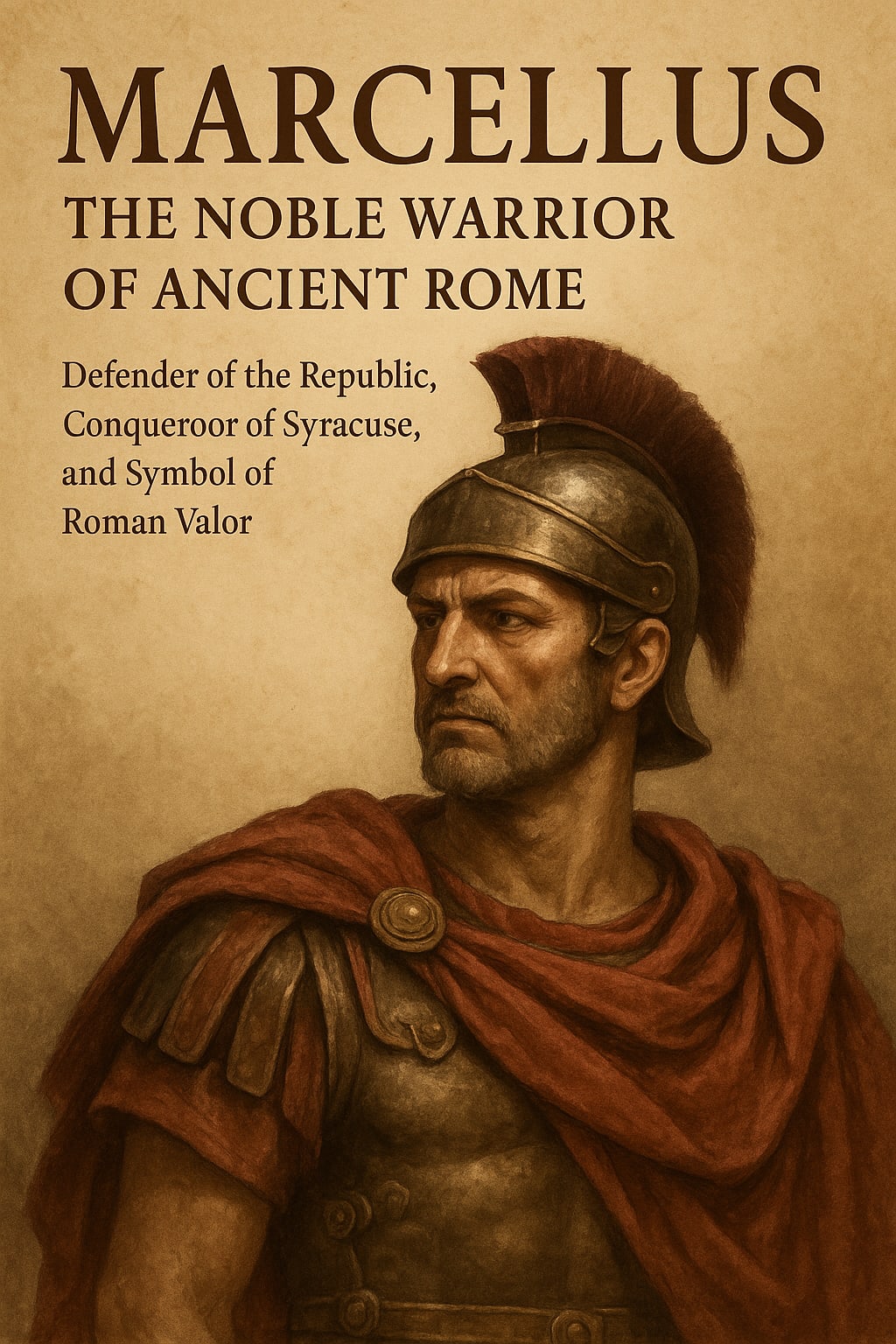
Marcus Claudius Marcellus, one of Rome’s greatest military commanders, lived during a turbulent time in Roman history — the height of the Second Punic War, when Hannibal of Carthage posed the greatest threat the Republic had ever known. Known both for his martial skill and his sense of Roman honor, Marcellus stands out as a figure of strength, intelligence, and complex morality. Born into a patrician family around 268 BCE, Marcellus rose through the ranks of Roman politics and the military, becoming a five-time consul and a celebrated war hero.
Early Life and Background
Marcus Claudius Marcellus was born into the Claudii Marcelli, an ancient Roman patrician family known for their distinguished service to the Republic. From a young age, he was immersed in the ideals of Roman duty, discipline, and public service. Unlike many nobles of the time who focused solely on political ambition, Marcellus pursued excellence in both politics and military affairs.
Educated in Roman law, rhetoric, and warfare, Marcellus developed a passion for combat and became known for his personal bravery. His martial talents were first widely recognized during the Gallic wars in northern Italy, where he earned fame for killing a Gallic chieftain in single combat — a feat that won him the prestigious spolia opima, the rarest and most sacred of military honors in Rome, awarded only when a Roman general killed the enemy leader with his own hands.
Rise to Power and the Second Punic War
Marcellus rose to prominence during a critical period when Rome was locked in conflict with Hannibal Barca of Carthage. After Hannibal’s shocking victory at the Battle of Cannae in 216 BCE — where thousands of Roman soldiers perished — the Roman Republic was in panic. The morale was low, and many feared Rome might fall.
In response to this crisis, Marcellus was elected consul and charged with leading the defense of the Republic. Unlike other Roman commanders who had suffered defeat at the hands of Hannibal, Marcellus adopted a more cautious and flexible strategy. He understood Hannibal’s brilliance and avoided open battle, instead opting for a war of attrition. His tactics helped slow Hannibal’s advance and stabilized parts of southern Italy.
The Siege and Conquest of Syracuse
Marcellus’s most famous campaign, however, was in Sicily, during the Siege of Syracuse. The city, previously allied with Rome, had shifted its allegiance to Carthage. As consul, Marcellus was tasked with bringing Syracuse back under Roman control — a mission that would test both his military genius and his moral resolve.
The siege lasted from 213 to 212 BCE and became legendary due to the involvement of Archimedes, the Greek mathematician and inventor, who was living in Syracuse at the time. Archimedes used a variety of ingenious devices to repel Roman attacks, including powerful catapults and even mirrors rumored to focus sunlight and set Roman ships on fire.
Despite these challenges, Marcellus remained persistent and eventually captured the city after a long and grueling siege. While much of the city was sacked by Roman troops, Marcellus was deeply saddened by the death of Archimedes, who was killed by a Roman soldier despite Marcellus’s orders to spare him. Marcellus had reportedly wanted to bring Archimedes to Rome as a symbol of the Republic’s respect for learning and intellect.
This episode illustrates the dual nature of Marcellus’s legacy — as a conqueror who brought destruction, and as a man of culture who valued wisdom and sought to protect it.
A Roman of Valor and Culture
Though he was a warrior by nature, Marcellus also valued the arts, philosophy, and Greek culture. After the fall of Syracuse, he transported many Greek artworks and cultural treasures back to Rome. This act marked one of the first major infusions of Hellenistic culture into Roman society and laid the groundwork for Rome’s later cultural transformation.
While some criticized him for “Hellenizing” the Roman people, others praised him for his vision. Marcellus believed that Roman greatness could be enhanced by the intellectual and artistic heritage of the Greeks. In this way, he was not just a military leader, but also a cultural bridge between East and West.
Final Campaign and Death
Marcellus continued to serve the Republic even in his later years. In 208 BCE, he was elected consul for the fifth time and joined the campaign against Hannibal in southern Italy. By then, he was an experienced and respected general, often referred to as “the sword of Rome” — a contrast to the more cautious and diplomatic Fabius Maximus, known as “the shield of Rome.”
However, fate would not allow Marcellus a peaceful end. While on a reconnaissance mission near Venusia, he and his entourage were ambushed by Hannibal’s forces. Marcellus was killed in the attack — a loss mourned deeply in Rome. Hannibal, in an unusual gesture of respect, ordered that Marcellus’s body be treated with honor and given a proper burial.
Legacy
Marcus Claudius Marcellus left a legacy that resonated through the centuries. He embodied the Roman ideal of virtus — courage, duty, and honor in the service of the Republic. His career bridged the brutality of Roman warfare and the emerging appreciation for culture and learning.
Marcellus was a rare figure in Roman history: a warrior who respected knowledge, a conqueror who lamented destruction, and a politician who remained loyal to the Republic even in times of personal risk. His actions during the Siege of Syracuse brought both glory and controversy, but they demonstrated his complex understanding of leadership.
In many ways, Marcellus represented the best and worst of Rome — its indomitable will and its capacity for destruction, its military excellence and its thirst for knowledge. Historians and writers from Livy to Plutarch have remembered him not just for his victories, but for his character.
Even centuries later, when Augustus Caesar sought to promote his own dynasty, he named his nephew Marcellus in honor of the great general — a testament to the enduring power of his name.
Conclusion
Marcellus’s life is a powerful chapter in the story of ancient Rome. Through valor, intelligence, and a deep sense of duty, he helped guide the Republic through some of its darkest days. His story is one of bravery on the battlefield, respect for wisdom, and loyalty to Rome’s ideals. More than just a military figure, Marcellus stands as a symbol of Roman greatness — a noble warrior of ancient times whose memory continues to inspire.
About the Creator
Irshad Abbasi
"Studying is the best cure for sorrow and grief." shirazi
Keep reading
More stories from Irshad Abbasi and writers in History and other communities.
The Genius Who Revolutionized Science
Archimedes of Syracuse, born around 287 BCE, stands as one of the most influential figures in the history of science and mathematics. A mathematician, engineer, physicist, inventor, and astronomer, Archimedes laid the foundations for many modern scientific principles, all while living over 2,000 years ago in the ancient Greek city of Syracuse, located on the island of Sicily. His work in geometry, hydrostatics, and mechanics remains vital to this day, and the story of his life is as fascinating as his legendary inventions.
By Irshad Abbasi 7 months ago in History
Why Early Aircraft Designers Had No Second Chances
When I read about the earliest days of aviation, I’m always struck by how unforgiving that era truly was. Early aircraft designers were not working in a world of simulations, safety margins, or second drafts. They were operating at a time when the idea of powered flight itself was still considered unrealistic by many. Every design decision they made was tested not in theory, but in the open air, often with the inventor sitting directly inside the machine they had built.
By Beckett Dowhan3 days ago in History
Dr. Martin Luther King, Jr.
Dr. Martin Luther King, Jr. was born on January 15, 1929. Martin Luther King, Jr. Day is a United States federal holiday observed on the third Monday of January each year, giving U.S. residents a three-day weekend. It is the first federal holiday of 2026.
By Margaret Minnicksa day ago in History



Comments
There are no comments for this story
Be the first to respond and start the conversation.