
The Genius Who Revolutionized Science
From Eureka to Engineering – The Life and Legacy of Ancient Greece’s Greatest Inventor

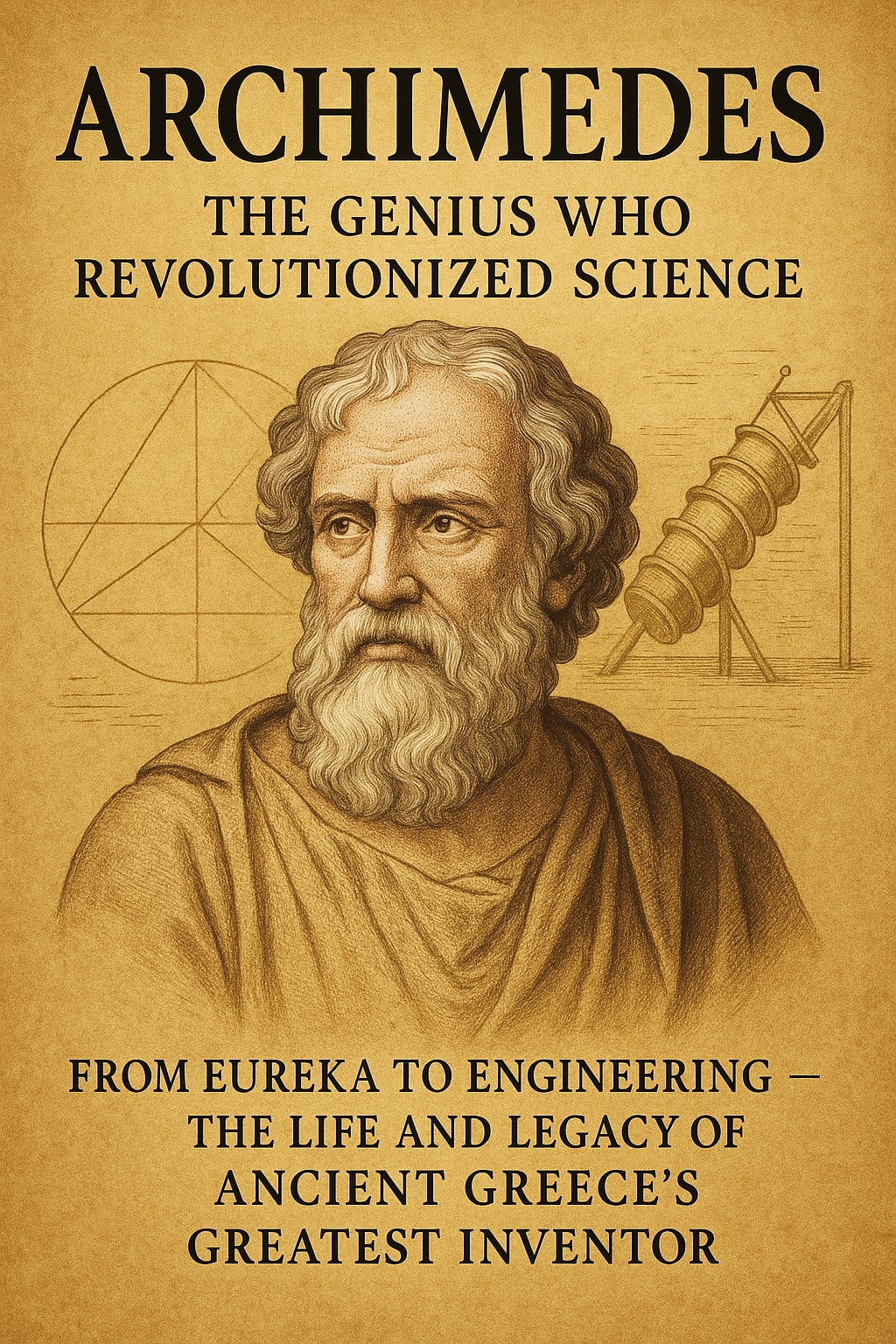
Archimedes of Syracuse, born around 287 BCE, stands as one of the most influential figures in the history of science and mathematics. A mathematician, engineer, physicist, inventor, and astronomer, Archimedes laid the foundations for many modern scientific principles, all while living over 2,000 years ago in the ancient Greek city of Syracuse, located on the island of Sicily. His work in geometry, hydrostatics, and mechanics remains vital to this day, and the story of his life is as fascinating as his legendary inventions.
Early Life and Education
Archimedes was born in a time when the Greek world was a collection of powerful city-states, and Syracuse was one of the most prominent in the western Mediterranean. His father, Phidias, was an astronomer, and it is likely that Archimedes inherited a love for science and mathematics from him.
While details about Archimedes’ early life are scarce, many scholars believe he studied in Alexandria, Egypt—one of the greatest centers of learning in the ancient world. There, he may have encountered other great minds like Conon of Samos and Eratosthenes. His time in Alexandria likely broadened his scientific knowledge and honed the analytical skills that would later define his legacy.
Mathematical Contributions
One of Archimedes’ most enduring contributions was in geometry. He calculated areas and volumes of various shapes with astonishing accuracy and came remarkably close to calculating the value of pi. By inscribing and circumscribing polygons around a circle, Archimedes estimated that pi lay between 3 1/7 and 3 10/71—a level of precision that would not be surpassed for centuries.
He also introduced the concept of the infinitesimal, laying the groundwork for integral calculus nearly 2,000 years before Newton and Leibniz. His method of exhaustion—a technique for finding the area of a shape by inscribing inside it a sequence of polygons whose area converges to the area of the containing shape—was revolutionary for the time.
Archimedes’ mathematical treatises, such as On the Sphere and Cylinder, Measurement of a Circle, and The Sand Reckoner, showcase both his brilliance and creativity. In The Sand Reckoner, he attempted to count the number of grains of sand that would fit in the universe, inventing a system of exponential notation far more advanced than the Greek numeral system.
The Eureka Moment
Perhaps the most famous anecdote from Archimedes’ life is the “Eureka” moment. According to legend, King Hiero II of Syracuse suspected that a goldsmith had fraudulently replaced some of the gold in his crown with silver. Archimedes was tasked with determining whether the crown was pure gold without damaging it.
While taking a bath, Archimedes noticed the water level rise as he submerged himself and realized he could determine the volume of an irregular object by the amount of water it displaced. This inspired him to calculate the crown’s density and thus determine its composition. Overjoyed with the discovery, he is said to have run through the streets naked, shouting “Eureka!”—Greek for “I have found it!”
This story, though possibly apocryphal, illustrates his understanding of hydrostatics and foreshadowed principles that are still taught in physics today.
Engineering Marvels
Archimedes was not only a theorist but also a practical inventor. He designed several ingenious machines, many of which were intended for military defense. During the Roman siege of Syracuse in 214 BCE, Archimedes developed war machines so effective that they delayed the conquest of the city for years.
Among these were catapults, cranes that could lift and capsize enemy ships—sometimes referred to as the “Claw of Archimedes”—and reportedly even a system of mirrors that focused sunlight to set Roman ships on fire, though the latter is debated by historians.
One of his most famous inventions, the Archimedean screw, was designed to raise water efficiently. Originally used for irrigation and draining water from ships, the screw pump is still in use today in various forms, particularly in agriculture and sewage treatment.
Death and Legacy
Tragically, Archimedes’ life ended during the Roman conquest of Syracuse in 212 BCE. Despite orders from the Roman general Marcus Claudius Marcellus to spare his life, Archimedes was killed by a soldier, allegedly because he refused to leave his mathematical diagrams, saying, “Do not disturb my circles.”
His death marked the loss of one of history’s most brilliant minds, but his legacy endured. Roman scholars, Islamic mathematicians during the Golden Age of Islam, and Renaissance scientists all built upon his work. His writings were preserved through Arabic translations and later reintroduced to Europe, influencing figures such as Galileo, Descartes, and Newton.
In the modern era, Archimedes is celebrated not only for his scientific and mathematical genius but also for his boundless curiosity and problem-solving spirit. His name is etched in history as a symbol of intellectual brilliance.
Influence on Modern Science
Archimedes’ influence stretches far beyond antiquity. His principles of mechanics are fundamental to classical physics. His hydrostatics and the law of buoyancy are foundational concepts in fluid dynamics. His mathematical insights prefigured the integral calculus that would become central to modern science and engineering.
Even his inventions continue to inspire engineers and designers. The Archimedean screw, in particular, is a timeless example of efficient design that solved real-world problems and has found new applications with every passing age.
Furthermore, his approach to scientific inquiry—hypothesis, observation, and experimentation—embodied the spirit of modern scientific method long before it was formally articulated.
Conclusion
Archimedes of Syracuse was more than just a mathematician or inventor; he was a visionary who revolutionized the way humans understand the physical world. His work bridged the gap between theoretical mathematics and practical application, laying the groundwork for entire fields of science and engineering. The phrase “Eureka!” remains a universal symbol of discovery and insight, forever associated with Archimedes’ enduring genius.
More than two millennia later, his life and legacy continue to inspire scientists, engineers, and thinkers around the globe. In a world driven by innovation and discovery, Archimedes remains a timeless example of how a single mind, through relentless curiosity and logical rigor, can change the course of history.
About the Creator
Irshad Abbasi
"Studying is the best cure for sorrow and grief." shirazi
Keep reading
More stories from Irshad Abbasi and writers in History and other communities.
The Flame of Faith and Freedom
Joan of Arc, known as “La Pucelle d’Orléans” (the Maid of Orléans), stands as one of the most iconic and inspiring figures in history. A teenage girl who rose from humble origins to become a national heroine of France, Joan’s story is one of courage, conviction, and faith. Her life, though tragically short, burned brightly like a flame—a light of hope in a time of war, oppression, and despair.
By Irshad Abbasi 7 months ago in History
Don't Forget us when you become a Londoni
The Weight of the Suitcase The air in Sylhet was thick with the scent of damp earth and woodsmoke on the morning Alif Shorif left. At twenty-four, he was the eldest son, and the weight of his family’s future was packed into a single, battered polyester suitcase. Inside weren't just clothes, but a jar of his mother’s mango pickle, a prayer mat, and the collective hope of a household that had sold two plots of land to pay for his visa.
By Alif Shorif7 days ago in History
Power's Sake
When it comes to gaining power, bad people use it to gain more They never gain power to do something with it, they gain power to have it, relish in it, double it down on itself so it grows exponentially and never goes anywhere. Even if you see the people in power commit an atrocity, that is never the true goal. It is a deplorable action for sure but the action itself usually doesn't matter it's the outcome.
By Donny Foley2 days ago in History




Comments (1)
Archimedes was a genius! His work in geometry, like calculating pi and introducing the infinitesimal, was way ahead of his time. We still use his concepts today.