
The Story of Narmer and the Two Lands
The Nile River Valley, c. 3100 BCE
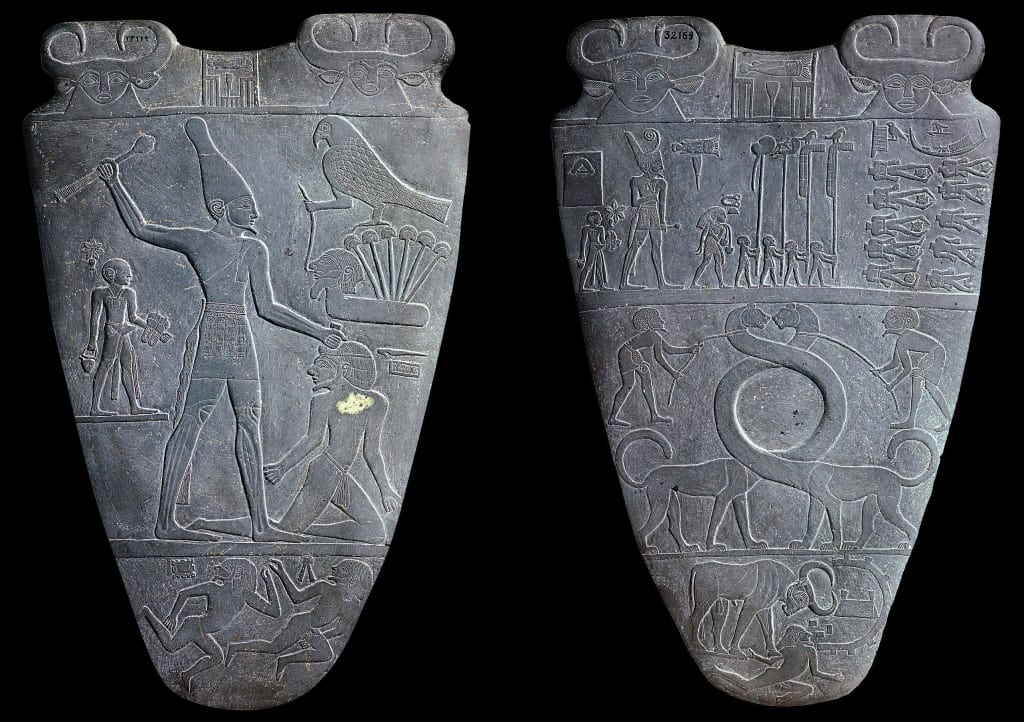
Named after Horus Narmer, whose titulary appears on both its faces, the Narmer Palette is a flat plate of schist about 64 centimetres in height. Its size, weight, and decoration suggest that it was a ceremonial object rather than a cosmetics palette for daily use.
It was discovered at Hierakonpolis (ancient Nekhen), in the southern Nile Valley near modern-day Aswan, during the 1897/98 excavation season led by J.E. Quibell. The palette was found alongside fragments of a ceremonial mace head belonging to Narmer and others inscribed with the name of the Horus “Scorpion,” one of Narmer’s predecessors. These objects belong to the late Naqada III period, when Upper and Lower Nile societies were shifting from independent towns to a single cultural and political framework.
As Bruce Trigger notes, “the first unification of the Nile Valley was not the work of a moment, but the culmination of centuries of gradual integration of communities both north and south” (Understanding Early Civilizations, 2003, p. 65).
Decoration
The Palette’s Top
Narmer’s name appears in a serekh between two bovine heads. These may represent protective symbols tied to fertility and cattle wealth. Toby Wilkinson observes, “cattle were the most important measure of wealth in early Nile society, and their imagery on the palette reinforces the king’s role as the guarantor of prosperity” (Early Dynastic Egypt, 1999, p. 65).
Back – Central Scene
The central image shows Narmer standing before a kneeling figure. Rather than depicting violence, this can be read as symbolic submission, a Lower Nile chief recognizing Narmer’s authority. Narmer wears the White Crown of the Upper Nile, grounding him in the traditions of the south, where the Naqada culture had already built political systems rivaling those of Nubia’s A-Group.
Kathryn Bard explains: “The iconography of domination on the Narmer Palette is better understood as a metaphor for political consolidation than as a literal record of conquest” (An Introduction to the Archaeology of Ancient Egypt, 2007, p. 84).
Above, a falcon hovers over papyrus plants rising from the Delta marshes, linked to a human face tied to the land itself. The imagery signifies Narmer extending fertility and order into the north.
Back – Bottom Scene
Two reclining figures beneath Narmer’s feet likely represent regional personifications or fortified towns now incorporated into his new order. As Fekri Hassan writes, “the palette illustrates not the annihilation of local identities but their integration into a wider whole” (The Roots of Egyptian Civilization, 1988, p. 142).
Front – Top Scene
On the front, Narmer wears the Red Crown of the Delta. He is depicted in ceremonial procession with attendants and standards. Each standard represents a clan or community now bound into a single structure.
Above, a falcon, ship, and harpoon may refer to a newly organized province. Toby Wilkinson suggests these signs “denote the first named provinces of the unified Nile Valley, evidence that Narmer’s reign marked the institutional beginnings of statehood” (Early Dynastic Egypt, 1999, p. 69).
Front – Central Scene
The entwined-necked beasts form a harmonious circle. Their image is one of the earliest visual metaphors for unity: two distinct powers brought into balance. As David Wengrow remarks, “the entwined serpopards are a striking image of symmetry-in-union, an artistic shorthand for political dualism reconciled” (The Archaeology of Early Egypt, 2006, p. 102).
Front – Bottom Scene
At the base, a bull pushes into the walls of a town. Rather than simple conquest, the bull is a symbol of strength, fertility, and protection. As Henri Frankfort observed long ago, “the king as bull expresses not destruction but creative force—the opening of new order” (Kingship and the Gods, 1948, p. 27).
Meaning
The Narmer Palette stands as both artifact and ancestral record. It crystallizes a transition in the Nile Valley from competing communities to a single integrated system.
The Naqada culture of the Upper Nile, the A-Group of Nubia, and the Delta cultures of the north all contributed traditions of ritual, trade, and governance. Narmer inherited these legacies and forged them into a durable political order. As Trigger reminds us, “the achievement of Narmer was to build on the long process of cultural convergence to create, for the first time, a single polity stretching the length of the Nile” (Understanding Early Civilizations, 2003, p. 67).
Narmer, wearing both crowns, unites both lands. His image would become the model for centuries of Nile kingship. Later rulers at Napata and Meroë looked back to him as a precedent, consciously reviving unification imagery. As Derek Welsby notes, “the kings of Kush drew their legitimacy from being heirs of the same ancient traditions first embodied in the Narmer Palette” (The Kingdom of Kush, 1996, p. 45).
The palette should therefore be read not only as a chronicle but as a charter of unity: Narmer as a strong ancestor at the root of the Nile Valley tradition, remembered for transforming a corridor of diverse peoples into a single cultural continuum that endured for millennia.
About the Creator
Atlas the Kid
Mad4tlas.bandcamp.com
Musician - Recording Artist -
Digital Artist - Writer - Political Organizer
🎶Now Streaming Everywhere 🎵
💿 Rain 11/19/21🔊
💿 NoFearEP 2/19/21🔊
💿 Pete 4/30/21🔊
Keep reading
More stories from Atlas the Kid and writers in History and other communities.
Is NATO Facing Its Biggest Crisis Yet?
Is NATO Facing Its Biggest Crisis Yet? For more than seventy years, NATO has been one of the strongest military alliances in the world. Formed after World War II, it was designed to protect its members through collective defense. An attack on one was considered an attack on all. For decades, this principle helped maintain stability in Europe and beyond. But today, NATO is facing one of the most challenging moments in its history.
By Wings of Time 2 days ago in History
Day 4 of Quitting
If this is how sobriety feels, maybe it’s better to go through life a little buzzed… this, along with other hits like, I want to kill myself, I wish I was dead, and I’m going to throw myself off a bridge have been the only thoughts on rotation these past few days. I promise myself that if, in a month, I still feel like this (‘this’ meaning despondent, full of rage, and simultaneously numb) I can go back to smoking. Until mid-February though? Nicotine is off the table.
By sleepy drafts6 days ago in Longevity


Comments
There are no comments for this story
Be the first to respond and start the conversation.