
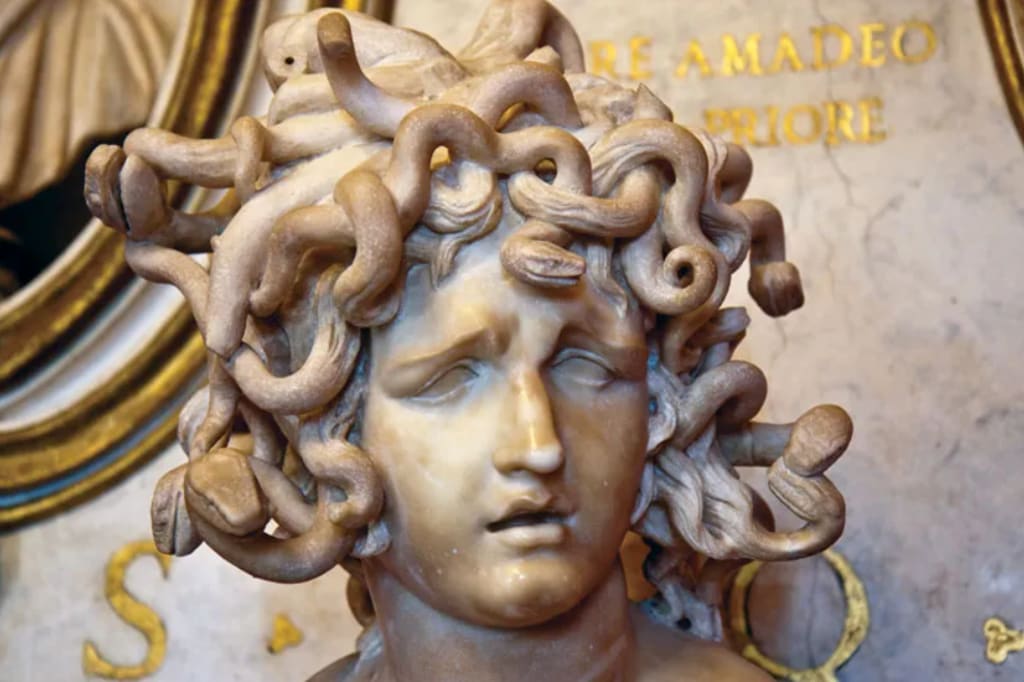
The story of Medusa, a captivating figure from Greek mythology, is one that weaves a tapestry of tragedy, power, and transformation. Medusa, renowned for her serpentine hair and the power to turn anyone who looked into her eyes into stone, has fascinated people for centuries. Her tale is not just one of monstrous proportions but also serves as a symbolic representation of various themes in Greek mythology.
In Greek mythology, Medusa was originally a beautiful mortal woman, one of the three Gorgon sisters. However, her beauty became her curse when she caught the eye of the sea god Poseidon. He ravished her within the temple of Athena, defiling the sacred space. Enraged by this desecration, Athena punished Medusa by transforming her into a monstrous creature. Her hair turned into serpents, her once captivating visage twisted into a horrifying mask, and her gaze became lethal.
Medusa's transformation from a beautiful woman into a Gorgon with serpentine hair and a petrifying gaze is often interpreted as a punishment. Yet, her newfound attributes can also be seen as tools of self-defense and autonomy. Medusa's monstrous appearance could be viewed as a manifestation of her internal strength and her refusal to be victimized further. Her gaze, which turns others to stone, can be seen as a metaphorical representation of her ability to assert control and protect herself in a world that had previously treated her unjustly.
Furthermore, Medusa's story is one of redemption through her encounter with the hero Perseus. While Perseus ultimately defeats her by using her reflection in a polished shield to avoid her gaze, the narrative underscores the power of redemption and second chances. Medusa's death at the hands of Perseus could be interpreted as a release from her curse, allowing her to finally escape the monstrous form that had been imposed upon her by the gods. In this light, her death becomes a liberating act rather than a tragic one.
Medusa's tale also holds a mirror to societal attitudes towards women and their agency. Her transformation and the fear she evokes can be seen as a reflection of the unease society often feels towards women who challenge norms and assert their independence. The notion of Medusa as a monstrous figure can be seen as a way to control and suppress women who refuse to conform, highlighting the societal discomfort with powerful and self-assured women.
Medusa's story resonates with themes of the abuse of power, transformation, and the consequences of divine wrath. The myth highlights how those in positions of power often exploit and manipulate those who are vulnerable. Poseidon's actions not only violated Medusa but also led to her tragic transformation, which exemplifies the capricious nature of the gods in Greek mythology.
Medusa's tale serves as a cautionary reminder of the dangers of unchecked rage and the devastating effects of vengeance. Athena's wrathful response to Poseidon's actions led to the creation of a monster that would go on to petrify anyone who dared to meet her gaze. This cycle of vengeance underscores the intricate web of consequences that unfolds in mythological narratives.
In a broader sense, Medusa can also be seen as a symbol of the complexities of femininity and the fear of powerful women. Her transformation from a beautiful maiden to a monstrous figure embodies society's discomfort with strong, independent women, often portraying them as threatening and dangerous. Medusa's snaky hair and petrifying gaze can be interpreted as metaphors for the challenges faced by women who assert themselves and challenge the status quo.
In conclusion, the story of Medusa is a multi-faceted narrative that delves into themes of abuse, transformation, vengeance, and gender dynamics. Her tragic tale offers insights into the complexities of human nature and the intricate interplay between power, consequences, and identity. Medusa's legacy continues to captivate our imaginations, inviting us to explore the depths of mythology and the intricate threads that weave together the stories of gods and mortals.
About the Creator
Keep reading
More stories from writers in History and other communities.
Who Replaces the United Nations If It Fails?
Who Replaces the United Nations If It Fails? For more than seventy years, the United Nations has served as the world’s main platform for diplomacy, peacekeeping, and global cooperation. Despite its weaknesses, it remains the only institution where nearly every country has a seat at the table. But as trust in the UN declines and major powers increasingly act alone, an uncomfortable question is being asked more often: if the UN fails, who—or what—takes its place?
By Wings of Time 18 minutes ago in History
Where the Pulse Ends
© 2026 Sai Marie Johnson The humidity in the city didn’t just hang; it leaned. It was a thick, stagnant soup of diesel exhaust, ozone, and the metallic tang of blood that drifted from the "Compliance Zones." Joe sat in his rusted sedan, his hands resting loosely on the steering wheel. He wasn't gripping it. He wasn't angry. Anger was a chemical spike, a biological inefficiency. Joe was simply... focused.
By Sai Marie Johnson4 days ago in History


Comments
There are no comments for this story
Be the first to respond and start the conversation.