
The Mysterious Disappearance of Louis Le Prince: The Father of Cinematography Lost to History
Lost with invention

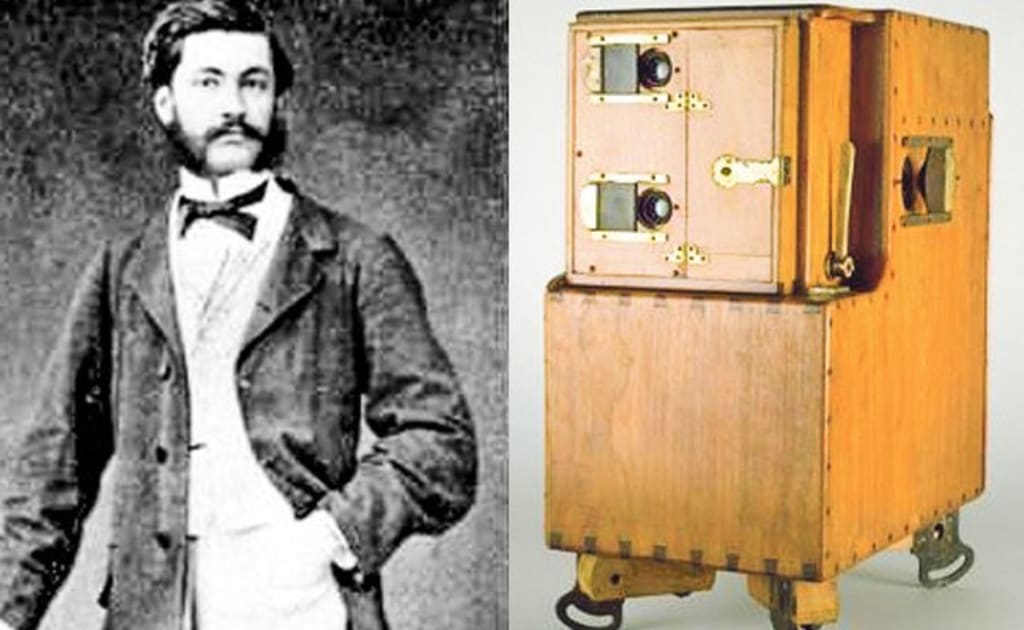
In the story of cinematic history, certain names loom large—Thomas Edison, the Lumière brothers, Georges Méliès. Yet, one name that arguably should stand at the forefront of this illustrious list is that of Louis Le Prince. A French artist and inventor, Le Prince is credited with creating the first motion-picture camera and shooting the first sequences of moving pictures on film. However, his contributions to the art and technology of cinema remain shrouded in mystery due to his inexplicable disappearance in September 1890. On the cusp of revealing his groundbreaking invention to the world, Le Prince vanished without a trace, leaving behind a legacy of unanswered questions and speculations.
The Genius of Louis Le Prince
Born on August 28, 1841, in Metz, France, Louis Aimé Augustin Le Prince demonstrated an early aptitude for the arts and sciences. His education spanned several disciplines, including painting, chemistry, and engineering, all of which would later converge in his innovative work with moving images. In 1886, while living in Leeds, England, Le Prince developed a single-lens camera capable of capturing motion pictures on paper film. This invention marked a significant leap forward from the static images of photography to the dynamic realm of cinema.
Le Prince's most notable surviving work is the "Roundhay Garden Scene," a brief sequence shot in 1888 that features his family members walking in a garden. This film, along with others he shot in Leeds, predates the earliest known films by Thomas Edison and the Lumière brothers, positioning Le Prince as the true pioneer of motion pictures.
The Trip to New York
By 1890, Louis Le Prince was ready to unveil his motion-picture camera to the public and secure his place in history. He planned an exhibition in New York, where he intended to demonstrate his invention and submit his patents. This exhibition was to be a landmark event, potentially revolutionizing entertainment and communication. However, fate had other plans.
In September 1890, Le Prince traveled to France to visit his family and finalize his preparations. On September 16, his brother, Albert Le Prince, accompanied him to the train station in Dijon, from where Louis was to take a train to Paris. From Paris, he would travel to the United States. Le Prince was in good spirits, carrying with him the camera, reels of film, and the valuable patents that would secure his legacy.
The Vanishing Act
What happened next remains one of the most perplexing mysteries in the history of technology and cinema. Despite being seen boarding the train in Dijon, Le Prince never arrived in Paris. The train conductor and passengers later reported that they had no recollection of seeing Le Prince on the train, and no trace of him or his belongings was ever found. He had seemingly vanished into thin air, leaving behind no clues as to his fate.
The disappearance of Louis Le Prince sparked immediate concern and widespread speculation. His family and colleagues were baffled and distraught. A thorough investigation was launched, but it yielded no concrete answers. French and British police, as well as private investigators, scoured the railway, interrogated passengers and staff, and even dredged rivers, but to no avail. Le Prince had disappeared without a trace, and with him, his invaluable inventions and documents.
Theories and Speculations
In the absence of concrete evidence, numerous theories have emerged over the years to explain Le Prince's disappearance. Some of these theories are plausible, while others venture into the realm of conspiracy and speculation.
One of the most enduring theories is that Le Prince was murdered, possibly due to rivalries or patent disputes. Some suggest that Thomas Edison, who was fiercely protective of his own motion picture patents, might have had a motive to eliminate competition. However, there is no direct evidence linking Edison to Le Prince's disappearance.
Another theory posits that Le Prince might have suffered an accidental death, such as falling from the train or being robbed and killed. The lack of any physical evidence or witnesses makes this theory difficult to prove or disprove.
Some speculate that Le Prince might have chosen to disappear voluntarily, perhaps due to personal or financial troubles. However, this theory seems inconsistent with his enthusiasm and preparation for the New York exhibition.
A more obscure theory suggests that Le Prince’s disappearance was related to a family dispute. However, there is little evidence to support this notion, and it remains largely speculative.
Legacy and Recognition
The disappearance of Louis Le Prince had profound implications for the development of cinema. In his absence, others like Thomas Edison and the Lumière brothers advanced their own technologies and claimed their places in history as the inventors of motion pictures. Le Prince’s family, particularly his wife Elizabeth and son Adolphe, fought tirelessly to gain recognition for his contributions, but the shadow of his mysterious vanishing clouded their efforts.
Despite this, recent historical research and the surviving films he created have helped to restore some of Le Prince's rightful place in the annals of cinematic history. The "Roundhay Garden Scene" and other early films are now celebrated as pioneering works, and Le Prince is increasingly acknowledged as the father of cinematography.
Conclusion
The disappearance of Louis Le Prince remains one of the greatest unsolved mysteries in the history of invention and cinema. As the true inventor of the motion-picture camera, his contributions were groundbreaking and set the stage for the future of film. Yet, his mysterious vanishing left a gap not only in his personal story but in the historical record of early cinema. His legacy, partially obscured by his disappearance, continues to be unraveled and appreciated as historians and film enthusiasts seek to honor the true pioneer of moving pictures. The story of Louis Le Prince is a compelling blend of innovation, mystery, and the relentless pursuit of recognition, ensuring his name endures in the history of cinema.
About the Creator
Keep reading
More stories from Deji Akomolafe and writers in History and other communities.
The Man Who Saved the World: The Unsung Heroism of Stanislav Petrov
In September 1983, amid the heightened tensions of the Cold War, an extraordinary act of courage and calm rationality by Soviet military officer Stanislav Petrov averted what could have been a catastrophic nuclear war. Petrov, stationed at the Serpukhov-15 bunker near Moscow, faced a situation that would test the limits of human composure and decision-making. He received a message indicating that five nuclear missiles had been launched by the United States and were hurtling toward the Soviet Union. The protocol demanded a swift retaliatory strike, but Petrov’s instinct and skepticism led him to question the validity of the alert. His decision to hold off on launching a retaliatory strike, based on a gut feeling that the warning was a false alarm, ultimately saved the world from an unimaginable disaster.
By Deji Akomolafe2 years ago in History
Savoy Hotel – Mussoorie: The Colonial Luxury Hotel Where an Unsolved Murder Still Walks the Corridors
The First Night: Beauty Wrapped in Silence Mussoorie looks peaceful from a distance. Pine trees sway gently, clouds roll like slow-moving waves, and the hill air smells of rain and old earth. But as evening falls, the silence becomes heavier—almost watchful.
By Gaurav Gupta4 days ago in History
Nobel Peace Prize
The Nobel Peace Prize has stood as one of the world’s most recognized honors. Awarded annually in Oslo, it is meant to celebrate individuals or organizations that have made significant contributions toward peace, diplomacy, and humanitarian progress. While its mission appears straightforward, the Nobel Peace Prize has never been free from debate. In recent years, conversations surrounding global politics—particularly discussions about the Trump Nobel Peace Prize—have brought renewed attention to how peace is defined, measured, and rewarded in the modern era. The Origins and Meaning of the Nobel Peace Prize The Nobel Peace Prize was established by Alfred Nobel, the Swedish inventor best known for creating dynamite. In his final will, Nobel directed that a portion of his wealth be used to recognize efforts that foster peace among nations, reduce standing armies, or promote diplomacy and cooperation. Since its first award in 1901, the prize has honored activists, diplomats, organizations, and world leaders whose actions shaped international dialogue. Unlike other Nobel categories, the peace prize is awarded by a Norwegian committee rather than a Swedish institution. This distinction reflects Nobel’s desire to separate the prize from national interests and focus instead on global responsibility. Over time, the definition of “peace” has expanded. Early recipients were often disarmament advocates or mediators. More recent laureates have included human rights defenders, climate activists, and international organizations working in conflict zones. Politics and the Nobel Peace Prize Despite its humanitarian ideals, the Nobel Peace Prize has always intersected with politics. Recognizing peace efforts often means evaluating political leadership, international negotiations, and long-term consequences—none of which are easy to measure in real time. Some awards have been widely celebrated, while others sparked controversy. Critics often argue that certain laureates were honored prematurely, before the lasting results of their actions became clear. Supporters counter that the prize is meant to encourage peace efforts, not merely reward completed achievements. This tension has made the Nobel Peace Prize a reflection of global priorities at any given moment, rather than a simple historical judgment. Donald Trump and Nobel Peace Prize Discussions Few modern political figures have generated as much debate in connection with the Nobel Peace Prize as Donald Trump. During and after his presidency, conversations about a potential Trump Nobel Prize emerged repeatedly, particularly among supporters who pointed to his role in diplomatic initiatives. The phrase Trump Nobel Peace Prize gained traction following agreements and negotiations in regions long marked by conflict. Advocates argued that these diplomatic efforts aligned with Alfred Nobel’s vision of reducing international tension through dialogue rather than force. At the same time, critics questioned whether these actions met the broader ethical and humanitarian standards traditionally associated with the award. They pointed to domestic divisions, foreign policy controversies, and unresolved global conflicts as reasons for skepticism. This divide highlights a core challenge of the Nobel Peace Prize: peace is rarely absolute, and political leadership is often complex and contradictory. Trump Nobel Peace Prize 2026: Speculation and Context As global politics continue to evolve, speculation around a Trump Nobel Peace Prize 2026 has appeared in media discussions and public commentary. It is important to note that nominations for the Nobel Peace Prize are confidential for decades, and speculation does not confirm consideration or selection. However, the mere discussion of Trump Nobel Peace Prize 2026 reflects how the award has become part of broader cultural and political conversations. Supporters view such recognition as validation of diplomatic achievements, while critics see the speculation as politicizing an institution meant to rise above partisan debate. This dynamic is not unique to Trump. Many past leaders, from various ideological backgrounds, were debated heavily before or after receiving the prize. The Nobel Peace Prize often mirrors global disagreements rather than resolving them. How the Nobel Committee Makes Its Decision Each year, hundreds of nominations are submitted by qualified individuals, including academics, lawmakers, and previous laureates. The Nobel Committee evaluates these nominations through research, expert consultation, and internal debate. The process considers intent, impact, and long-term significance. However, because peace efforts often unfold over years or decades, the committee must make decisions without full historical clarity. This reality explains why some awards age gracefully while others remain controversial. The committee rarely responds directly to public pressure or online campaigns. Media attention, including discussions around a Trump Nobel, does not guarantee influence over the final decision. The Broader Impact of the Nobel Peace Prize Beyond individual recipients, the Nobel Peace Prize plays a symbolic role. It brings global attention to issues that might otherwise be ignored, from humanitarian crises to fragile peace processes. Even controversial nominations can spark meaningful debate about what peace truly means in the modern world. The prize also raises questions about accountability. When leaders are considered for such recognition, the public is encouraged to examine policies, outcomes, and moral responsibility more closely. In this sense, discussions surrounding the Trump Nobel Peace Prize are not just about one individual. They reflect deeper conversations about diplomacy, leadership, and the evolving standards by which peace is judged. Conclusion: A Prize That Reflects the World The Nobel Peace Prize remains one of the most influential and debated honors in global society. Its power lies not only in recognizing peace efforts but also in challenging the world to think critically about conflict, cooperation, and responsibility. Whether discussions involve historic activists or modern political figures like those associated with Trump Nobel Peace Prize 2026 speculation, the award continues to reflect the complexities of international relations. Peace is rarely simple, and neither is the process of honoring it. Ultimately, the Nobel Peace Prize serves as a reminder that striving for peace is an ongoing journey—one shaped by ideals, actions, and the difficult choices that define human history.
By Saboor Brohi 4 days ago in History
Silver Screen Magic with Mae West
American actress and singer Mae West became a popular film actress during the Great Depression. She started entertaining in vaudeville, then performed on Broadway, and finally went to Hollywood. She signed up with Paramount Pictures and made her debut in the 1932 film “Night After Night.” She also starred in musicals, comedies, and crime dramas. The American Film Institute named her one of the best classic Hollywood actresses.
By Rasma Raisters6 days ago in Geeks


Comments
There are no comments for this story
Be the first to respond and start the conversation.