
The Mongol Conqueror Who Shaped the Middle East
From the Steppes of Mongolia to the Fall of Baghdad — The Legacy of Genghis Khan’s Grandson

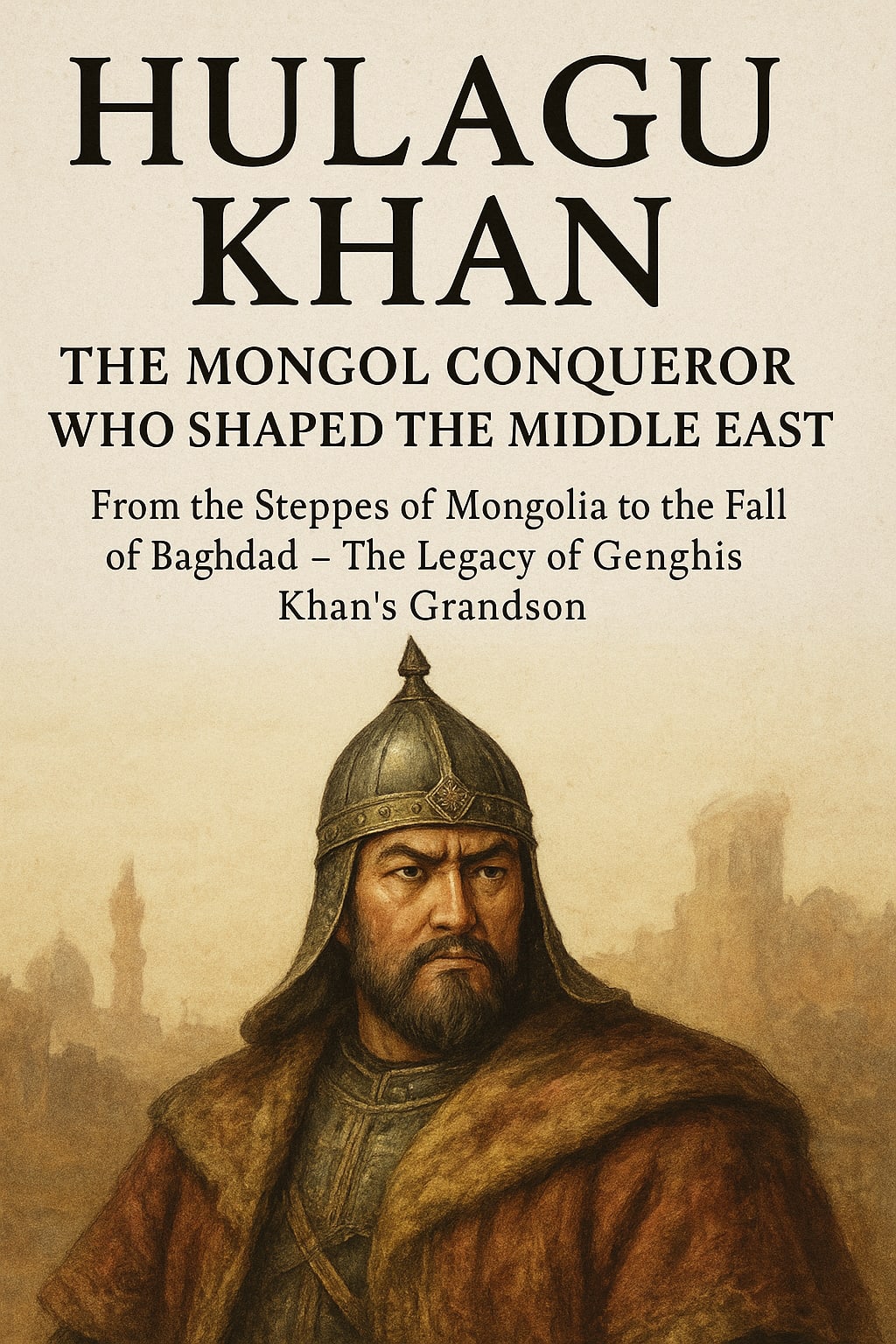
Hulagu Khan, born circa 1217, was a grandson of the legendary Genghis Khan and a pivotal figure in Mongol expansion during the 13th century. As the founder of the Ilkhanate in Persia, Hulagu’s campaigns radically altered the political and cultural landscape of the Middle East. His conquests, particularly the devastating sack of Baghdad in 1258, marked the end of the Islamic Golden Age and ushered in a new era dominated by Mongol rule.
⸻
Early Life and Background
Hulagu was the son of Tolui, the youngest son of Genghis Khan, and Sorghaghtani Beki, a Keraite Christian noblewoman. Sorghaghtani was known for her intelligence and political wisdom, raising her sons—Möngke, Kublai, Hulagu, and Ariq Böke—to become powerful leaders within the Mongol Empire.
Growing up in the Mongol heartland, Hulagu was trained in warfare, diplomacy, and leadership from a young age. His family’s lineage gave him access to both military opportunities and political influence, particularly after his brother Möngke became Great Khan in 1251. This marked the beginning of Hulagu’s rise to power as one of the empire’s key generals and governors.
⸻
The Great Southwest Campaign
In 1253, Möngke Khan commissioned Hulagu to lead a massive expedition into the Islamic territories of Southwest Asia. His mission was to destroy the Assassins, subdue the Abbasid Caliphate, and extend Mongol control as far as Egypt.
The campaign was enormous in scale. Hulagu was given the largest Mongol army ever assembled—possibly over 150,000 troops—along with siege engineers, Chinese specialists, and logistics support. The goal was not merely to raid, but to conquer and govern.
⸻
Elimination of the Assassins
Hulagu’s first major target was the Nizari Ismaili sect, known in the West as the Assassins, who operated from mountain fortresses like Alamut in northern Persia. This secretive group had long wielded influence through political assassinations.
In 1256, after a calculated military campaign, Hulagu captured Alamut and dismantled the Assassins’ network. Their defeat removed a significant threat to Mongol control and demonstrated Hulagu’s military prowess and strategic effectiveness.
⸻
The Fall of Baghdad (1258)
Hulagu’s most infamous and consequential act came in 1258 with the siege and sack of Baghdad, then the capital of the Abbasid Caliphate and one of the world’s greatest centers of culture and learning.
Caliph Al-Musta’sim, misjudging the seriousness of the Mongol threat, refused to submit. In retaliation, Hulagu laid siege to the city. The Mongols used advanced siege tactics, including catapults and incendiary devices. After only a few days, Baghdad’s defenses crumbled.
The aftermath was catastrophic. Tens, perhaps hundreds, of thousands were killed. The House of Wisdom, containing centuries of scientific and philosophical manuscripts, was destroyed. According to legend, the Tigris River ran black with ink and red with blood. The Caliph himself was executed—likely trampled to death, in accordance with Mongol customs to avoid spilling royal blood.
This event not only ended the Abbasid Caliphate but also marked the collapse of the Islamic Golden Age. The destruction of Baghdad left a psychological scar on the Islamic world and reshaped regional power dynamics.
⸻
Foundation of the Ilkhanate
Following his successful campaigns, Hulagu established the Ilkhanate in 1256, a Mongol state that ruled over Persia, Iraq, and parts of the Caucasus. Though technically under the Great Khan, the Ilkhanate functioned independently and became a major power in the region.
Hulagu ruled as Ilkhan (subordinate Khan) and began a period of reconstruction. Despite the devastation of his conquests, Hulagu promoted trade, agriculture, and the arts. His court became a cultural crossroads, hosting Muslims, Christians, Buddhists, and others. His wife, Doquz Khatun, was a Christian and influenced many of his religious policies.
Though a follower of Tibetan Buddhism, Hulagu was relatively tolerant of other faiths. He offered protection to Christians and sometimes favored them in court, but relations with Muslims were strained due to the destruction of Baghdad.
⸻
Conflict with the Mamluks and the Battle of Ain Jalut
Hulagu’s expansion continued into Syria, where Mongol forces captured Aleppo and Damascus. But his ambitions were checked by the rise of the Mamluk Sultanate in Egypt.
In 1260, after learning of his brother Möngke’s death, Hulagu withdrew a large portion of his forces to the east, leaving his general Kitbuqa in charge of a smaller army. This proved fatal.
At the Battle of Ain Jalut in September 1260, the Mamluks decisively defeated the Mongols—the first major Mongol defeat in history. This battle not only stopped further Mongol advances into North Africa but also preserved the Islamic holy cities from Mongol domination.
⸻
Later Years and Death
After the setback at Ain Jalut, Hulagu returned to the region but never regained the momentum of his earlier campaigns. He focused more on consolidating his rule, managing conflicts within the Mongol Empire, and administering his vast territory.
Hulagu died in 1265, likely near Tabriz in modern-day Iran. As was customary for Mongol royalty, he was buried in a secret location. His son, Abaqa Khan, succeeded him and continued the Ilkhanate dynasty.
⸻
Legacy
Hulagu Khan’s legacy is complex and deeply controversial. In the Islamic world, he is remembered largely for the destruction of Baghdad, an event viewed as both a military catastrophe and a cultural apocalypse. For Persians and some historians, however, he also represents a transformative figure who helped end centuries of feudal fragmentation and initiated an era of centralized rule.
The Ilkhanate, under Hulagu and his successors, laid the groundwork for the eventual Persian renaissance under later dynasties. Over time, the Mongol rulers of Persia adopted Islam and integrated into the Persian cultural and administrative traditions they once threatened to erase.
⸻
Conclusion
Hulagu Khan was not merely a brutal conqueror; he was a transformative figure whose actions reshaped the Islamic and Mongol worlds alike. As a grandson of Genghis Khan, he inherited the ambition of world conquest, but unlike many of his predecessors, he also sought to govern and rebuild.
His campaigns ended the Abbasid Caliphate, weakened Islamic unity, and paved the way for Mongol and later Turkic empires in the Middle East. At the same time, his foundation of the Ilkhanate established political stability and fostered cultural integration that would influence the region for centuries.
Hulagu’s name is remembered with awe, fear, and controversy—a symbol of both destruction and legacy in one of history’s most dynamic periods.
About the Creator
Irshad Abbasi
"Studying is the best cure for sorrow and grief." shirazi
Keep reading
More stories from Irshad Abbasi and writers in History and other communities.
The Visionary Behind BlackBerry and the Smartphone Revolution
Mike Lazaridis is one of the most influential yet understated figures in the history of modern communication technology. As the founder of Research In Motion (RIM) and the mind behind the BlackBerry smartphone, Lazaridis played a key role in shaping the way the world connects, communicates, and does business. Though his name may not be as universally recognized as Steve Jobs or Bill Gates, his contributions to mobile technology have left an indelible mark on the industry.
By Irshad Abbasi 7 months ago in History
Power's Sake
When it comes to gaining power, bad people use it to gain more They never gain power to do something with it, they gain power to have it, relish in it, double it down on itself so it grows exponentially and never goes anywhere. Even if you see the people in power commit an atrocity, that is never the true goal. It is a deplorable action for sure but the action itself usually doesn't matter it's the outcome.
By Donny Foley3 days ago in History
Military Strength of Alexander the Great and the Chola Empire: A Historical Comparison
Though separated by more than a thousand years and operating in vastly different geographical and cultural contexts, both forces achieved extraordinary success through discipline, innovation, and strategic brilliance. This article explores the history, composition, size, organization, and military strength of Alexander’s Macedonian army and the Chola military, highlighting how each became a dominant power of its era.
By Say the truth 3 days ago in History
Miss Persephone's Manual to a Seemingly Ordinary Life
Miss Persephone was found at the dining table, her blue eyes swollen, her tears arriving and retreating like the tides of the ocean. Earlier that day, her family had visited her in the retirement home where she had lived for eight years. It was her eightieth birthday.
By Imola Tótha day ago in Fiction



Comments
There are no comments for this story
Be the first to respond and start the conversation.