
The Mind Beyond Limits: The Stephen Hawking Story
How a Brilliant Mind Reshaped Our Understanding of the Universe

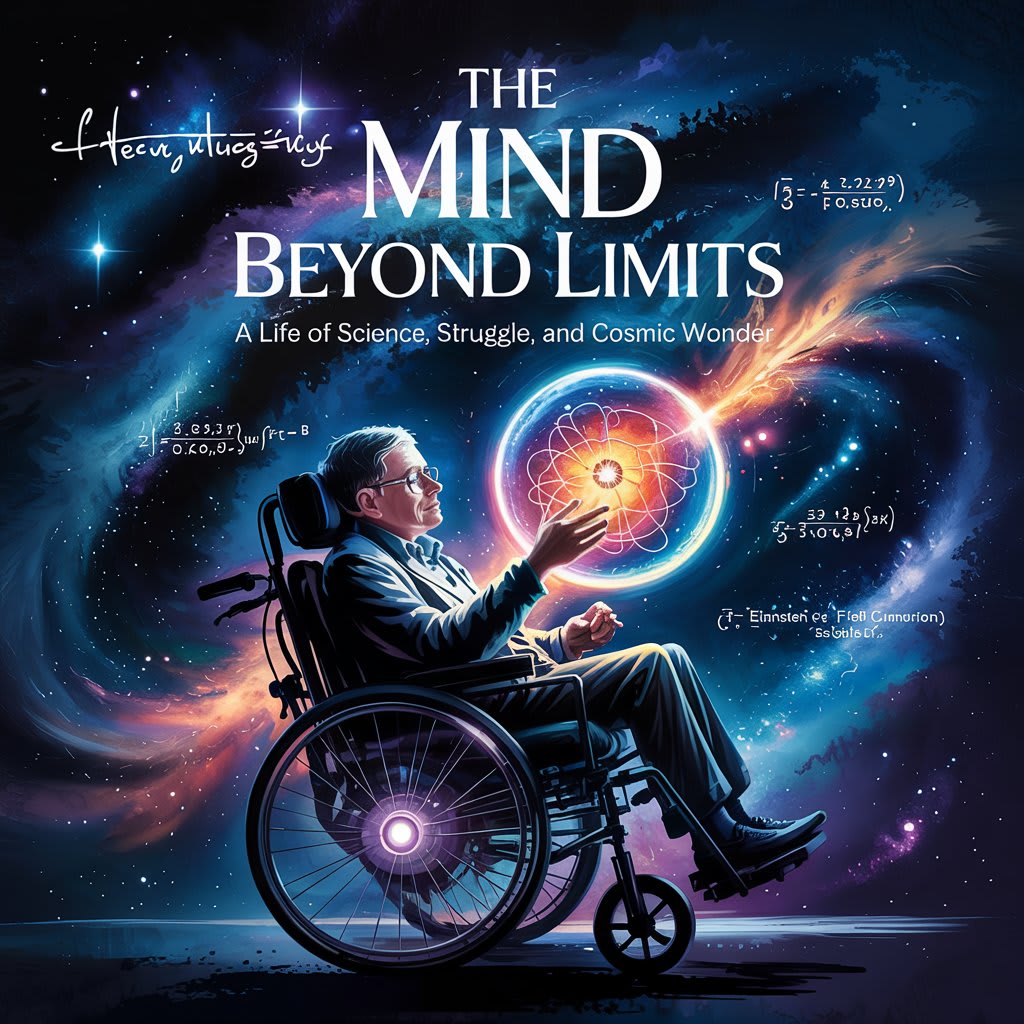
In the vast theater of the cosmos, few minds have burned as brightly as that of Stephen Hawking. His life was not just a journey through science—it was a triumph of spirit over limitation, of intellect over illness, and of vision that transcended the confines of the physical world.
Stephen William Hawking was born on January 8, 1942, exactly 300 years after the death of Galileo—a poetic coincidence for a man who would later redefine our understanding of the universe. Raised in Oxford and later St. Albans, he was curious, imaginative, and often lost in thought. As a child, he was far from exceptional in academics. His handwriting was poor, and his grades were unremarkable. But within him, a restless intellect was quietly awakening.
At the age of 17, Hawking enrolled at Oxford University. He found the coursework easy, often spending his time more in rowing clubs and parties than in lectures. But even then, there were hints of brilliance—of a mind that could simplify the complex and imagine the unimaginable. After Oxford, he pursued a PhD in cosmology at Cambridge, diving deep into questions few dared to ask: What happened at the beginning of time? What lies beyond a black hole?
Then, at 21, everything changed.
He began to stumble. His speech slurred. His body weakened. The diagnosis was devastating: Amyotrophic Lateral Sclerosis—ALS, a neurodegenerative disease. Doctors gave him two years to live.
Two years.
Faced with what seemed like an inevitable decline, Hawking did what only a true mind beyond limits could do: he kept going. He fell in love with Jane Wilde, who would become his first wife and emotional anchor. He returned to his work with renewed vigor. While his muscles weakened, his ideas only grew stronger.
By the late 1960s, Hawking was making waves in theoretical physics. He challenged the notion that nothing could escape a black hole. In a groundbreaking leap, he proposed that black holes could emit radiation—now famously known as Hawking radiation. The idea shook the foundations of physics and fused the once-distant worlds of quantum mechanics and general relativity.
As his body deteriorated, he lost the ability to speak. But silence never dimmed his voice. With the help of a speech-generating device, Hawking's thoughts once again found sound. His robotic voice became iconic—not just a means of communication, but a symbol of unyielding determination.
In 1988, he released A Brief History of Time, a book aimed at explaining the nature of the universe to non-scientists. It became an international bestseller, selling over 25 million copies. But more than the content, it was the image of the author—a man confined to a wheelchair, speaking through a computer, exploring the farthest reaches of space-time—that inspired millions.
Stephen Hawking became a symbol. Not just of scientific genius, but of human resilience. He traveled the world, delivered lectures, mentored young scientists, and appeared in pop culture—from The Simpsons to Star Trek. Always with wit, always with humility.
Yet, Hawking's story was never just about fame or accolades. It was about asking why. Why does the universe exist? Why is there something rather than nothing? What is the nature of time?
He believed science could—and should—be accessible to everyone. "Look up at the stars and not down at your feet," he once said. "Try to make sense of what you see, and wonder about what makes the universe exist. Be curious."
His life was marked by extraordinary paradoxes: a man trapped in a failing body who wandered freely through galaxies. A scientist bound by time who uncovered its secrets. A voice that could not speak, yet echoed through generations.
Stephen Hawking passed away on March 14, 2018—Pi Day, and the birthday of Albert Einstein. Once again, the universe seemed to mark the passing of a mind too rare for coincidence.
But even in death, Hawking's light continues to shine. His contributions to cosmology, quantum gravity, and black hole physics remain at the heart of modern science. More than that, his story continues to inspire students, dreamers, scientists, and storytellers.
He proved that limitations are only what we accept. That even in silence, one can roar. That from a wheelchair, one can touch the stars.
In the end, Stephen Hawking’s life was not defined by ALS. It was defined by questions, by courage, by an unrelenting pursuit of knowledge. He was not a prisoner of his condition. He was a pioneer of the cosmos. A reminder to us all that the greatest journeys are those made with the mind—and that some minds are truly beyond limits.
About the Creator
Farhan
Storyteller blending history and motivation. Sharing powerful tales of the past that inspire the present. Join me on Vocal Media for stories that spark change.
Escobar’s Paradox: The Poorest City in the World’s Richest Nation
The story of Escobar is not just the story of one man; it is the story of a city, a country, and a paradox. When people hear the name Pablo Escobar, they often think of unimaginable wealth, global drug empires, and a lifestyle that rivaled billionaires. Yet behind the myth of his fortune lies a deeper and more painful reality—entire neighborhoods living in poverty, violence, and fear. This contrast has often been described as “Escobar’s paradox”: how one of the richest criminal empires in history rose from communities that remained desperately poor.
By Irshad Abbasi 6 days ago in History
📢 Raise Your Voice Thread: 03/05/2026
Our “Raise Your Voice Threads” are hosted most alternating Thursdays at 12PM ET to offer creators more avenues to uncover exceptional stories on Vocal. As we are continuously searching for fresh creators and inspiring stories, this thread provides an opportunity to exchange and discuss the stories that have moved and motivated us on Vocal.
By Raise Your Voice by Vocal4 days ago in Resources




Comments (1)
Very interesting article and well written, good luck.