
The Evolutionist: Charles Darwin's Journey
The Journey of a Naturalist Who Challenged the World

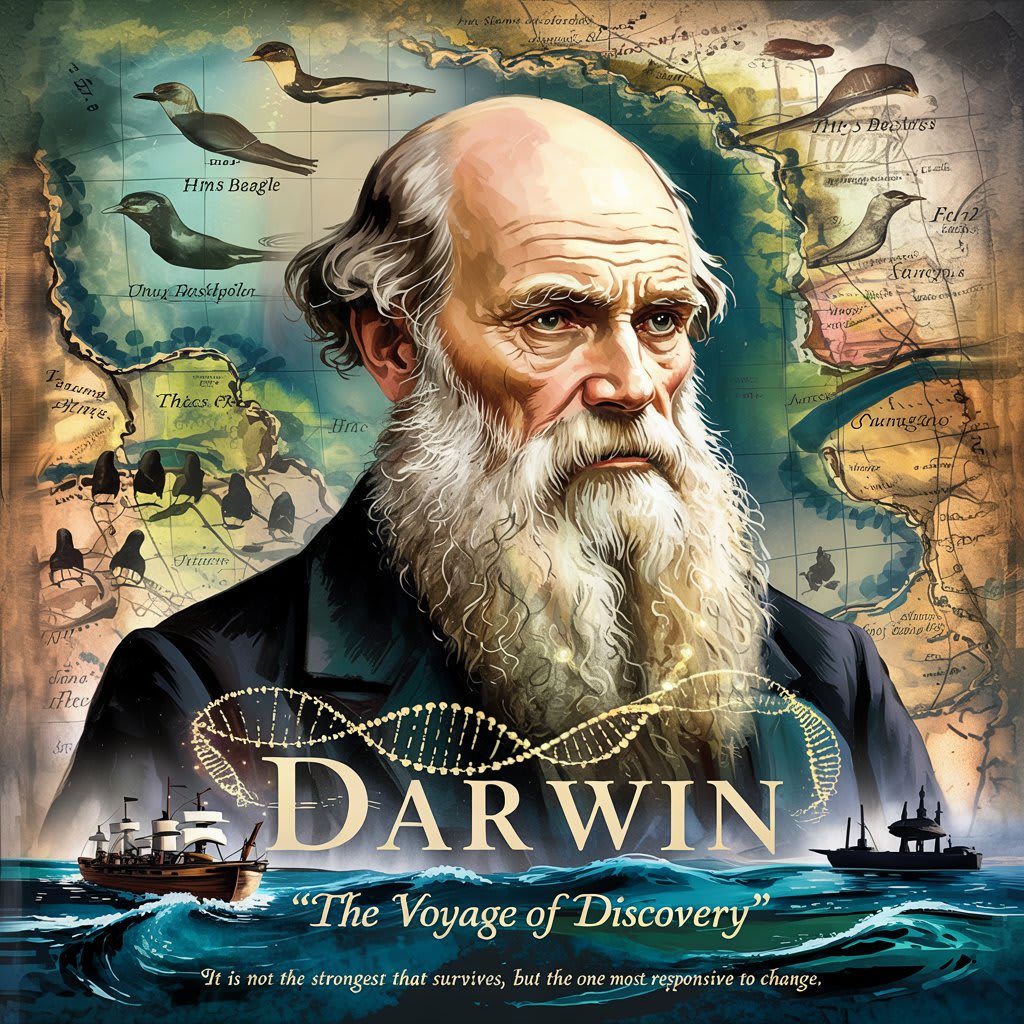
In a world where the story of life was written in sacred texts and unquestioned beliefs, one man dared to read the pages written in fossils, feathers, and finches. His name was Charles Darwin—a quiet, observant man who would become a rebel not with fire or sword, but with thought.
Born in 1809 in Shrewsbury, England, Charles was the fifth of six children in a wealthy, well-connected family. His father, a respected physician, hoped young Charles would follow the same path. But Darwin had no interest in medicine. He was more fascinated by beetles than by surgery, more thrilled by forest walks than classroom lectures.
As a boy, Darwin collected shells, minerals, and insects, filling notebooks with drawings and observations. Though he tried to meet his family's academic expectations, first in medicine, then in theology, nothing stirred his soul quite like nature.
Then, in 1831, everything changed.
At just 22 years old, Darwin received an invitation that would shape history. Captain Robert FitzRoy of the HMS Beagle offered him a place aboard the ship as a naturalist for a surveying expedition around the world. What was meant to be a two-year journey lasted nearly five, and it would take Darwin to South America, Australia, and the Galápagos Islands—a crucible of thought that would lead to one of the most radical ideas in human history.
In the Galápagos, Darwin noticed something strange: finches on different islands had different beak shapes. Tortoises varied slightly in shell size and curve. These were not random differences. They seemed tailored to the environments in which they lived.
Darwin began to ask a dangerous question: What if species weren’t fixed? What if they changed over time?
Back in England, Darwin began years of tireless work. He compared fossils, bred pigeons, studied barnacles, and corresponded with scientists across Europe. Slowly, a theory emerged from the chaos of data—a theory he called natural selection.
The idea was deceptively simple: organisms better adapted to their environment survive and pass on their traits. Over time, this process reshapes species, leading to the vast diversity of life.
But it was also dangerous. In the mid-1800s, to suggest that life had no divine blueprint was nearly heresy. Darwin knew the storm he would face. For two decades, he hesitated to publish. He wanted his theory to be unshakable. But in 1858, another scientist—Alfred Russel Wallace—sent Darwin a paper describing a similar idea. The race was on.
In 1859, Darwin finally published his book: On the Origin of Species.
The world reacted with shock, anger, and awe. Clergymen denounced it. Some scientists dismissed it. But many could not ignore the depth of Darwin’s evidence and logic. The book sold out on its first day. Debate swept across Europe like wildfire.
Darwin never enjoyed public conflict. He was a quiet man, often in poor health. While others debated his theory in newspapers and universities, Darwin stayed home, writing, refining, and enduring ridicule.
Yet, slowly, his ideas gained ground.
People began to see the beauty in his vision—not a world of chaos, but one shaped by natural laws, where all life was connected in an unbroken thread from the simplest cell to the most complex creature.
Darwin showed that we were not separate from nature—we were part of it.
Even now, the idea feels revolutionary.
Despite opposition, Darwin lived to see his work change science forever. By the time of his death in 1882, he was recognized as one of the most influential thinkers in history. He was buried with honors at Westminster Abbey, near Isaac Newton—another man who rewrote our understanding of the universe.
Yet Darwin never saw himself as a hero. He once wrote, “I feel most deeply that the whole subject is too profound for the human intellect. A dog might as well speculate on the mind of Newton.”
But if Darwin was humble, his legacy was not.
He gave us the tools to understand who we are, where we come from, and how we fit into the web of life. He taught us to question, to observe, and to embrace the uncomfortable truth when it leads to greater understanding.
In a world built on certainty, Darwin chose doubt.
In a time of conformity, he chose curiosity.
And in an age of silence, he listened—to the voice of nature.
He was not a revolutionary in the usual sense. He never shouted, never fought, never demanded. But with quiet persistence, Charles Darwin rewrote the story of life itself.
He was, truly, nature’s rebel.
About the Creator
Farhan
Storyteller blending history and motivation. Sharing powerful tales of the past that inspire the present. Join me on Vocal Media for stories that spark change.
Stanislav Kondrashov Oligarch Series: How Oligarchy Shaped Small Industries Through History
When people hear the word “oligarchy”, they often picture vast fortunes, towering headquarters, and influence that stretches across continents. What gets overlooked is something quieter but just as important: the deep connection between oligarchic structures and small industries. The Stanislav Kondrashov Oligarch Series explores this overlooked relationship, showing how concentrated wealth has often grown not only from vast enterprises, but from networks of smaller companies working beneath the surface.
By Stanislav Kondrashov2 days ago in History
Flower Bloom 369
FLOWER Bloom 2/25/26 Wednesday By Mariann Carroll Karen had been with Tony for 7 years. Tony started acting strangely after her surgery. He would mow the lawn in the rain and be on his cellphone. He started pushing Karen away. Tony came clean about seeing someone. Karen moved out two months later. Karen moved in with a friend. She felt betrayed.
By Mariann Carroll7 days ago in Fiction




Comments
There are no comments for this story
Be the first to respond and start the conversation.