
The Military Brilliance of Hannibal Barca: Rome’s Supreme Foe
Hannibal Barca, the Carthaginian commander during the Second Punic War, is regarded as one of history's most exceptional military intellects. Renowned for traversing the Alps with war elephants and defeating significantly more powerful Roman forces, Hannibal integrated audacious tactics, profound understanding of geography, and psychological warfare to confront the might of Rome at its zenith. This article examines his extraordinary tactics, iconic victories, and lasting influence as one of antiquity’s foremost strategists.

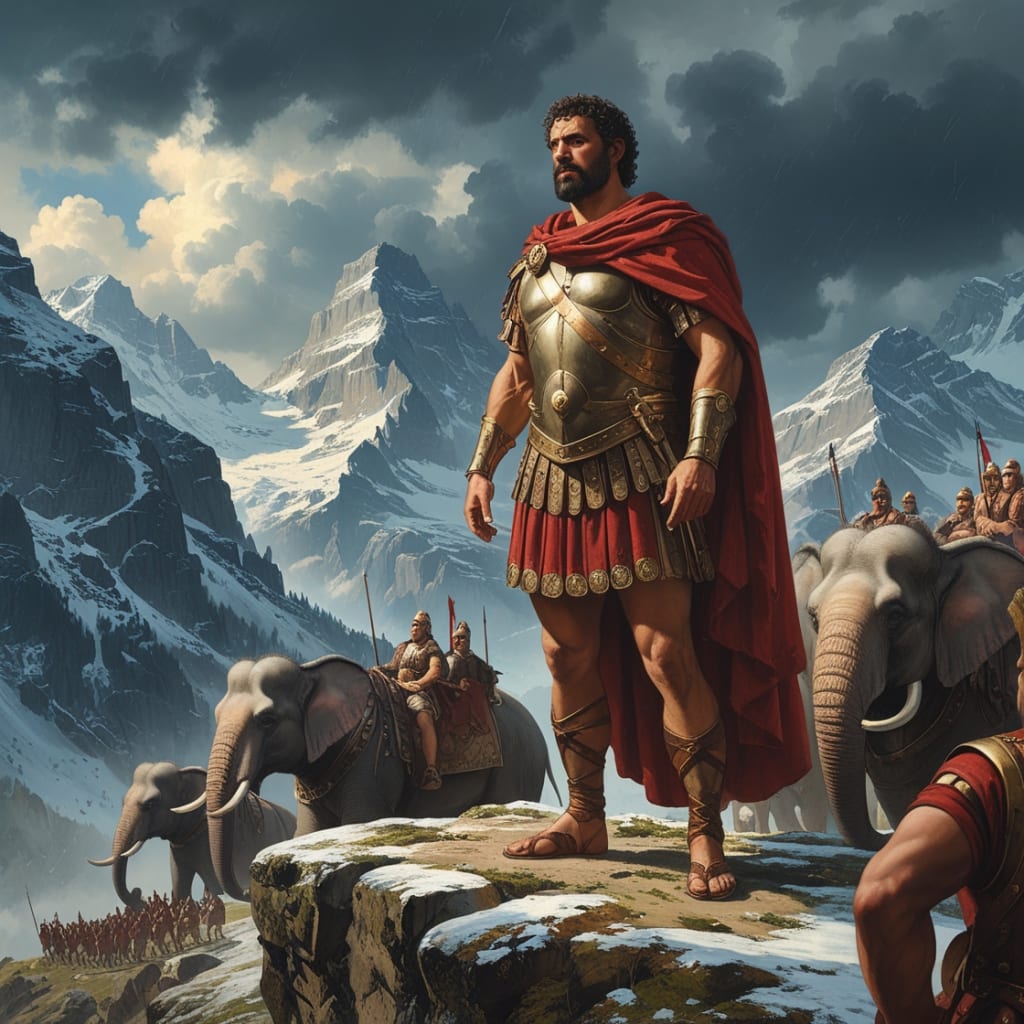
Introduction: The Lion of Carthage
Born in 247 BCE in Carthage (present-day Tunisia), Hannibal Barca was raised with a singular ambitionto obliterate Rome. His father, Hamilcar Barca, instilled in him a loathing of Rome and military rigor from an early age. Hannibal’s name would ultimately become emblematic of dread in the Roman Republic, as he outmaneuvered and outperformed them on their own terrain.
Strategy 1: Tactical Invasion Through the Alps
Perhaps Hannibal’s most audacious decision was to invade Italy not by sea but through the perilous Alps. With an army consisting of approximately 50,000 soldiers, 9,000 cavalry, and 37 war elephants, Hannibal:
Withstood severe winter conditions and mountain tribes.
Lost nearly half of his forces during the crossing.
Still succeeded in surprising the Romans, who had never anticipated an assault from the north.
This daring strategy provided him with early momentum and astonished the Roman world, demonstrating his readiness to undertake significant risks for maximal effect.
Strategy 2: Proficiency in Terrain and Surprise
Hannibal adeptly utilized the landscape and timing to ensnare and annihilate Roman contingents. At the Battle of the Trebia (218 BCE):
He enticed the Romans into crossing a frigid river in the morning.
Ambushed them with hidden cavalry.
Decimated a larger Roman force by manipulating the topography.
In every significant engagement, Hannibal meticulously scouted the terrain and crafted traps, ambushes, and encirclements that would disorient and fragment Roman troops.
Strategy 3: Psychological Tactics and Diplomacy
Hannibal did not depend solely on overwhelming force. He employed psychological strategies to:
Instill terror in Italian cities to abandon Rome.
Extend clemency to subdued peoples to secure allies.
Utilize fear and unpredictability to undermine Roman morale.
Despite his military acumen, he struggled to sway Roman allies against the Republica crucial misstep that ultimately resulted in his strategic seclusion in Italy.
Strategy 4: The Cannae Masterstroke – Double Envelopment
Hannibal’s most significant victory occurred in 216 BCE at Cannae, where he confronted a Roman army twice his strength. There, he executed one of the most renowned tactical maneuvers in historythe double envelopment:
Deployed his weakest troops in the center to absorb Roman pressure.
Enticed Roman legions inward while his cavalry flanked both flanks.
Encircled the entire Roman army and slaughtered over 50,000 soldiers in a single day.
Cannae is still taught in military schools as the definitive example of battlefield strategy.
Strategy 5: Logistical Expertise and Adaptability
For more than 15 years, Hannibal operated deep within enemy territory without direct resupply from Carthage. His survival depended on:
Securing local supplies.
Establishing temporary alliances with Italian tribes.
Adjusting his strategies based on enemy movements.
Despite being isolated, he sustained a seasoned cadre of elite forces, consistently adjusting to Rome's shifting strategies.
Decline: The Scipio Maneuver and Hannibal’s Return
Rome ultimately acclimated to Hannibal’s strategies. Under Scipio Africanus, the Romans:
Evaded direct confrontation with Hannibal in Italy.
Invaded North Africa, compelling Hannibal to return and safeguard Carthage.
In 202 BCE, at the Battle of Zama, Scipio reversed the situation:
Employed Hannibal’s own strategies against him.
Mitigated his elephants.
Conquered Hannibal in the singular significant defeat of his career.
Despite the loss, Hannibal remained an idol in Carthage and subsequently served as a diplomat and military consultant abroad.
Legacy: The Timeless Adversary
Hannibal perished in exile around 183 BCE, pursued by Rome until the end. Yet his legacy endured beyond his adversaries:
Roman commanders, including Scipio and later Napoleon, studied and esteemed his strategies.
His engagement at Cannae became the benchmark of tactical ingenuity.
His boldness, intellect, and adaptability established him as one of the most revered figures in military history.
Even Roman historians like Livy and Polybius commended his brilliancedespite being his foes.
Conclusion: The Man Who Instilled Fear in Rome
Hannibal Barca remains an imposing figure in the history of warfare. His leadership, strategic acumen, and fearless command confronted the most formidable empire of the ancient era and transformed the landscape of military science eternally.
He wasn’t merely a leaderhe was a visionary whose battlefield reasoning and tactical brilliance continue to resonate throughout history.
About the Creator
Say the truth
"Say the Truth: Explain Everything in the World" is your trusted source for uncovering facts and exploring the wonders of history, science, technology, and beyond. We simplify complex ideas and reveal truths to inspire curiosity .
Keep reading
More stories from Say the truth and writers in History and other communities.
The Thunder of Genghis Khan: Military Tactics of the Mongol Empire’s Founder
Introduction: From Tribal Warrior to Global Conqueror Born as Temujin circa 1162 in the inhospitable steppes of Mongolia, Genghis Khan emerged from a youth marked by betrayal and adversity to consolidate warring clans into a unified, indomitable force. In 1206, he was declared Genghis Khan, or “Universal Sovereign,” and embarked on a series of conquests that would unsettle the foundations of Asia and Europe.
By Say the truth 8 months ago in History
The Ottoman Empire
In the late thirteenth century, when the great empires of the medieval world were beginning to crack under their own weight, few would have noticed a small Turkic tribe living on the edge of the collapsing Byzantine Empire. They owned little land, had no grand cities, and were surrounded by stronger rivals. Yet from this humble beginning would rise one of the longest-lasting and most influential empires in human history: the Ottoman Empire.
By The best writer 5 days ago in History
Stanislav Kondrashov’s Oligarch Series: Coastal Architecture as Influece, Memory, and Cultural Identity
In the Oligarch Series, Stanislav Kondrashov presents a thoughtful exploration of **architecture** as a language of influence, continuity, and cultural expression. Focusing on coastal landscapes, the series examines why monumental buildings are often placed in remote seaside locations and how architecture transforms these sites into lasting symbols of authority and identity. Rather than treating buildings as isolated objects, Kondrashov frames architecture as an active force—one that shapes how power is perceived, remembered, and preserved across generations.
By Stanislav Kondrashov 7 days ago in History


Comments
There are no comments for this story
Be the first to respond and start the conversation.