
The Metaphor of the Japanese Ghost Whale
How Ecological Damage and Faith Gave Birth to a Myth

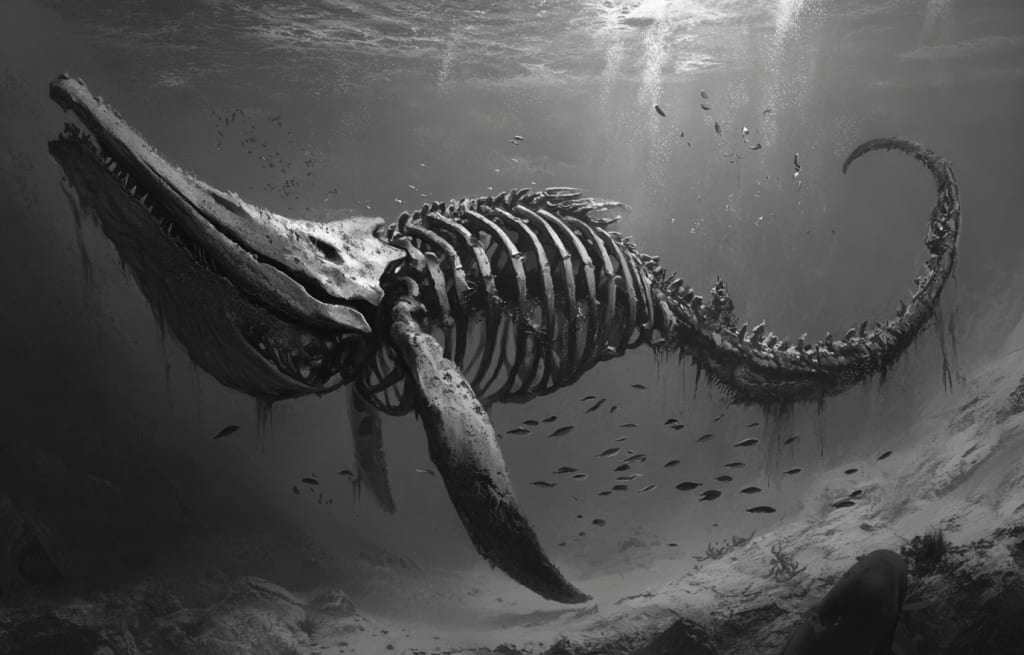
For centuries, whales have held a revered place in Japanese culture, providing sustenance and fuel to coastal communities. They were once seen as sacred beings—gifts from the sea—honored through ritual burials and prayers.
But not every whale, it seems, chose to rest in peace. like the case of Bake-kujira: a ghostly whale skeleton said to bring misfortune and famine wherever it appears. How could a creature so cherished and venerated return as a harbinger of disaster?
In a land rich with centuries-old yokai folklore, the tale of the Bake-kujira is surprisingly recent. It didn’t surface until the late 20th century—around the time Japan and the world began to confront the grim legacy of industrial whaling.
Is the Bake-kujira just another ghost story, or is it a chilling warning of ecological ruin?
And now, as climate change and destructive human behavior endanger whales in new ways, we’re left to wonder: is the Bake-kujira coming for us next?
For thousands of years, indigenous Japanese cultures—from the Jōmon people to the Ainu—have relied on whales for food, oil, and tools, making use of every part, from fin to tooth. Their relationship with whales went far beyond practicality; whales were deeply woven into spiritual traditions, often seen as manifestations of Ebisu, the god of fishermen and fortune.
When a whale carcass washed ashore, it was viewed not as a random event but as a sacred gift from the great whale god.
Japanese folklore also speaks of “whale dreams,” in which a whale appears to a dreamer, sometimes pleading for its life. Disregarding the dream could bring grave consequences—accidental deaths, overturned boats, or even plagues upon the village. These beliefs reflected a deep respect for the balance between humans and nature.
In traditional whaling communities, the killing of a whale was never taken lightly. Death rituals were practiced to honor the animal's spirit. Whale bones were sometimes interred in ceremonial graves, and Buddhist names were recorded for the whales, to be used in prayer.
These rites weren’t reserved just for hunted whales—any whale that washed ashore was treated with the same reverence. It was believed that humans held a responsibility for guiding the whale's soul to rest, with seasonal ceremonies performed to ensure peace in the afterlife.
In Japanese religious belief, beings that die violently or without proper burial can become vengeful or restless spirits. This belief extends beyond humans to include animals—whales among them.
In the 16th and early 17th centuries, whale hunting in Japan was largely opportunistic rather than aggressive. Only whales that wandered into shallow coastal waters were pursued. Despite their importance to coastal communities, there are no ancient records of the Bake-kujira, which is striking given that yokai—supernatural creatures and spirits—have been documented in Japanese texts since at least the 8th century.
By the 17th and 18th centuries, new techniques like net-whaling made the process more efficient, shifting it from a sustainable local practice to a booming industry critical to coastal economies.
Then, in the late 18th century, the introduction of steam-powered vessels and harpoon cannons transformed whaling into a fully industrialized enterprise, marking a dramatic shift in humanity’s relationship with whales.
With the advent of industrial whaling, hunters could now catch larger numbers of whales and even pursue species that were once too fast to hunt. Whales were processed into a wide range of products—soaps, lubricants, materials for umbrellas and hoop skirts, carriage springs, and most notably, oil.
The whaling industry boomed, reaching its global peak in the 1960s. Driven by unregulated hunting, mass industrialization, and soaring demand, whale harvests skyrocketed. By 1965, more than 80,000 whales were being killed each year. Over the course of the 20th century, nearly three million whales were slaughtered, with some species pushed to the brink—populations declining by as much as 90%.
As the scale of the destruction grew impossible to ignore, scientists and conservationists began sounding the alarm about the real threat of extinction. and it was around this time that a strange new legend surfaced: the Bake-kujira.
In 1969, renowned manga artist Shigeru Mizuki introduced the story of a mysterious skeletal whale. He set the tale in the distant past, on the stormy shores of the Oki Islands. On that fateful night, the sky darkened with flocks of strange birds, and the surrounding waters churned with unfamiliar fish—a sign that something otherworldly had arrived.
As rain poured down and waves crashed violently against the rocky shore, local fishermen spotted a massive shape moving just offshore. Their instincts told them it could only be one thing—a whale, and a truly enormous one at that.
Eager at the prospect, the fishermen readied their weapons and launched their boats into the stormy sea. But as they drew closer and raised their harpoons, something unsettling happened. One of them hurled a harpoon—only for it to pass straight through the creature, as if through mist.
Peering through the downpour, the fishermen saw the terrifying truth. This was no living whale. It was a vast, ghostly skeleton—a phantom gliding silently through the water. They were face to face with the Bake-kujira, the spectral remains of a whale, impossibly swimming despite its death.
With the tide, the skeletal whale and the strange sea creatures that had accompanied it slipped silently back into the deep, leaving only a chilling presence behind. In the days that followed, the village was plagued by misfortune. Illness spread, crops failed, and fishing nets came back empty. Whatever had emerged from the sea that night had left behind a curse.
It’s unclear whether Mizuki drew inspiration from an older oral tradition or created the Bake-kujira entirely from his own imagination. Either way, his chilling depiction of the skeletal whale has become the defining image of the creature in popular folklore.
But it raises an intriguing question: why did the Bake-kujira take the form of a ghostly skeleton?
Mizuki may have drawn on traditional Japanese folklore, which is rich with skeletal spirits and yokai. Skeletons often symbolize unfulfilled death, restlessness, or punishment—especially when rituals and remembrance have been neglected. In that sense, the Bake-kujira could represent a spiritual echo of the whales lost to mass hunting and forgotten ceremonies.
Take the Gashadokuro, for example—a towering, malevolent skeleton formed from the bones of the dead. It was said to wander the night in search of revenge against the living. Its name means “starving skeleton,” and like the Bake-kujira, it represents a restless spirit denied peace.
Within Japanese cultural and spiritual traditions, whales were believed to have afterlives that needed honoring, and spirits that deserved protection. So a ghostly whale isn’t as surprising as it might seem—it could even be seen as a spiritual consequence of consuming whale meat without proper ritual or respect.
And beyond the striking visual, skeletons symbolize the natural end of physical life. In the context of whaling, this imagery had deep resonance. Harvesting a whale wasn’t easy—it required the coordination of entire communities. Even in the industrial era, whaling crews could number between 300 and 1,000 people, all working together to extract meat, oil, bones, and baleen. In such a context, exposure to whale skeletons was not only common—it was culturally embedded.
This familiarity was further reinforced in the 19th century, when Japan began producing anatomical whale drawings—the only animals rendered in this detailed, skeletal form at the time.
After the peak of commercial whaling in the 1960s, Japan—and the world—underwent a dramatic shift. In 1972, the United States passed the Marine Mammal Protection Act, helping to halt the mass slaughter of whales and dolphins. By 1975, Greenpeace had launched its first anti-whaling protests, drawing global attention to the cause and sparking a broader conservation movement.
The declining whale populations and growing public support for conservation led the International Whaling Commission to impose a ban on commercial whaling in 1982. Since then, the ban has sparked ongoing controversy, with some countries, like Japan, choosing to leave the IWC in 2019.
However, despite this, many whale species—such as humpback, bowhead, and fin whales—have begun to rebound, thanks to the protections in place. While the Bake-kujira is rooted in folklore as a ghost story, its themes may have subtly shaped attitudes toward whaling in Japan and beyond. It not only symbolized a time of scarcity and suffering but also served as a warning of an ecological resource in collapse.
Although certain whale populations are showing signs of recovery, new threats loom. Climate change is now posing unprecedented challenges. Rising sea temperatures and disruptions to habitat are putting whale populations at risk in ways we are only beginning to comprehend.
The Bake-kujira, once viewed as a supernatural omen, now takes on a deeper significance as a cautionary tale. It stands as a ghostly reminder of how environmental destruction can return to haunt us.
The legend of the ghost whale teaches us that whether through overhunting or climate change, the consequences of our actions will inevitably resurface. The Bake-kujira is a prophecy that we can no longer afford to ignore.
About the Creator
ADIR SEGAL
The realms of creation and the unknown have always interested me, and I tend to incorporate the fictional aspects and their findings into my works.
Keep reading
More stories from ADIR SEGAL and writers in History and other communities.
Celtic Halloween
In the west of Ireland, on the night of October 31st, a peculiar atmosphere descended upon the villages, as if the very air were charged with an unseen energy. The evening hung in the balance, caught between the fading warmth of summer and the biting chill of winter, a time when the natural world itself seemed to hold its breath.
By ADIR SEGAL11 months ago in History
The Years 1870 to 1879 Unveiled: Intriguing Facts and Landmark Events
This quick read is a collection of fun facts, trivia, and historical events from the years 1870 to 1879. Discover the decade’s top news stories, most influential people, notable inventions, historic firsts, retail prices, and much more.
By Gregory DeVictor3 days ago in History




Comments
There are no comments for this story
Be the first to respond and start the conversation.