
The Mastermind Behind Modern Theoretical Physics
Exploring the Life and Legacy of the Father of String Theory

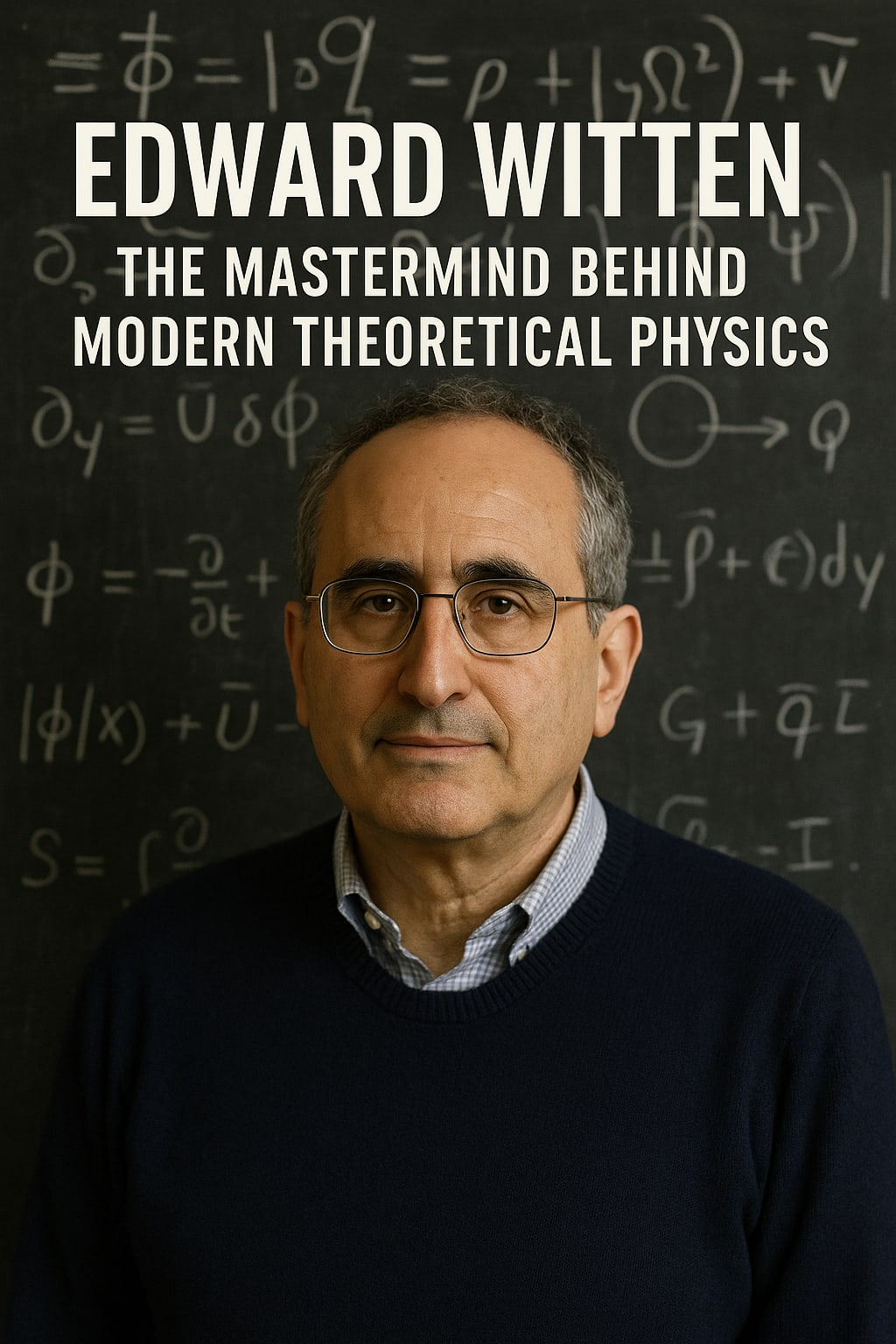
Edward Witten stands as one of the most influential and brilliant physicists of the late 20th and early 21st centuries. Revered for his extraordinary insights in theoretical physics and mathematics, Witten has profoundly shaped our understanding of the universe through his groundbreaking work in string theory and quantum field theory. Often hailed as the “father of modern string theory,” his career blends deep mathematical rigor with revolutionary physical ideas, placing him at the pinnacle of both physics and mathematics.
⸻
Early Life and Education
Edward Witten was born on August 26, 1951, in Baltimore, Maryland, into an intellectually stimulating environment. His parents were both academics—his father, Louis Witten, was a physicist, and his mother, Lorraine Witten, was a teacher. Growing up in a family that prized education and inquiry, Witten exhibited an early fascination with the abstract and fundamental questions of the universe.
Witten’s academic brilliance became evident early on. He attended Brandeis University, where he majored in history and linguistics rather than physics, showcasing his broad intellectual curiosity. This unusual path hints at Witten’s unique way of thinking—always searching for connections across different domains of knowledge.
After Brandeis, Witten shifted his focus decisively towards physics and enrolled at Princeton University to pursue graduate studies in applied mathematics. There, he earned his Ph.D. in 1976 under the mentorship of David Gross, a Nobel laureate physicist himself. This marked the beginning of Witten’s lifelong journey at the intersection of physics and advanced mathematics.
⸻
Contributions to Theoretical Physics and String Theory
Witten’s impact on theoretical physics is profound, especially in the realm of string theory. In the 1980s, string theory was emerging as a promising framework to unify all fundamental forces of nature, including gravity, which had eluded unification under the standard model of particle physics.
Witten revolutionized string theory by introducing new mathematical tools and perspectives, which helped to establish string theory as a serious candidate for a “Theory of Everything.” His work provided key insights into how strings, one-dimensional objects vibrating in multiple dimensions, could underlie the fundamental particles and forces observed in the universe.
One of his most notable achievements came in 1995, during what is now called the “Second Superstring Revolution.” Witten proposed the existence of “M-theory,” a more profound framework that unified five previously distinct string theories. This was a monumental breakthrough, suggesting a single underlying theory connecting all consistent string theories, which hinted at the deep unity of physical laws.
Beyond string theory, Witten has contributed significantly to quantum field theory, the mathematical framework that describes fundamental forces and particles. His work bridged gaps between abstract mathematics and theoretical physics, leading to advances in understanding gauge theories, topology, and geometry.
⸻
Awards and Honors
Witten’s extraordinary contributions have earned him numerous prestigious awards and honors. Notably, he is the only physicist to have won the Fields Medal (in 1990), the highest accolade in mathematics, often regarded as the equivalent of a Nobel Prize for mathematicians. This rare honor reflects his unique ability to apply mathematical concepts to solve deep problems in physics.
He has also received the National Medal of Science, the Dirac Medal, the Breakthrough Prize in Fundamental Physics, and many others. Witten’s accolades acknowledge not only his technical achievements but also his role as a visionary leader pushing the boundaries of human knowledge.
⸻
Influence and Legacy
Edward Witten’s influence extends far beyond his specific discoveries. As a professor at the Institute for Advanced Study in Princeton, he has mentored and inspired a generation of physicists and mathematicians. His lectures and writings are celebrated for their clarity and insight, and he is known for encouraging interdisciplinary approaches that blend physics and pure mathematics.
Witten’s work has also shaped how physicists think about the nature of reality, spacetime, and the fundamental building blocks of the cosmos. His ideas have propelled the search for a unified theory that explains both the quantum realm and the large-scale structure of the universe.
Moreover, Witten’s blending of mathematical elegance with physical intuition has helped to cement string theory as a central framework in theoretical physics, stimulating new research directions and inspiring countless scientists worldwide.
⸻
Personal Characteristics and Philosophy
Witten is often described as intellectually intense, deeply thoughtful, and modest despite his towering achievements. His approach to science emphasizes creativity, rigor, and the pursuit of beauty in theoretical formulations. He sees theoretical physics not just as a technical endeavor but as an art form, where elegance and simplicity in equations often reveal profound truths about nature.
His ability to traverse and unify diverse fields—from pure mathematics to high-energy physics—makes him a uniquely versatile thinker. Witten exemplifies the spirit of inquiry, constantly questioning assumptions and seeking deeper understanding.
⸻
Conclusion
Edward Witten’s life and work represent a remarkable journey of intellect, creativity, and discovery. From his early days as a curious student to his status as the foremost architect of modern theoretical physics, Witten has transformed our understanding of the universe’s fundamental workings. His pioneering contributions to string theory and quantum field theory continue to shape the future of physics and mathematics.
As the “father of modern string theory,” Edward Witten’s legacy is not only the groundbreaking theories he formulated but also the inspiration he provides to scientists striving to unlock the universe’s deepest mysteries. His career stands as a testament to the power of human imagination and intellect in advancing knowledge and expanding the horizons of science.
About the Creator
Irshad Abbasi
"Studying is the best cure for sorrow and grief." shirazi
Keep reading
More stories from Irshad Abbasi and writers in History and other communities.
The Geneticist Who Decoded the Language of Genes
Pierre Chambon, born on February 7, 1931, in Mulhouse, France, is a French physician and molecular biologist renowned for his groundbreaking discoveries in gene expression, nuclear receptors, and transcription mechanisms. His lifelong work has had a transformative impact on modern molecular biology, contributing significantly to the understanding of how genes are regulated and expressed in eukaryotic cells. Chambon’s pioneering research not only opened new doors in genetics and cell biology but also laid the foundation for developing innovative therapies for hormonal and metabolic diseases, cancers, and more.
By Irshad Abbasi 6 months ago in History
Corruption's Impact On Society
Corruption, a term with a broad spectrum of definitions, is often a result of government officials overpowering legal policies. Corruption can weaken the ideal democracy within a nation, erode trust in the relationship between the government and society, and exacerbate inequality and poverty. Forms of this act can include bribery, lobbying, extortion, cronyism, nepotism, parochialism, and embezzlement. Furthermore, corruption is the deterioration of moral and ethical standards that are characterized by the prioritization of personal gain over public good, abuse of power, and a lack of transparency.
By Katherine Roteman3 days ago in History
From Desert Sands to a Global City
Long before Dubai became a city of glittering skyscrapers and global ambition, it was a quiet settlement shaped by the desert, the sea, and the determination of its people. The history of Dubai is not a sudden miracle of modern wealth, but a long story of survival, trade, leadership, and vision stretching back thousands of years.
By The best writer 2 days ago in History



Comments
There are no comments for this story
Be the first to respond and start the conversation.