
The Man Who Screamed Into the Void: The Uncomfortable Truth of the Challenger Disaster
Roger Boisjoly knew the Space Shuttle would explode. He had the charts, the data, and the proof. But in a room governed by power rather than science, being right was not enough to save seven lives.

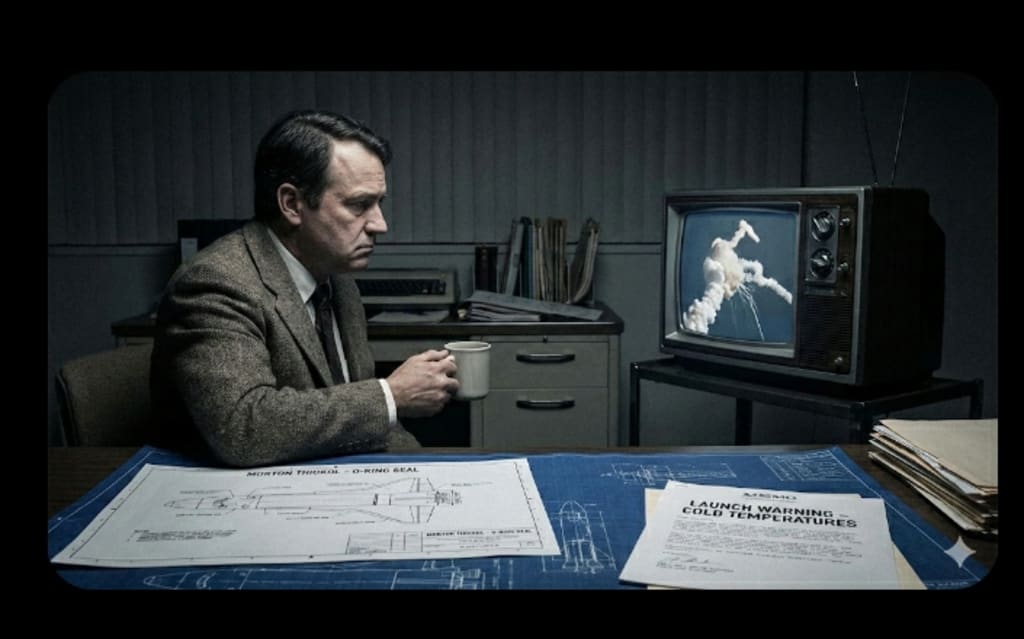
On the night of January 27, 1986, the temperature in Brigham City, Utah, was plummeting. Inside his home, an American engineer named Roger Boisjoly sat awake, his stomach knotted with a specific, heavy dread that most people will never experience.
He wasn’t suffering from a vague premonition. He wasn’t guessing. He was looking at a mathematical certainty.
Boisjoly knew something that the excited school children across America, the news anchors, and the families of the astronauts did not know. He knew that if the Space Shuttle Challenger launched the next morning from Florida, where temperatures were hitting record lows, it was going to explode.
He had the blueprints. He had the data. He had the proof.
What followed is not just a tragedy of mechanics, but a tragedy of human nature. It is the story of the Challenger disaster whistleblower, a man who did everything right in a system designed to do everything wrong. It is a Roger Boisjoly true story that remains one of the most chilling examples of real American engineering failure.
This is the story of the night the engineers were told to stop thinking like engineers.
The Flaw Hidden in Plain Sight
To understand the horror of January 28th, we have to look at the machinery. Roger Boisjoly worked for Morton Thiokol, the contractor responsible for building the Solid Rocket Boosters (SRBs)—the massive white pillars attached to the side of the shuttle that provided the raw power to escape gravity.
These boosters were assembled in segments. Where the segments joined, they needed a seal to keep the white-hot pressurized gases from escaping and melting the ship. These seals were called O-rings. They were essentially giant rubber bands.
Rubber has a specific property: when it is warm, it is pliable and creates a tight seal. When it is cold, it becomes hard, brittle, and slow to react.
Boisjoly had been studying the O-rings for months. He had identified a pattern that terrified him. In previous launches, even in mild weather, the O-rings had shown signs of erosion—"blow-by"—where hot gas leaked past the primary seal.
The data was absolute. The colder the temperature, the greater the failure.
The launch of the Challenger was scheduled for a morning when the temperature in Florida was forecast to drop to 18°F (-8°C). This wasn't just cold; it was freakishly cold. It was 35 degrees colder than any previous launch in history.
Boisjoly didn’t speculate. As a methodical engineer, he documented. He created charts. He wrote internal memos that were ignored, memos that contained prophetic warnings like: "The result would be a catastrophe of the highest order—loss of human life."
On the eve of the launch, he wasn't fighting a hunch. He was fighting physics.
The Teleconference from Hell
The events of the night of January 27th should be studied in every business school and ethics class in the world. It was the moment NASA ignored warnings in favor of optics.
A teleconference was set up between the engineers at Morton Thiokol in Utah and NASA management at the Kennedy Space Center and Marshall Space Flight Center.
Boisjoly and his team of engineers were adamant. They presented their charts. They explained that at 18°F, the O-rings would be hard as rocks. They would not seal in time. The hot gas would escape, burn through the strut, and detonate the main fuel tank.
"We recommend a launch delay," they said. "Do not launch until temperatures reach 53°F."
For a moment, silence hung on the line. Then, the pushback began.
NASA was under immense pressure. The shuttle program was already behind schedule. This specific mission had been delayed multiple times. It was a high-profile PR event; Christa McAuliffe, a high school teacher, was on board, set to become the first civilian in space. President Reagan was preparing to mention the launch in his State of the Union address.
Lawrence Mulloy, a NASA manager, was frustrated. He looked at the recommendation to delay and uttered a sentence that would go down in the annals of administrative arrogance:
"My God, Thiokol, when do you want me to launch—next April?"
NASA challenged the data. They argued that the evidence wasn't "conclusive" enough to stop the countdown. They demanded that Morton Thiokol reconsider.
This is where the story turns from an engineering debate into a moral horror story.
The executives at Morton Thiokol asked for a timeout. They muted the phone line.
In that room in Utah, the engineers—Boisjoly and his colleague Arnie Thompson—fought for their lives. Not their own lives, but the lives of the seven people sitting on top of the rocket. Boisjoly pulled out photos of burnt O-rings from previous flights. He slammed them onto the table. He pleaded with his managers to look at the reality of the situation.
The managers looked at the engineers, and then they looked at each other. They were worried about their contract with NASA. They were worried about being the company that held up the space program.
Then, a senior vice president at Thiokol turned to the Vice President of Engineering, Bob Lund, and said the words that sealed the fate of the Challenger:
"Take off your engineering hat and put on your management hat."
It was a command to ignore the facts and focus on the politics.
Bob Lund obeyed. He overruled Boisjoly.
Thiokol unmuted the phone. They told NASA the launch was a "go."
Boisjoly sat back in his chair. He felt a physical sickness. He went home that night and told his wife, "It’s going to blow up."
The Longest 73 Seconds
On the morning of January 28, 1986, the launch pad at Cape Canaveral looked like an icebox. Icicles hung from the gantry. The ground crews were shivering.
Roger Boisjoly refused to watch the launch on the big screens in the corporate auditorium. He couldn't bear to see the celebration of what he believed was a death sentence. Instead, he went to a colleague's office where they could watch privately.
As the countdown hit zero and the solid rocket boosters ignited, Boisjoly watched the smoke. He expected the explosion to happen immediately, right on the pad.
It didn't. The shuttle lifted off. It cleared the tower.
"Thirteen seconds," his colleague whispered. "Roger, we made it past the throttle up."
For a brief, agonizing moment, Boisjoly allowed himself to hope. Maybe he was wrong. Maybe the physics had granted them a miracle. The O-rings, perhaps, had sealed just in time.
The shuttle soared into the clear blue sky, a beautiful streak of white smoke trailing behind it.
At 73 seconds into the flight, the relentless laws of thermodynamics caught up with the Challenger.
On the screen, a small puff of black smoke appeared on the right solid rocket booster—exactly where Boisjoly predicted the O-ring would fail. A flame jet escaped, cutting into the main fuel tank like a blowtorch.
The massive orange tank, filled with liquid hydrogen and oxygen, collapsed.
In the office in Utah, Boisjoly watched the screen fill with a chaotic cloud of fire and debris. The singular trail of smoke split into a horrific "Y" shape.
The room went silent.
Boisjoly didn't cry. He didn't scream. He simply sat there, destroyed. It wasn't shock he was feeling; it was the utter devastation of confirmation.
Seven astronauts—Dick Scobee, Michael Smith, Ronald McNair, Ellison Onizuka, Judith Resnik, Gregory Jarvis, and Christa McAuliffe—were gone.
The Ice Water and the Truth
In the weeks that followed, the nation mourned. President Reagan gave a touching speech. But behind the scenes, a battle for the truth was brewing.
President Reagan appointed the Rogers Commission to investigate the disaster. The commission included heavyweights like Neil Armstrong and the brilliant theoretical physicist Richard Feynman.
NASA and Morton Thiokol attempted to control the narrative. They tried to frame the disaster as an unfortunate accident, a freak occurrence. They buried the memos. They obscured the teleconference.
But Roger Boisjoly refused to let the lie stand.
When the investigators questioned him, Boisjoly did something that few people in corporate America dare to do: He told the truth. He handed over his memos. He described the teleconference. He detailed the pressure, the arguments, and the "management hat" comment.
He found an ally in Richard Feynman. In a now-famous televised hearing, Feynman performed a simple, devastating experiment. He took a piece of the O-ring material, clamped it with a C-clamp, and dropped it into a glass of ice water.
After a few minutes, he pulled it out and unclamped it. The rubber didn't bounce back. It stayed compressed.
"I believe that has some significance for our problem," Feynman said dryly.
It was the smoking gun. It proved that NASA ignored warnings and that the real American engineering failure was not a lack of knowledge, but a lack of integrity.
The Price of Integrity
In a just world, Roger Boisjoly would have been hailed as a hero. He would have been promoted. He would have been given a medal for trying to save lives.
But this is the uncomfortable part of real motivation stories USA. We like to believe that truth is rewarded. Often, it is punished.
After his testimony, Boisjoly became a pariah at Morton Thiokol. He was isolated. Former friends stopped making eye contact in the hallway. He was cut out of meetings and removed from projects. He was labeled a troublemaker, a leaker, a man who wasn't a "team player."
The psychological toll was immense. Boisjoly suffered from severe depression and PTSD. He experienced headaches, double vision, and mood swings. He blamed himself, constantly replaying the teleconference in his mind, wondering if he could have shouted louder, if he could have flipped a table, if he could have physically stopped the sign-off.
He eventually left the aerospace industry entirely. The career he loved was over.
The Legacy of the "Unwanted" Hero
Roger Boisjoly passed away in 2012. He never returned to the space program.
However, his story did not end in silence.
In the later years of his life, Boisjoly found a new purpose. He began traveling to engineering schools and universities across the world. He spoke to young students—the future designers, architects, and managers of the world.
He taught them about the Challenger disaster whistleblower, not to scare them, but to arm them.
He taught them that ethical decision-making isn't just a soft skill; it is a life-or-death responsibility. He taught them that there will come a day in their careers when they are asked to "put on their management hat" and ignore the facts.
His legacy is not in the shuttle that was lost, but in the disasters that never happened because a young engineer remembered the story of Roger Boisjoly and had the courage to say "No."
Why This Story Matters Today
We live in an era that feels frighteningly similar to January 1986.
We see it in tech companies rushing AI products to market despite safety warnings. We see it in infrastructure projects where budgets override durability. We see it in corporations where "yes-men" are promoted and critical thinkers are silenced.
The Roger Boisjoly true story is uncomfortable because it forces us to look in the mirror. It forces us to ask:
* Do we reward speed over safety?
* Do we value confidence over competence?
* Do we create environments where people are afraid to speak up?
The Challenger didn't explode because of a rubber O-ring. That was just the mechanism. The Challenger exploded because of Groupthink. It exploded because power structures silenced expertise.
Roger Boisjoly was a hero not because he saved the ship—he couldn't. He was a hero because he refused to let the seven astronauts die in vain. He ensured that the truth was written into history so that we might learn from it.
America loves stories of triumph. But sometimes, we need the stories of failure. We need to remember the man who screamed into the void, so that next time, we might actually listen.
Author's Note:
This story serves as a reminder of the weight of professional ethics. If you are an engineer, a doctor, or a decision-maker, remember Roger Boisjoly. When the data tells you to stop, listen to it.
About the Creator
Frank Massey
Tech, AI, and social media writer with a passion for storytelling. I turn complex trends into engaging, relatable content. Exploring the future, one story at a time
Reader insights
Nice work
Very well written. Keep up the good work!
Top insights
Easy to read and follow
Well-structured & engaging content
Excellent storytelling
Original narrative & well developed characters
Expert insights and opinions
Arguments were carefully researched and presented
Eye opening
Niche topic & fresh perspectives
Heartfelt and relatable
The story invoked strong personal emotions
On-point and relevant
Writing reflected the title & theme
Keep reading
More stories from Frank Massey and writers in History and other communities.
The Man Who Mapped the Poison: How an Invisible Janitor Exposed the Most Dangerous Building in America
The harrowing true story of the whistleblowers at the Rocky Flats Nuclear Weapons Plant, whose warnings about plutonium contamination led to the unprecedented 1989 FBI raid and the shutdown of a toxic American secret.
By Frank Massey 5 days ago in Motivation
What Is Really Happening Between the USA and Venezuela?
What Is Really Happening Between the USA and Venezuela? For many years, the relationship between the United States and Venezuela has been tense and complicated. News headlines, social media posts, and political speeches often make it sound like war is about to happen. However, the reality is more complex. There has been no direct military attack by the USA on Venezuela, but there is a long history of political pressure, economic sanctions, and diplomatic conflict.
By Wings of Time 5 days ago in History


Comments (1)
Thought provoking