
The Man Who Mapped the Poison: How an Invisible Janitor Exposed the Most Dangerous Building in America
In the shadow of the Rocky Mountains, the U.S. government was building nuclear triggers in a factory that was secretly leaking death. It took a man with a mop, a bucket, and nothing to lose to reveal a disaster that threatened to poison a city of millions

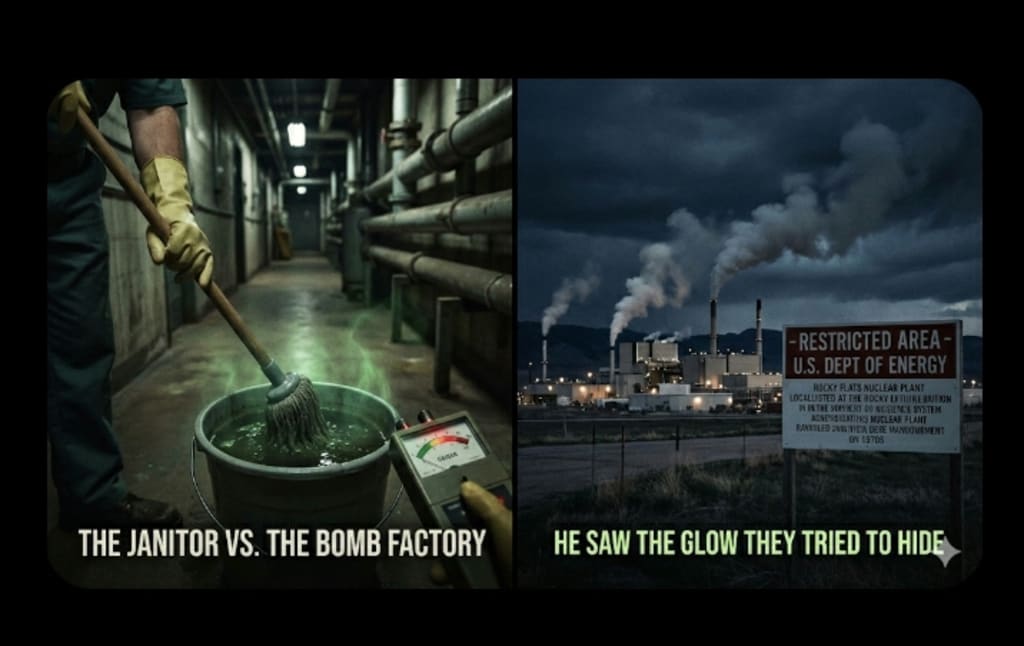
The harrowing true story of the whistleblowers at the Rocky Flats Nuclear Weapons Plant, whose warnings about plutonium contamination led to the unprecedented 1989 FBI raid and the shutdown of a toxic American secret.
Introduction: The Wind from the Mountains
Sixteen miles northwest of downtown Denver, Colorado, the wind sweeps down off the Front Range of the Rocky Mountains. It is a strong, relentless wind, often reaching speeds of hurricane force. It scours the high desert plateau, kicks up dust, and blows directly toward the suburbs, the schools, and the skyscrapers of the Mile High City.
For nearly forty years, that wind carried a secret.
From 1952 to 1989, a facility known as the Rocky Flats Plant sat on that plateau. To the locals, it was a mysterious collection of concrete buildings surrounded by barbed wire and armed guards. The government said they were making "household chemicals." Later, they admitted they were making "components."
The truth was far more terrifying. Rocky Flats was the primary production facility for the plutonium triggers—or "pits"—for every nuclear warhead in the United States arsenal. It was the heart of the Cold War machine. Inside those buildings, workers were machining plutonium, a man-made element named after the god of the underworld.
Plutonium is pyrophoric; it can ignite spontaneously in contact with air. It is also one of the most toxic substances on Earth. A single microscopic particle, if inhaled, can lodge in a lung and cause cancer.
The plant was operated by private contractors—first Dow Chemical, later Rockwell International—under the supervision of the Department of Energy (DOE). The mandate was simple: Build bombs. Beat the Soviets. Don't ask questions.
But in the rush to arm the nation, safety became an afterthought. The facility was a ticking time bomb of radioactive waste, leaking pipes, and makeshift solutions.
While scientists and engineers looked at the big picture, the reality of the danger was noticed by the people looking at the floor. The people with the mops. The people who saw the dust that wasn't supposed to be there.
This is the story of the invisible workforce—represented by men like the janitor Stanley Petrowski—who realized that the most dangerous building in America was killing its own neighbors.
Part I: The Night Shift in Building 771
In 1974, the Cold War was freezing cold. The demand for nuclear warheads was relentless. Rocky Flats was running 24 hours a day.
Stanley Petrowski was not a nuclear physicist. He was a janitor. In the hierarchy of a nuclear weapons plant, the janitor is the lowest rung. You are there to empty the trash, wax the linoleum, and disappear. You are not paid to think about isotopes or critical mass.
But the janitor has a unique vantage point. The janitor sees what the supervisors miss. The janitor sees what gets swept under the rug—literally.
Petrowski worked in and around the production areas, including the infamous Building 771. Years later, ABC's Nightline would call Building 771 "the most dangerous building in America."
It was a labyrinth of gloveboxes—sealed containers where workers manipulated radioactive metal through thick rubber gloves. The air pressure was supposed to be carefully controlled to keep the dust inside.
But Petrowski began to notice things that defied the official safety briefings.
He saw liquids leaking from pipes that were supposed to be sealed. He saw "infinity rooms"—areas where the radiation was so high that the Geiger counters maxed out—being cleaned with standard equipment. He saw ventilation ducts taped together with duct tape.
Most alarmingly, he saw the dust.
In a facility handling plutonium, "dust" is a death sentence. The floors were supposed to be pristine. But during the night shifts, when the top brass was asleep in their beds in Boulder or Denver, the pace of production created a chaotic mess.
Petrowski found himself mopping up substances that glowed on the monitors. He realized that the water in his bucket was becoming radioactive waste. And then, he realized that this waste wasn't always being treated with the care of a nuclear hazard. Sometimes, it was just being dumped.
He was witnessing a terrifying disconnect. On paper, Rocky Flats was a fortress of safety. In reality, it was a sweatshop making doomsday devices.
Part II: The Culture of Production
When Petrowski tried to raise questions, he hit the "Silicon Curtain."
This was the nickname for the culture of silence that permeated the nuclear weapons complex. The Cold War provided the ultimate excuse for negligence: National Security.
If you complained about safety, you weren't just a complainer; you were unpatriotic. You were slowing down the production of the weapons needed to keep America free.
Petrowski approached his supervisors. "This reading is too high," he would say. "We shouldn't be mopping this."
The responses were variations of the same theme:
"That's not your job, Stanley."
"The sensors are faulty; ignore them."
"If you don't want to work here, there’s a line of people outside who do."
It was gaslighting on an industrial scale. The workers were told they were safe, even as they watched fires break out in the production lines. (A major fire in 1969 had already nearly caused a catastrophe, sending a plume of plutonium smoke into the atmosphere, a fact the government downplayed for decades).
Petrowski was stuck in a moral vice. He needed the job. The pay at Rocky Flats was better than anywhere else for a man without a degree. But every night, he went home wondering if he was poisoning his family by wearing his work shoes into the house.
He wondered about the wind. He knew the ventilation filters were clogged. He knew the incinerators were burning things they shouldn't. And he knew that just downwind, thousands of families were building homes, oblivious to the invisible rain falling on their lawns.
Part III: The Cost of Speaking Out
Eventually, the burden became too heavy. Petrowski, along with a handful of other concerned workers over the years, began to talk.
He didn't go to the New York Times immediately. He tried to go through channels. He tried to talk to safety inspectors.
The reaction was brutal and swift.
In the 1970s, whistleblower protection laws were virtually non-existent, especially in the defense sector. The moment Petrowski was identified as a "troublemaker," his life at the plant became hell.
He was isolated. He was given the worst assignments—cleaning the "hot" spots that no one else wanted to touch. It was a form of retaliatory punishment designed to make him quit.
He was followed. In the paranoia of the nuclear industry, security officers viewed dissent as potential espionage. His psychological stability was questioned. Only a crazy person would think the government is lying.
Eventually, he was forced out. He lost his livelihood. He was blacklisted. In a company town, word travels fast. Who wants to hire the guy who snitched on the bomb plant?
Petrowski spiraled. The stress of knowing the truth, coupled with the destruction of his personal reputation, broke him. He suffered from mental health struggles. He lost friends. He became a ghost in his own community—a man shouting about a fire that no one else could see.
For years, it seemed the government had won. Rocky Flats kept churning out triggers. The waste kept piling up. The wind kept blowing.
Part IV: The Impossible Raid
But the truth has a half-life. It doesn't disappear; it just waits.
The warnings from workers like Petrowski, and later from engineers like Jim Stone (who famously used a hidden tape recorder to document the negligence), began to seep out. They reached the ears of the Environmental Protection Agency (EPA) and the FBI.
The FBI was skeptical at first. The Department of Justice raiding another government department (the Department of Energy) was unprecedented. It was constitutionally messy.
But the evidence provided by the insiders was too specific to ignore. They described exactly where the waste was being illegally incinerated. They described the "midnight dumping."
On the morning of June 6, 1989, the unthinkable happened.
Operation Desert Glow.
Seventy-five FBI agents and EPA officials, armed with guns and search warrants, swarmed the Rocky Flats plant. They didn't knock. They invaded.
To deceive the plant managers, the FBI had told the Air Force they were conducting a counter-terrorism exercise. They flew low over the plant to distract the guards while the agents drove through the gates.
It was the first time in U.S. history that a nuclear weapons facility was raided by federal law enforcement.
Inside, they found exactly what the janitors and engineers had been saying for years.
They found massive environmental crimes. They found that the plant was illegally treating hazardous waste. They found that the "safety culture" was a myth.
The raid vindicated everyone who had been silenced. The plant was forced to shut down operations. The production of plutonium triggers stopped, never to resume at Rocky Flats.
Part V: The Cleanup and the Cost
The aftermath of the raid revealed a horror story. The contamination was so bad that the plant could not be fixed. It had to be demolished.
The cleanup took over a decade and cost the American taxpayers $7 billion.
Thousands of barrels of radioactive waste were removed. The buildings were torn down and shipped to secure landfills. The land was scraped.
Today, the site is a wildlife refuge. On the surface, it looks like a beautiful prairie. But underneath, deep in the soil, the legacy of Rocky Flats remains.
And what of the whistleblowers?
Stanley Petrowski and the others who sounded the alarm didn't get a ticker-tape parade. There were no medals for them.
Many of them died of cancers that were likely linked to their exposure. Others, like Petrowski, died in obscurity, their lives wrecked by the stress of the conflict.
Rockwell International, the contractor, eventually pleaded guilty to environmental crimes and paid an $18.5 million fine—a pittance compared to the damage done. No individual manager went to prison.
Part VI: The Quiet Heroism of the Mop
The story of the Rocky Flats janitor challenges our definition of heroism.
We like heroes who win. We like heroes who stand on a podium at the end of the movie while the music swells.
But real heroism is often a losing game.
Stanley Petrowski lost his job. He lost his standing in the community. He lost his peace of mind.
But because he—and others like him—refused to accept the lie, the plant was closed.
If Rocky Flats had continued to operate the way it was, a catastrophic fire was inevitable. The 1969 fire had been a near-miss. A future fire could have released a Chernobyl-sized plume of plutonium directly into the Denver metro area.
Hundreds of thousands of people are alive and healthy today because a janitor looked at a dirty floor and decided that "good enough" wasn't good enough.
Conclusion: The Warning in the Wind
This story matters deeply to Americans today because it exposes the fragility of the systems we trust.
We assume that if something is dangerous, the government will fix it. We assume that "National Security" implies the security of the citizens.
Rocky Flats proved that institutions will often protect themselves before they protect the people. It proved that "safety" is often just a paperwork exercise.
The only failsafe mechanism in a corrupt system is the individual. The only thing standing between a city and a disaster is often a single person—a janitor, a clerk, a nurse—who decides to break the rules to tell the truth.
Stanley Petrowski’s life is a reminder that the truth is expensive. It can cost you everything.
But the cost of silence is higher.
Today, if you drive northwest of Denver, you will see rows of new houses built near the edge of the old buffer zone. You will see children playing in parks. You will feel the wind coming off the mountains.
That wind is cleaner today because of the people who were punished for trying to save it. Their names are not on the maps, but their legacy is in the air we breathe.
About the Creator
Frank Massey
Tech, AI, and social media writer with a passion for storytelling. I turn complex trends into engaging, relatable content. Exploring the future, one story at a time
Keep reading
More stories from Frank Massey and writers in Motivation and other communities.
The Soldier the Army Rejected—Who Became the Commander-in-Chief
The year was 1917, and the world was burning. Europe had been trench-locked in the First World War for three years, and the United States was finally stepping into the fray. Across the American Midwest, young men were lining up at recruitment centers, eager to prove their valor in the "war to end all wars."
By Frank Massey 8 days ago in Motivation
The Day I Stopped Waiting
For most of my life, I believed I was waiting for something. I didn’t know exactly what—maybe confidence, maybe opportunity, maybe permission. I just knew that once that thing arrived, my real life would finally begin. Until then, I stayed careful, quiet, and comfortably stuck.
By Asghar ali awan7 days ago in Motivation
Where's the Glory?
In breaking news, rehabilitated Republican Senator Johnnie Johnson (Pronouns: HE, HIM, HIS) called a press conference from the Men’s room of the New Orleans Louis Armstrong International Airport, Concourse B, across from the Ignatius Reilly’s Lucky Dog stand. The Senator had just returned from a sexual reorientation rehabilitation program in Memphis, TN after being publically disgraced at a Buckee’s Truckstop restroom soliciting sex from an undercover cop three months ago. He is a founding member of the Reformed Christians for Christ, a conservative, pro-family and ex-gay advocacy group. In the spirit of being reborn, Senator Johnson invited reporters to marvel at his plans for a major remodeling of airport bathrooms.
By Cathy Schieffelin4 days ago in Humor


Comments
There are no comments for this story
Be the first to respond and start the conversation.