
The Man Who Refused to Quit
A Story of Grit, Grease, and Greatness

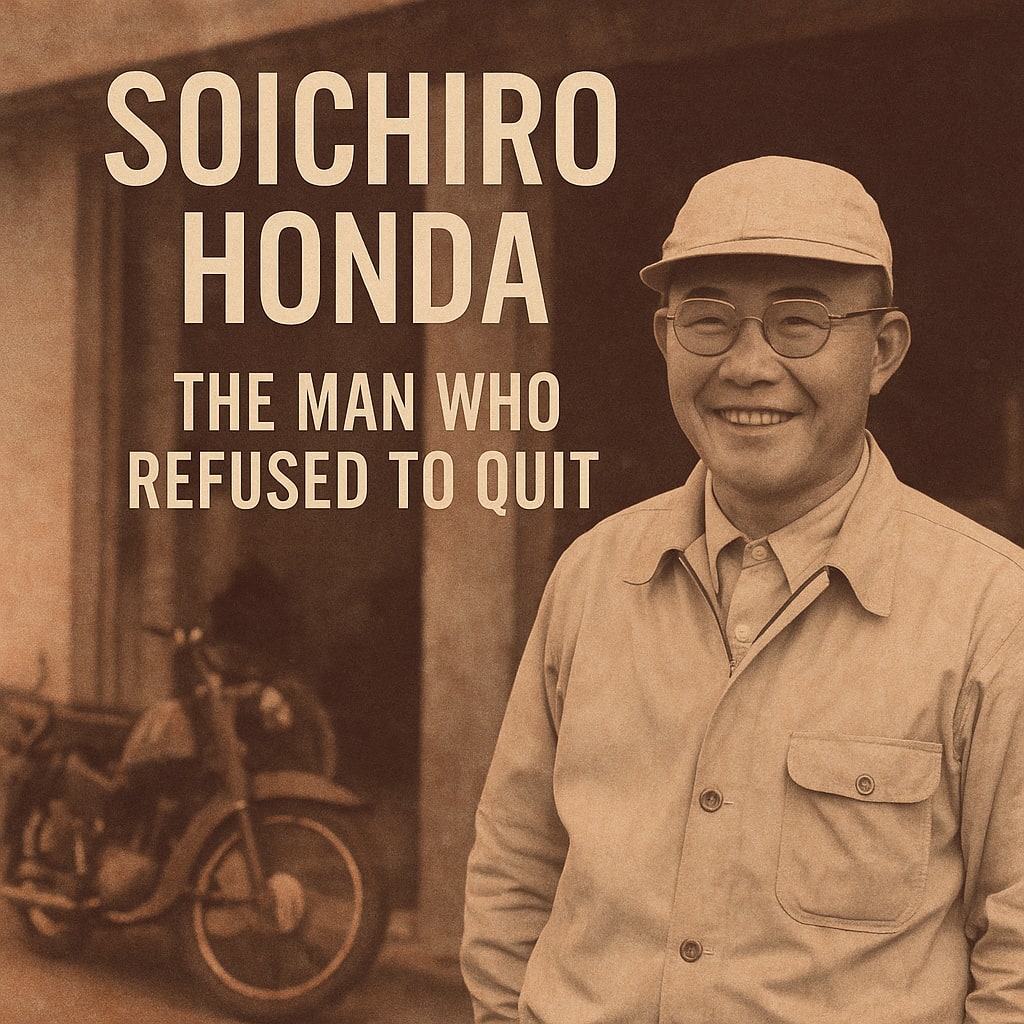
In the dusty countryside of Hamamatsu, Japan, a young boy named Soichiro Honda spent his days tinkering with broken bicycles and watching his father repair metal tools. Born in 1906, in a time when Japan was still transitioning into an industrial nation, Soichiro showed signs early on that he was no ordinary child. He wasn't a good student—his hands were too restless, his mind too curious, and the classroom too small for his imagination.
At the age of 15, he moved to Tokyo and began working as an apprentice at a small auto repair shop called Art Shokai. He worked long hours, sometimes sleeping on the floor. But he wasn’t complaining. Every bolt he tightened, every engine he cleaned, added fuel to his dream — to build something extraordinary.
For six years, Soichiro absorbed everything. By the time he returned to his hometown, he had a vision: to start his own workshop. With meager savings, he opened a garage and began designing piston rings. It was a small, niche part of the automobile engine, but Honda had big plans.
He approached Toyota with his prototype, but they rejected it — citing poor quality and design flaws. Most people would have given up. Not Honda. He enrolled in an engineering school—despite not finishing regular school—and studied metallurgy and mechanics in depth. His teachers thought he was odd. He didn’t care. He wasn’t there for grades. He was there for knowledge.
Eventually, his improved piston rings were accepted by Toyota. It was a breakthrough. He started a company to manufacture them. But fate had other plans.
During World War II, Honda's factory was bombed twice. What little remained was destroyed by an earthquake. His life's work was reduced to rubble. He sold whatever remained of his business to Toyota and could have faded into obscurity.
Instead, he started again.
In post-war Japan, fuel was scarce, and people needed an affordable mode of transport. Honda saw a problem — and an opportunity. He began fitting surplus military engines onto bicycles. They were loud, awkward-looking, and often unreliable. But they worked.
And people noticed.
With the last of his savings, he founded the Honda Motor Company in 1948. This time, he wasn’t alone. He teamed up with Takeo Fujisawa, a brilliant businessman who managed the finances while Honda focused on innovation.
They launched the Honda Cub in 1958 — a lightweight, reliable, and inexpensive motorcycle. Their motto was bold: "You meet the nicest people on a Honda." It worked. The Honda Cub became the best-selling motorcycle in history.
By the 1960s, Honda Motor Company was dominating motorcycle markets in Japan, the U.S., and Europe. But Honda wasn’t satisfied. He wanted to make cars.
Critics laughed. “How can a motorcycle company compete with Detroit?” they said. But Honda wasn't listening. He built compact, fuel-efficient cars, just as the world began to worry about fuel shortages.
Then came the Honda Civic — a small car that met U.S. emission standards when most American cars failed. It was a hit. Later came the Accord, and then the luxury brand Acura. Each success was built on the failures that came before it.
Honda didn’t just build machines. He built a mindset: Never quit. Embrace failure. Trust your hands. Trust your gut.
In 1973, Soichiro Honda retired, handing over the reins to the next generation. But he didn’t stop working. He pursued his love for engineering, airplanes, and even racing. Under his leadership, Honda became a force in Formula One racing, competing — and winning — against giants like Ferrari.
Until his death in 1991, Soichiro Honda remained a symbol of what determination, curiosity, and humility could achieve. He had no formal degree, no business training, and no powerful connections. Yet he built one of the most respected automotive empires in the world.
His philosophy was simple:
> “Success can only be achieved through repeated failure and introspection. In fact, success represents the 1% of your work which results from the 99% that is called failure.”
---
🔧 Lessons from Honda’s Life
Failure is fuel – Every rejection and disaster made him stronger.
Hands-on learning beats theory – He learned by doing, not just by reading.
Innovation comes from problems – He looked at the world’s problems and built solutions.
Never stop reinventing – From bicycles to bikes, to cars and even jets, he never stopped dreaming.
---
Soichiro Honda’s story isn’t just about motorcycles or cars. It’s about the fire inside a person who refuses to give up. It’s about turning broken pieces into powerful machines. It’s about grit.
And most importantly, it’s about believing — in yourself, even when no one else does.
About the Creator
Waqif Khan
i'm creating history from old people
Keep reading
More stories from Waqif Khan and writers in History and other communities.
The Rise and Fall of Rome
Rome didn’t start as an empire. It began as a myth. A story of two brothers — Romulus and Remus — abandoned in the wild, raised by a she-wolf, and destined to build a city that would one day rule the known world. In 753 BC, Romulus is said to have founded Rome, naming it after himself — by blood, by war, and by destiny.
By Waqif Khan7 months ago in History
Can Global Peace Exist Without a Global Authority?
Can Global Peace Exist Without a Global Authority? The idea of global peace without a global authority sounds appealing to some people. In theory, nations could manage their own affairs, respect each other’s borders, and resolve disputes peacefully without an overarching institution telling them what to do. Supporters of this view argue that global bodies are slow, biased, and often ineffective. But history and current events raise a difficult question: can lasting global peace truly exist without a central authority to guide it?
By Wings of Time 3 days ago in History


Comments
There are no comments for this story
Be the first to respond and start the conversation.