
The Lost City of Dwarka: A Glimpse into an Ancient Submerged Civilization
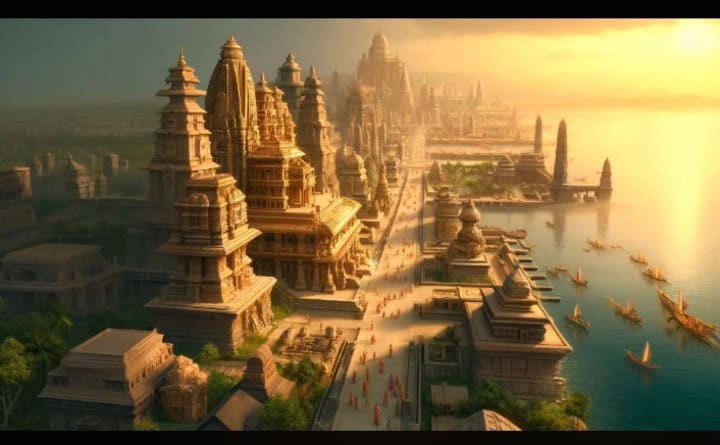
Mythological Significance and the Legend of Krishna’s Dwarka According to Hindu mythology, Dwarka was established by Lord Krishna, who relocated his kingdom from Mathura to escape the wrath of King Jarasandha. With divine guidance, Krishna is said to have created a magnificent city adorned with palaces, temples, and wide avenues. This city, as described in texts like the Mahabharata, was a prosperous and sacred place, revered as one of the seven most holy cities in Hinduism. After Krishna’s departure from the mortal world, Dwarka is believed to have sunk beneath the ocean, fulfilling a prophecy foretold by ancient sages.

The Lost City of Dwarka: A Glimpse into an Ancient Submerged Civilization
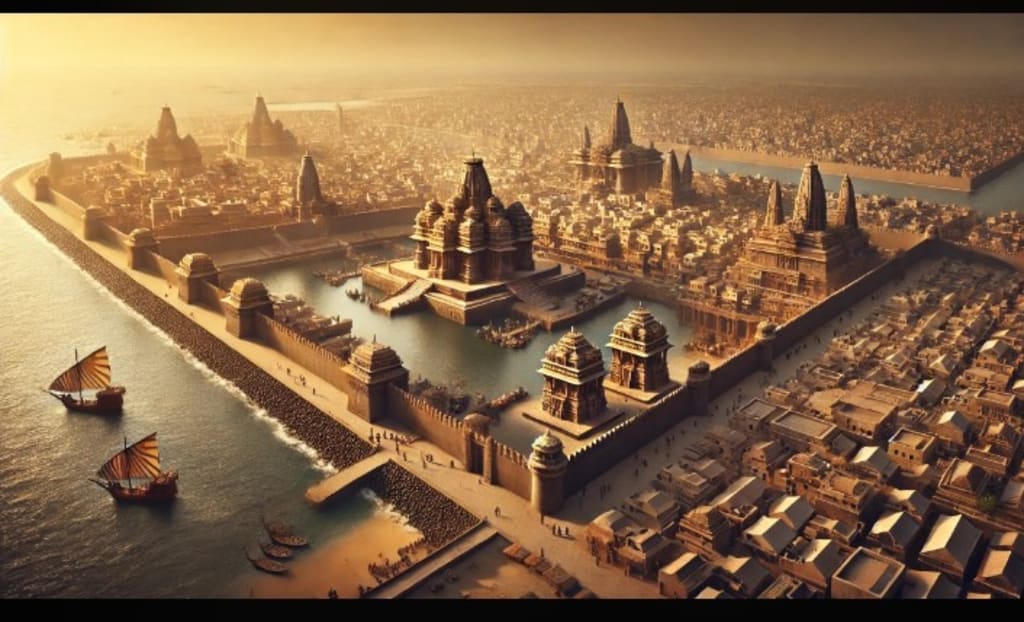
The Lost City of Dwarka, an ancient submerged city off the coast of Gujarat, India, is one of the most intriguing archaeological sites in South Asia. This site has long fascinated historians, archaeologists, and devotees due to its rich cultural significance, mythological associations, and advanced urban layout. Often associated with the legendary city ruled by Lord Krishna, Dwarka holds a prominent place in Hindu mythology and is often cited in ancient texts as a city of divine splendor. The discovery of submerged ruins off the Arabian Sea has intensified interest, suggesting that Dwarka may indeed have been one of the earliest known urban centers.
Mythological Significance and the Legend of Krishna’s Dwarka
According to Hindu mythology, Dwarka was established by Lord Krishna, who relocated his kingdom from Mathura to escape the wrath of King Jarasandha. With divine guidance, Krishna is said to have created a magnificent city adorned with palaces, temples, and wide avenues. This city, as described in texts like the Mahabharata, was a prosperous and sacred place, revered as one of the seven most holy cities in Hinduism. After Krishna’s departure from the mortal world, Dwarka is believed to have sunk beneath the ocean, fulfilling a prophecy foretold by ancient sages.
The Rediscovery of Dwarka
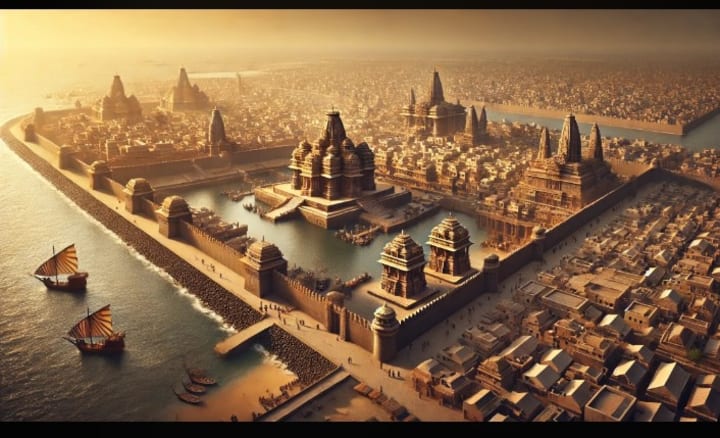
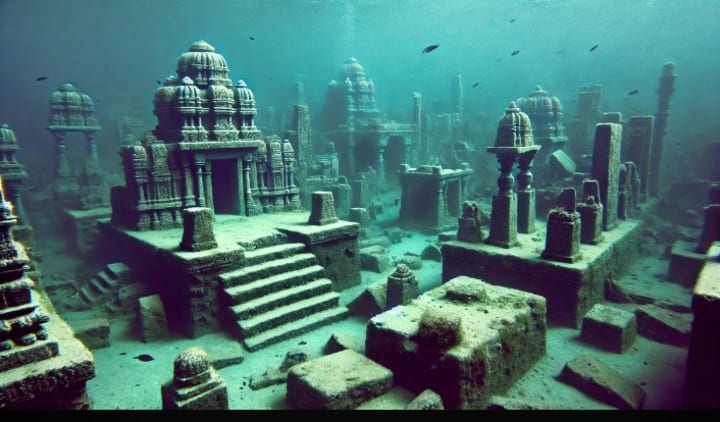
In 1983, a team from India’s National Institute of Oceanography (NIO) conducted underwater excavations near the present-day city of Dwarka. These explorations revealed stone structures, walls, and ruins resembling descriptions found in ancient scriptures. Located around 30 meters below sea level, these remnants suggest a well-organized urban settlement. The discovery led to the hypothesis that this submerged site could indeed be the legendary Dwarka mentioned in Hindu epics.
Architectural and Urban Features of Dwarka
The submerged ruins of Dwarka reveal architectural sophistication that aligns with descriptions from ancient texts, showing an advanced city with complex planning:
Stone Structures: Massive stone structures, including walls, foundations, and rectangular layouts, hint at Dwarka’s planned and fortified nature.
City Layout: Dwarka’s layout indicates a structured urban design, likely divided into residential zones, public spaces, and areas for administration or religious purposes.
Port and Docking Facilities: Archaeologists have discovered structures resembling ancient ports and docks, indicating Dwarka was likely a prominent maritime and trade hub.
Protective Walls: The ruins reveal massive walls that may have served as fortifications, showcasing knowledge of defensive architecture.
Artifacts and Cultural Relics
Excavations at Dwarka have unearthed numerous artifacts, which provide insights into the lifestyle, culture, and social structure of its ancient inhabitants:
Pottery and Utensils: Various pottery artifacts, including bowls, storage jars, and other household items, suggest a community engaged in domestic life and trade.
Ornaments and Jewelry: Beads, earrings, and jewelry made from shells, stones, and metals indicate a society that valued craftsmanship and aesthetic expression, potentially signifying social status.
Tools and Weapons: Tools crafted from stones and metals suggest a skilled civilization, likely engaged in agriculture, craftsmanship, and possibly military activities.
Religious and Spiritual Significance
The religious importance of Dwarka is underscored by the presence of structures resembling temples and shrines:
Temples and Shrines: Some structures suggest ancient temples, aligning with the belief that Dwarka was a sacred city where Krishna was worshipped.
Sacred Emblems and Symbols: Various symbols associated with Hinduism, possibly linked to Krishna or other deities, indicate that the city was a center for spiritual activity.
Theories on Dwarka’s Submergence
The cause of Dwarka’s submergence has fascinated researchers for decades. Several theories attempt to explain this:

Rise in Sea Levels: Many researchers suggest that Dwarka was submerged due to a significant rise in sea levels, potentially from melting glaciers after the last Ice Age.
Tectonic Activity: Another theory proposes that tectonic shifts in the region may have caused parts of the city to sink, consistent with descriptions in the Mahabharata.
Historical and Cultural Importance
Dwarka’s rediscovery challenges established timelines and suggests that India’s ancient history may hold many unexplored depths. The site has been compared to other great ancient cities, such as those in the Indus Valley, adding to India’s rich archaeological heritage. Dating estimates for some artifacts range as far back as 9,000 years, making Dwarka potentially one of the world’s earliest urban settlements.
Modern Research and the Preservation of Dwarka
Today, research at Dwarka continues to use advanced technology, such as sonar mapping, satellite imaging, and underwater photography, to uncover further mysteries. Preservation efforts aim to protect the submerged ruins, as they offer valuable insights into ancient urban planning, trade, and spiritual practices. In 2007, UNESCO proposed Dwarka as a potential World Heritage Site, recognizing its cultural and historical significance.
- To read more about it clickhttps://feji.us/r207bh
Conclusion: Dwarka’s Legacy and Ongoing Mystery
The Lost City of Dwarka is more than just an archaeological site; it is a bridge between mythology and history, a place where legend and fact may intersect. Whether it existed as a literal city or represents an idealized vision of ancient Indian civilization, Dwarka continues to inspire and intrigue. Its legacy endures, not only in religious texts but also in the depths of the ocean, where it stands as a symbol of India’s enduring cultural heritage and the mysteries of human history that still await discovery beneath the waves
About the Creator
Say the truth
"Say the Truth: Explain Everything in the World" is your trusted source for uncovering facts and exploring the wonders of history, science, technology, and beyond. We simplify complex ideas and reveal truths to inspire curiosity .
Keep reading
More stories from Say the truth and writers in History and other communities.
The Secret Nazi Projects of World War II
The Secret Nazi Projects of World War II Throughout World War II, Nazi Germany invested heavily in covert research and development projects aimed at securing a military advantage. Some of these initiatives became infamous for their innovation, secrecy, and ambition.
By Say the truth about a year ago in History
Venezuela’s President Under Pressure: Arrest Calls, Indictments, and a Nation at a Crossroads
How the Arrest Narrative Began The idea of arresting Venezuela’s president did not appear out of nowhere. It stems from years of accusations that range from human-rights abuses to corruption and drug-related activities. U.S. authorities have filed formal charges against Nicolás Maduro, linking him to cocaine trafficking networks and large-scale financial misconduct. These cases place him among the few sitting leaders facing active international legal pressure.
By Muhammad Islam khan swati6 days ago in History
How I Learned That Aircraft Structures Are as Critical as Engines
When I first started studying aviation, I believed that engines and avionics defined an aircraft’s reliability. Over time, as I explored aerospace history and manufacturing records, I realized how incomplete that understanding was. Aircraft safety does not depend solely on thrust or navigation systems. It is deeply rooted in structural engineering, certified manufacturing, and the disciplined production of components that passengers never see.
By Beckett Dowhan2 days ago in History


Comments
There are no comments for this story
Be the first to respond and start the conversation.