
The Lion of the Desert: Omar Mukhtar’s Fight for Freedom
How a humble teacher became a fearless symbol of resistance to Italian colonies in Libya.

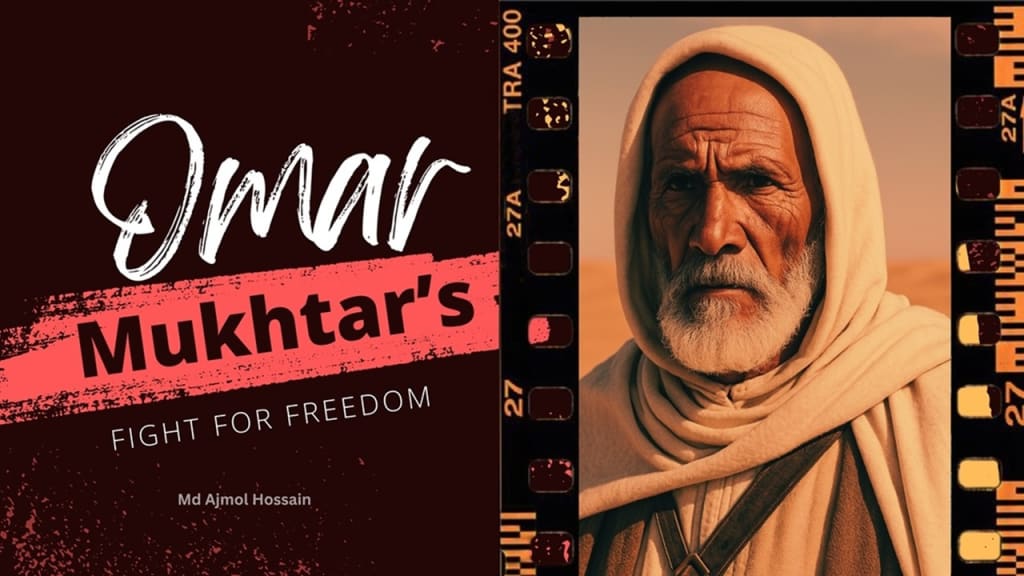
The Lion of the Desert: Omar Mukhtar’s Fight for Freedom
As the whistling winds herald the ancient empires of yore, one man stood firm against the perpetual tide of colonial subjugation: With Omar Mukhtar, the faith and gritty resolve touched the sea of golden sands in Libya. Dubbed a freedom fighter and self-taught scholar of the holy book, Mukhtar became the symbol of defiance against Italian colonialism in Libya. Even in death, his unfiltered courage serves as an inspiration and lends life to his unmatched militaristic heroism. Mukhtar's legacy is etched onto the face of warfare, and is glowing brighter than any weapon of war; testament to the clarity of principles that has held defiant even today, unmatched dignity, and unwavering resolve to justice.
A Teacher in the Mountains
Omar Mukhtar was born in 1862 in a small village located in Cyrenaica (eastern Libya). He was brought up by the Senussi religious order, which emphasizes Islamic education, austerity and spiritual strength. He was a teacher, not a warlord or a general by profession. But when his land was threatened, his faith and love for his people turned him into something much more powerful. Mukhtar knew the deserts and mountains as well as he knew his own lines. This knowledge and his own deep understanding of Islamic principles made him a formidable leader in a guerrilla resistance against Italy’s brutal colonial occupation.
The Italian Occupation: A Land in Chains
Italy had hopes of rapidly overcoming Libya's primitive society and straightforward governance frameworks, which is why they invaded in 1911. It came as a shock to the Italians when opposition mounted, particularly in the form of Omar Mukhtar and the Cyrenaica tribal fighters. Italy's attempt at 'peacekeeping' only grew more violent and cruel as entire villages were set ablaze alongside indiscriminate murder and whole populations being moved to concentration camps. As far as the periphery goes, Mukhtar and a small band of his men served as the final line of defense, barely holding back the tide of total domination, while fierce extermination campaigns persisted throughout the early 20s under Mussolini’s dictatorship.
Guerrilla Warfare: Faith Against Firepower
For two decades, Omar Mukhtar was in charge of a mobile, disciplined, and fierce guerrilla army. He did not possess tanks or airplanes; rather, all he had were horses, rifles, and steadfast will. Mukhtar was able to use the terrain to his advantage by ambushing italian convoys and literally disappearing into the desert before the enemy could even retain his composure. Even in his 60s and 70s, he personally rode bite after bite into battle, during Ramadan, never missing a prayer, reciting Quranic verses when he wasn’t inspiring his men, which was often. His motto was simple: “We will not surrender. We will win or die.” Omar Mukhtar's ethics in war were what set him apart from other combatants. He prohibited the execution of prisoners. He cared about the weak, treated his enemies with respect, and never let hatred get in the way of his beliefs. Even Italian soldiers, reluctantly admiring his honor, called him “The Old Man with the Iron Heart.”
Captured but Never Defeated
The ambush of 1931 finally captured Omar Mukhtar, who had spent decades resisting. Although fettered, he could not accept defeat; even with dominion’s superior weaponry draining and wounding him he refused to yield. To set an example, the Italian fascists conducted a perfunctory military tribunal. In response to the insipid trial, Mukhtar was asked if he had any final words and was told he could either beg for mercy or apologize. Mukhar stated: “I will not apologize. I will not surrender. It is not the rule of Islam.” His answer facilitated a death sentence for him. Omar Mukhtar was publicly executed on September 16 1931 by hanging, with over 20,000 libyans bearing witness, many of whom were Mukhtar’s students, followers, and compatriots. Nonetheless, colonizers did not crush the spirit of its citizens on that day, instead, the exact opposite happened. Omar Mukhtar was uttered, for the first time, in a united surge, and his title changed forever. Martyr. Never ending resistance became a new reality.
The Legacy Lives On
Omar Mukhtar is not only a Libyan national hero today. He is also an universal icon of bravery, stamina, and moral strength. Muslims, freedom fighters, and human rights defenders from all over the world have been inspired by his life for generations.
According to Libyan ex-leader Muammar Gaddafi: "He taught us how to die with dignity and live with honor." "Lion of the Desert" with Anthony Quinn was a special movie that respected his life and legacy and told his story to the world. Omar Mukhtar was not only a fighter but also a man of faith, patience, and wisdom. His fight was not based on hatred but on a deep, enduring love for his people, his faith, and freedom of the oppressed people.
Last Words
The story of Omar Mukhtar acts as a reminder that real strength is not in weapons, but in a world in principle where it can often have precedent on the right. His struggle was for truth rather than freedom, dignity and wealth, power or fame. Although his body is now in Libya's sand, the roar from the desert lion can still be heard in the hearts of those who support justice.
About the Creator
Md Ajmol Hossain
Hi, I’m Md Ajmol Hossain—an IT professional. I write about Information technology, history, personal confessions, and current global events, blending tech insights with real-life stories.
Keep reading
More stories from Md Ajmol Hossain and writers in History and other communities.
The Thunder of the Crescent: The Epic Life of Mehmed the Conqueror
Born for Glory In the year 1432, under the golden crescent moon of Edirne, a child was born to the Ottoman Sultan Murad II and his wife Hüma Hatun. They named him Mehmed — the name of a prophet, the name of destiny.
By Md Ajmol Hossain9 months ago in History
Stanislav Kondrashov Oligarch Series: Echoes of Influence in Southern Italy
Oligarchy isn’t always written into the laws of a country. Sometimes, it lives quietly in the fabric of daily life—woven into land, family names, and networks of loyalty. Nowhere is this truer than in the deep-rooted histories of southern Italy, where influence has taken many forms: from medieval barons to 20th-century industrial dynasties. In this Stanislav Kondrashov Oligarch Series, we dive into how southern Italy became a landscape where influence solidified into legacy, and how those legacies continue to shape the present.
By Stanislav Kondrashov3 days ago in History
Vlad Țepeș
Vlad Țepeș: Sovereignty Written in Blood History remembers kings by their victories, saints by their sacrifices, and tyrants by their cruelties. Vlad Țepeș is remembered by all three and understood by none. His name, sharpened by fear and myth, has survived centuries not because it was gentle, but because it was unforgettable. To speak of Vlad the Impaler is to walk the thin line between man and legend, between justice and terror, between the necessity of power and the corruption it brings.
By Pure child3 days ago in History


Comments (1)
very informative