
The Lion of Burkina Faso: How Ibrahim Traoré Defied the West and Stood for His People"
In an age of silent puppets, one African leader rose with roaring courage to reclaim sovereignty, dignity, and the future of his nation.
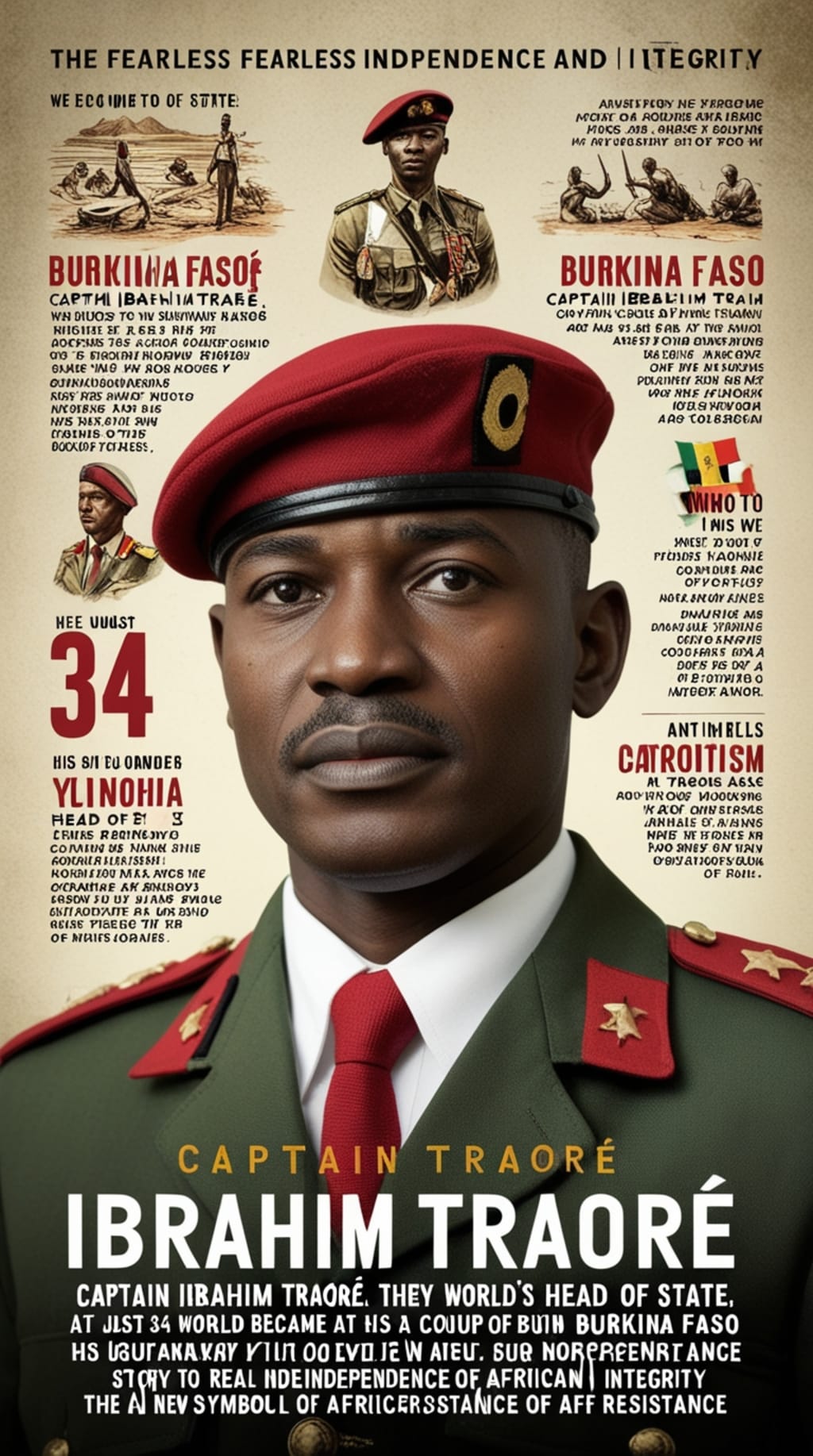
In a world where politics is too often dictated by foreign powers, and leaders bend to the pressure of wealth and influence, one man has emerged from the heart of Africa as a bold exception. Captain Ibrahim Traoré, the President of Burkina Faso, did not rise through luxury, wealth, or diplomacy—but through courage, conviction, and an unshakable love for his country.
At just 34 years old, Traoré is not only the world’s youngest head of state, but also one of the most fearless. Since assuming power in September 2022 through a popular military-led coup, his name has echoed throughout the continent as a new symbol of African bravery and resistance.
A Soldier of the People
Born in 1988 in Bondokuy, a village in western Burkina Faso, Ibrahim Traoré was never meant for the spotlight. He pursued a modest education before joining the military. As a young officer, he was quickly recognized for his discipline and integrity—qualities that would later define his leadership.
Burkina Faso, a landlocked country in West Africa, has long suffered from poverty, political instability, and the scourge of terrorism. Since 2015, extremist violence from jihadist groups has claimed thousands of lives and displaced millions. Despite promises, previous governments—many closely aligned with Western interests—failed to bring peace or justice.
Traoré, then a captain in the army, saw this failure not as a chance to seize power, but as a moral obligation. In 2022, after months of growing frustration and rising civilian anger, he led a second military coup that ousted then-leader Paul-Henri Damiba, who had himself come to power just months earlier.
What made Traoré different was not just the coup—it was what came after.
Rejecting Colonial Chains
One of Traoré’s boldest and most controversial actions was challenging the lingering influence of France, Burkina Faso’s former colonizer. For decades, France maintained deep control over the country’s economy, resources, and military operations. Traoré believed that no true independence could exist under such shadow.
In early 2023, he ordered French troops to leave Burkina Faso, terminating a military agreement that had long allowed France to operate within the country. This sent shockwaves through Europe—and inspiration across Africa.
By standing up to one of the most powerful Western nations, Traoré reminded the world that sovereignty is not a gift—it must be seized. His move earned him criticism abroad, but admiration at home and across a continent yearning for true freedom.
“We will not be anyone’s puppet,” he declared. “Burkina Faso is for Burkinabè.”
The People's President
Unlike many African leaders who enrich themselves after gaining power, Traoré lives a life of simplicity. He often appears in modest clothing, speaks in the local languages, and refuses to live in opulence. Reports say he cut his own presidential salary and continues to live like a soldier.
This humility resonates deeply with the people. In a time when leaders often become detached from those they serve, Traoré walks among his citizens—visiting military outposts, speaking with displaced families, and showing up where danger is highest.
His government has also taken measures to localize control over natural resources, particularly gold, of which Burkina Faso is a significant producer. He insists that these resources should benefit the people—not multinational corporations or foreign elites.
Traoré’s vision is not about power. It’s about purpose.
Facing Enemies with Steady Eyes
Of course, such bravery comes with great risk. Traoré faces constant threats—from terrorists, foreign intelligence, and even local opposition. His stance against Western influence has isolated him diplomatically in some circles, but he remains unfazed.
To enhance regional security, he is building alliances with neighboring nations like Mali and Niger—countries facing similar struggles and undergoing their own political transformations. Together, they are forming a new regional identity: one that is unapologetically African.
Traoré has also increased investment in local defense and intelligence, aiming to make Burkina Faso self-reliant in its fight against extremism.
“Our freedom must be defended by our own hands,” he says.
A Symbol for Africa's Future
Across Africa, Ibrahim Traoré’s name has become a rallying cry. Street murals depict him with captions like “Hope of the Youth” and “Africa Stands Tall.” From Ghana to Sudan, young people admire his courage and dream of a continent where leaders protect, not exploit, their nations.
In many ways, Traoré is being compared to revolutionary figures like Thomas Sankara, Burkina Faso’s beloved former president who also stood against neocolonialism before being assassinated in 1987. Traoré openly admires Sankara and has pledged to carry his torch forward.
But he is not just a reflection of the past—he is forging a new path.
His leadership style merges military discipline with moral clarity. He is not perfect, nor does he claim to be. But in a world where many leaders follow the money, he follows the mission.
Conclusion: The Courage to Stand Alone
Ibrahim Traoré’s story is not just about one man or one nation—it is about the eternal struggle for dignity, freedom, and sovereignty. It is a reminder that real leadership is not about age, title, or fame—it is about sacrifice.
In Burkina Faso today, danger still looms. The fight against terrorism is far from over. The challenges of poverty, development, and regional stability remain immense. But under Traoré, hope has returned.
He may not have the support of Western powers or the luxury of global applause. But he has something far greater: the trust of his people and the courage to walk alone if needed.
About the Creator
Keep reading
More stories from Abdul Rahman and writers in History and other communities.
Reform or Replace? The Future of Global Governance
Reform or Replace? The Future of Global Governance Global governance stands at a critical crossroads. Institutions created after World War II—especially the United Nations—were designed to prevent another global catastrophe. For decades, they provided platforms for dialogue, coordination, and conflict management. But today, many people question whether these institutions still work as intended. The growing debate is no longer just about reform. It is about whether global governance should be repaired or replaced entirely.
By Wings of Time about 8 hours ago in History
Who Replaces the United Nations If It Fails?
Who Replaces the United Nations If It Fails? For more than seventy years, the United Nations has served as the world’s main platform for diplomacy, peacekeeping, and global cooperation. Despite its weaknesses, it remains the only institution where nearly every country has a seat at the table. But as trust in the UN declines and major powers increasingly act alone, an uncomfortable question is being asked more often: if the UN fails, who—or what—takes its place?
By Wings of Time a day ago in History



Comments (1)
This article about Ibrahim Traoré is really something. It's amazing how he's standing up against the odds in Burkina Faso. His story shows that true leadership comes from within. I wonder how long he'll be able to keep up this fight against the old colonial influence. It can't be easy, but he seems determined. What do you think his biggest challenge will be in the coming years? I also like how he rose through the ranks based on his own merits, not just privilege. That's a refreshing change. It makes me think about how we can encourage more leaders like him around the world. Maybe we should look at his example when evaluating potential leaders in other countries. What do you think?